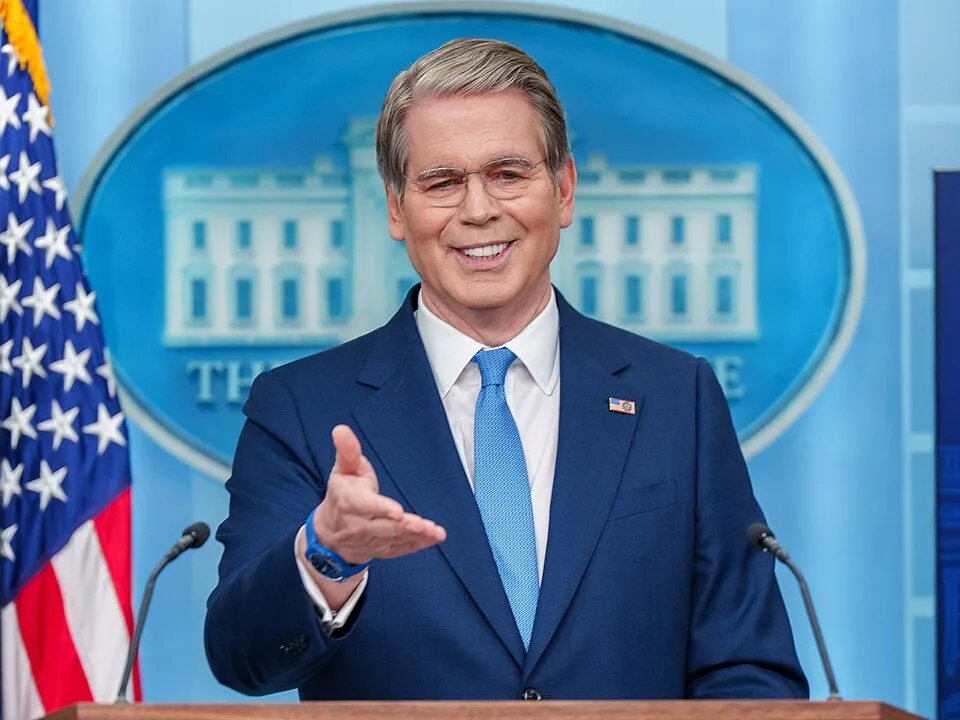
Scott Bessent stood up Wednesday and announced the US Treasury would buy back $6 billion in government bonds to calm a rattled bond market. The bond market looked him dead in the eyes and got worse. This is the story of how America's top financial official is losing a very public staring contest with the people who actually hold the money.
What Bessent Did and What Happened Next
At 11 a.m. ET on Wednesday, the Treasury Department formally announced it would repurchase $6 billion worth of 10- to 20-year government bonds. The logic was straightforward enough: pull bonds off the market, reduce supply, drive up demand, push yields down. Basic stuff. Treasury secretary announces bold intervention, market stabilizes, everyone goes home.
That is not what happened. According to NBC News, most Treasury yields sharply jumped on the very announcement that was supposed to calm them. The 10-year bond yield surged to 4.85%, its highest since November 2023. The 20- and 30-year yields hit as high as 5.3%. The Nasdaq dropped 0.8% by midday. The S&P 500 fell 0.6%. The Dingo Daily did not make any of that up.
As The Guardian reports, the 30-year Treasury yield is now sitting around 5.2%, the highest since the 2008 financial crisis. Let that sink in for a second. The last time the bond market was this stressed, Lehman Brothers was collapsing and people were building spreadsheets about whether their 401(k) would survive the decade.
This Was Not Bessent's First Rodeo This Month
Wednesday's buyback was not some spontaneous emergency move. Back on August 19, Bessent had already announced the Treasury would at least double its typical buyback operation, per The Guardian. The yields kept rising anyway. So he came back with a bigger number. The yields kept rising anyway. There is a pattern forming here and it is not a flattering one.
Bessent also made news this week for helping prop up the Japanese yen, as NBC News reports. The reasoning was defensive: Japan is one of the largest holders of US Treasury bonds, and if the yen got too weak, Tokyo might sell a chunk of its T-bill holdings to raise cash, which would push American yields even higher. So Bessent jumped in to stabilize a foreign currency in order to indirectly protect American bond prices. The man is playing three-dimensional chess while the board is on fire.
At an event at Southern Methodist University earlier this week, Bessent told currency traders directly: "I am the house now. You can bet against me if you want." On Wednesday, a lot of people did exactly that, and the house did not do great.
The Fever That Won't Break
Here is a phrase that will follow Scott Bessent around for a while. On Tuesday, speaking to Breitbart of all places, he described the bond market sell-off as a kind of "fever" driven by the financial press. "They get a hold of a narrative," he said, "and I wanted things to become more fact-based." The implication being that the problem was mostly vibes, not fundamentals, and that Bessent could simply correct the vibes.
The fundamentals are not vibes. As NBC News reports, the US national debt surpassed $40 trillion just weeks ago, double what it was ten years ago. Diane Swonk, chief economist at KPMG, put it plainly: "Sovereign debt around the world has exploded and we're all competing for the same pool" of investors. "You've got a lot of debt without as many buyers." That is not a press narrative. That is arithmetic.
Legendary investor Stanley Druckenmiller published a widely read Wall Street Journal op-ed in August warning that once markets believe Treasury is defending a price level, every yield spike becomes a test. "The operations must grow to survive the tests," he wrote. On Wednesday, Peter Boockvar, chief investment officer at One Point BFG Wealth, cited that op-ed and wrote that markets would "continue to 'test' the 'official resolve' if they feel the fundamentals warrant." They apparently felt the fundamentals warranted it. Immediately.
The Fed Is Caught in the Middle of All of This
While Bessent is firefighting in the bond market, the Federal Reserve is being squeezed from both sides. Inflation, driven up by the war in Iran and Trump's trade policies raising the cost of imported goods, hit a three-year high in May before settling at 3.4% in July, still 0.7% above the same period last year, according to The Guardian. Oil prices are not helping: Brent crude crossed $100 a barrel again on Wednesday as the Middle East conflict escalates.
The textbook response to that kind of inflation is raising interest rates. The problem is that the president of the United States is on social media screaming the opposite. Last week, Trump demanded the Fed "must get smart" and lower rates, writing in all caps: "A STRONG COUNTRY MEANS A LOWER INTEREST RATE." Subtle.
That puts Fed chair Kevin Warsh, who took the job in May after Trump installed him, in an impossible position. At the Fed's Jackson Hole symposium in August, Warsh said it was "the Fed's job to deliver stable prices" but gave no commitment on whether rates would actually move, per The Guardian. NBC News notes that Warsh's lack of clear commitment at a July press conference is what first spooked bond markets into the surge we are watching now. The new Fed chair gave investors one ambiguous press conference and the bond market has been running a temperature ever since.
What Higher Yields Mean for You, Specifically
This is not just a story about traders and hedge funds and institutional investors arguing with each other. The Guardian notes that higher Treasury yields tend to push up interest rates on mortgages, student loans, and car loans, because those consumer products are tied to the bond market. The people who feel a 5.2% 30-year yield most acutely are not the ones trading it. They are the ones trying to buy a house or pay off a degree.
Bessent told CNBC last month that he was working with the White House on a "fiscal consolidation package" to address the debt picture, but neither the Treasury Department nor the Office of Management and Budget has shared any details of that plan. The plan to have a plan is, at this point, the only plan in evidence.
The Dingo Take
Scott Bessent told a reporter this week that he is "the house." The house, in that metaphor, is supposed to always win. The house sets the rules, holds the edge, weathers the variance. What the house does not do is announce a $6 billion rescue operation and then watch yields go up in real time while the stock market slides. That is not the house. That is a guy who borrowed the house's jacket.
The deeper problem here is not Wednesday's bad afternoon. It is that the Trump administration has spent eighteen months making decisions, from the tariff regime to the Iran war to the installation of a Fed chair who gave one wobbly press conference and spooked global bond markets, that have compounded each other into this exact situation. The national debt just hit $40 trillion. Oil is back above $100. Inflation is running hot. And the president's primary contribution to monetary policy is typing in all caps that rates should go down. The Treasury secretary is out here trying to bail out a boat with a coffee cup while the engine room floods.
Bessent is not a stupid man. He knows how this looks. He also knows that the tools he has available, buybacks, currency interventions, strongly worded remarks to Breitbart, are not sized to the problem. Stanley Druckenmiller told him in print, in August, that this strategy would get tested harder every time he deployed it. Druckenmiller was right on day one of the test. The fever is not a press narrative. The fever has a temperature, and right now it reads 5.3%.




Comments