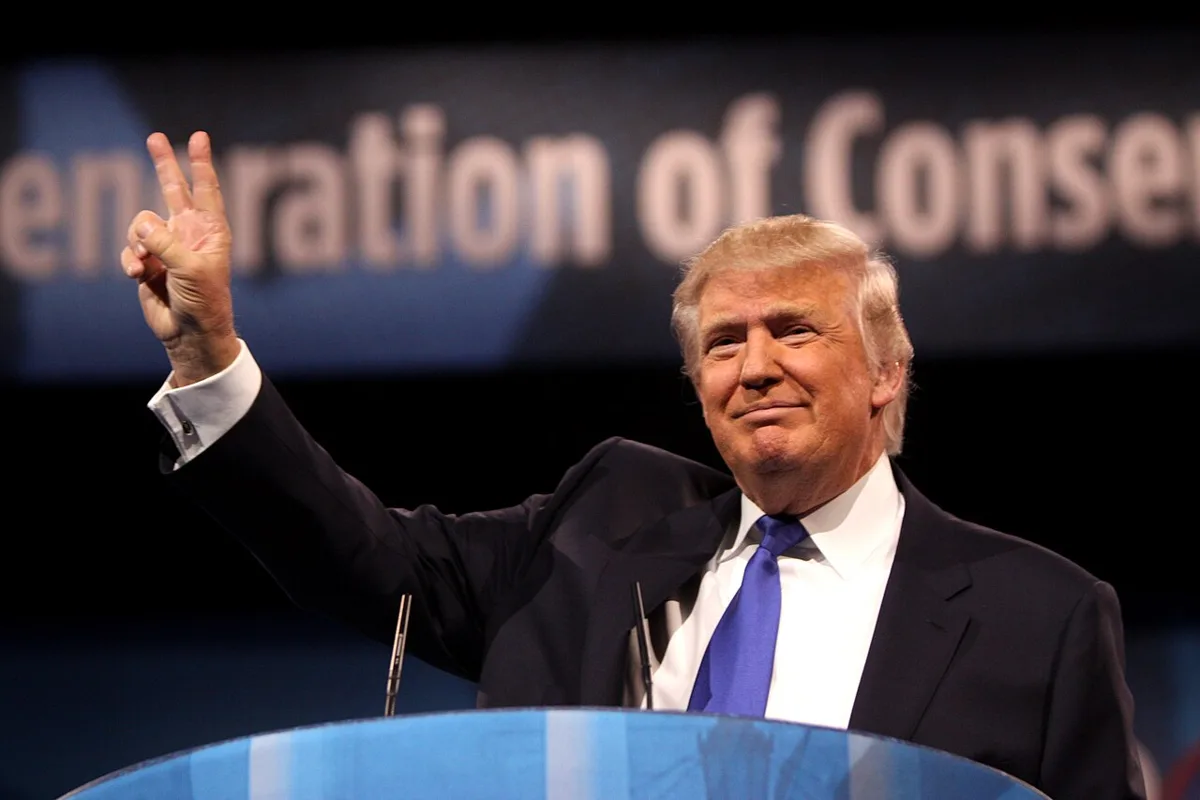
Donald Trump stood at the Republican midterm convention in Dallas and promised every American adult a $5,000 check — but only if you keep his party in power. His own allies immediately called it bribery. Which, to be clear, is exactly what it is.
What He Actually Said
On Wednesday night at the American Airlines Center in Dallas, Trump delivered the keynote address for the 2026 Republican National Convention and dropped this line: "If the Republicans win the House of Representatives and the United States Senate, both of them… I will issue a dividend to every adult citizen in the United States of America for $5,000."
He compared it to a corporate dividend, the kind a company pays its shareholders when times are good. The catch — and there's always a catch — is that recipients would have to spend the money domestically. "We don't want you going to Canada to spend the money," Trump said, apparently very concerned about a $5,000 tourism surge to Vancouver.
JD Vance materialized after the speech to sell it harder. "If you keep us in power and allow us to continue to do these things, then you're going to share in some of the benefit of this incredible wealth that we're creating," the Vice President told the crowd. That framing — keep us in power, get the cash — is not subtle. It is not trying to be subtle.
The Math Does Not Math
Fox News ran the numbers on this one, which is a sentence that should tell you something about how badly the math fails here. Based on roughly 240 million eligible American adults, the total cost of $5,000 checks comes to more than $1.2 trillion.
Trump and Vance have pointed to tariff revenue as the funding source. Treasury data, however, show the federal government collected about $154.4 billion in customs duties between October 2025 and July 2026. That covers approximately 13% of the projected cost. The remaining 87% — something in the neighborhood of $1 trillion — would need to come from other revenue, spending cuts, or just stapling it onto the national debt, which has already blown past $40 trillion.
The White House has not provided an income threshold for eligibility, has not explained what portion of tariff revenue would go to this program, and has not detailed any mechanism for covering the rest. Vance hinted after the speech that it might be limited to middle-class Americans, which would lower the price tag but also introduce the problem of the administration having to define "middle class," something no one in Washington has managed to do with any consistency in living memory.
Republicans Are Eating Each Other Over This
Former GOP Rep. Bob Good of Virginia called it "a socialist vote-buying scheme." Conservative commentator Matt Walsh called it "flagrant bribery" and wrote that "holding it as a carrot on the stick for after the election is just shameless." Investor Joe Lonsdale went with "bread and circus bribes." Former Arkansas Governor Asa Hutchinson told Republican leaders to reject it outright and focus on the debt.
Rep. Chip Roy of Texas did the math a different way, pointing out that $1.2 trillion could instead eliminate taxes entirely for married parents with dependents earning up to $200,000. Roy then added, for good measure, that "maybe some of us think dependency is evil and soul-sucking in all its forms." Chip Roy versus the $5,000 check: a fight for the soul of a party that has not had a coherent fiscal philosophy since approximately 2015.
James Fishback, a former Florida gubernatorial candidate who had himself proposed a "DOGE dividend" earlier, drew the obvious distinction: his version would have returned money saved through spending cuts. Trump's version, by contrast, proposes handing out money with no corresponding reduction in what the government spends. That is not a dividend. That is a loan from your grandchildren's future, gift-wrapped and handed to you six weeks before an election.
Some Republicans Are Already Planning the Legislation
Not everyone on the right is appalled. Senator Bernie Moreno of Ohio announced he would prepare legislation to pass the dividend after the election. Senator Roger Marshall of Kansas skipped the skepticism entirely and asked voters how they planned to spend their $5,000, which is a hell of a thing to tweet when the mechanism for paying it doesn't exist yet.
The split inside the GOP is real and it is revealing. For decades, the party's central argument against direct government payments was that they create dependency, undermine the work ethic, and amount to Democrats buying votes with other people's money. That argument is now being made by Republicans against their own president's proposal, while other Republicans plan the rollout legislation. Whatever coherent ideology once held the party together, this is not it.
The Part Where This Is Constitutionally Complicated
Trump cannot simply order the Treasury to mail out checks. Fox News points out clearly that Congress would need to pass a law authorizing the spending before any of this happens. The president floated the idea; actually executing it requires the legislative branch to write, pass, and send him a bill.
Which means the whole thing is, at minimum, a two-step process: vote Republican in November, then wait for a Republican Congress to pass the law, then wait for the money to materialize from a funding source that currently covers 13 cents of every dollar it would cost. Trump framed this as a sure thing. The fine print says otherwise.
The Dingo Take
You are supposed to believe this is a dividend. A return on investment. The American people, as shareholders in the national enterprise, receiving their rightful cut of the wealth being generated by the genius tariff regime. That is the framing. Here is what it actually is: a president standing at his party's convention, six weeks before a midterm election, promising cash payments that do not yet exist, are not funded, require an act of Congress to authorize, and will only happen if you vote for his party. If a Democrat had proposed this, the word "socialist" would have been on every Fox chyron for a month. The word showed up anyway — in the mouths of Republicans describing their own president's idea.
The debt is $40 trillion. The tariff revenue covers 13% of the cost. The rest is a shrug and a promise. And the conservative movement, which spent the better part of two decades arguing that any direct government payment was a corruption of the American character, is now split between guys calling it bribery and guys drafting the legislation. That is not a policy debate. That is a party that has no idea what it believes anymore, organized entirely around whatever the man at the podium says next.
Here's the thing about dangling $5,000 in front of 240 million people right before an election: it works whether the check ever arrives or not. The promise is the point. The debt it would create is someone else's problem. The funding gap is left as an exercise for the reader. This is not governance. It is an infomercial, and the product being sold is four more years of this.


Comments