
The Department of Government Efficiency, which exists to save money, spent $9.5 billion in 2025 paying federal employees to sit at home and do absolutely nothing. That number, confirmed Tuesday by the Government Accountability Office, represents a sixfold increase from 2023. Elon Musk would like you to know he is very good at this.
The Numbers Are Actually Insane
The GAO report breaks it down precisely, and the precision makes it worse. According to the watchdog agency, paid administrative leave for federal workers exploded 435% between 2023 and 2025. The total number of workdays where the government paid someone full salary to not perform job duties jumped from roughly 4 million workdays in 2023 to 21.6 million in 2025. That is not a rounding error. That is a policy.
Of the $9.5 billion total, $6.7 billion was tied specifically to the Deferred Resignation Program, the buyout scheme the Office of Personnel Management rolled out in January 2025 to clear out the workforce. The program let employees resign on paper while still collecting paychecks through September 30, 2025. About 144,312 workers took the deal, according to the GAO's calculations. For context, the combined administrative leave salary costs for all of 2023 and 2024 together were $3.2 billion. DOGE more than tripled that in a single year while promising the opposite.
The White House Says This Is Actually a Win
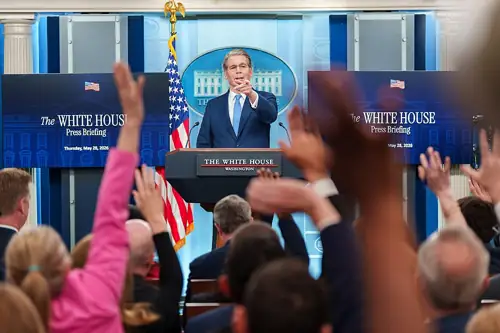
Scott Kupor, the director of the Office of Personnel Management, pushed back on the report Wednesday with the kind of math that would get a college student a C-minus. He argued the GAO failed to highlight that the $9.5 billion was a "one-time expense" that he claims yields $40 billion per year in savings by shrinking the workforce by 270,000 employees. "That 400% return on investment is a massive benefit to the taxpayer," he said in a statement reported by CBS News.
The GAO, pointedly, said it could not verify whether the long-term savings goals were actually being met. The report states clearly that OPM "does not know the actual costs of the paid administrative leave used for workforce reduction efforts" because the agency lumped deferred resignation leave data in with general administrative leave numbers. In other words, Kupor is claiming a return on an investment nobody actually measured. The GAO recommended that OPM create a tracking system so the government can know whether any of this is working. That system does not currently exist.
DOGE's Savings Claims Are Already Falling Apart Elsewhere
This is not the first time a GAO report has embarrassed the efficiency project this month. A separate report released last month found that DOGE's famous "Wall of Receipts" webpage, which claimed $215 billion in cuts from contracts, leases, and grants, had inflated the number by roughly $110 billion. The same report noted that DOGE could not provide "sufficient information to verify the method used" to calculate 96% of its reported savings, according to CBS News.
So the organization that cannot verify how it counted its savings also cannot verify whether the $9.5 billion it spent on people doing nothing was worth it. At some point this stops being an accountability gap and starts being a feature.
What $9.5 Billion in Cuts Actually Looks Like in the Real World
Douglas Pasternak, research director of Public Citizen's Trump Accountability Project, told the Guardian the entire workforce overhaul was "haphazard" from the jump. He is not wrong. The Trump administration has shed approximately 355,000 federal employees since January 2023, by the Guardian's count, and has since had to rehire people in multiple agencies after determining, apparently in retrospect, that some of those jobs were necessary.
The real-world results have not been subtle. Pasternak cited delays in Social Security check deliveries, longer wait times at VA hospitals for veterans seeking medical and mental health care, cuts to federal firefighters, and gutted staffing at the Cybersecurity and Infrastructure Security Agency, which has since tried to bring people back. "It's a case study in mismanagement," Pasternak told the Guardian. "To simply say we're going to have fewer workers and therefore less costs is not the way to look at this." He's describing, in polite terms, the assumption that government is just overhead rather than a service that people actually depend on to stay alive.
Congress Is Not Happy, For Whatever That's Worth
Senator Patty Murray, vice-chair of the Senate Appropriations Committee, released a statement Tuesday that did not mince words. "After promising to cut waste, Trump instead set billions upon billions in taxpayer dollars on fire to quite literally pay people not to do jobs they loved," she said, per the Guardian. She went further: "Trump spent billions to push out experienced and badly needed experts across government. This was the most expensive way imaginable to make government worse."
Murray represents the Democratic minority, so this statement will change nothing immediately. But the GAO is a nonpartisan watchdog whose reports carry real institutional weight, and having two of them land in the same month calling out DOGE's math and transparency is not nothing. The question is whether any Republican with committee power decides they care about $9.5 billion in salaries paid for zero work output. Recent evidence suggests the answer is no, but the paper trail is getting long.
The Dingo Take
You are supposed to believe that paying 144,312 people full government salaries to do nothing for months was a shrewd fiscal maneuver. That the agency overseeing this cannot actually track the costs, cannot verify the savings, and has already been caught inflating its headline number by $110 billion is, apparently, beside the point. The brand is efficiency. The product is chaos with a logo.
The cruelest part of this story is not the money, though $9.5 billion is a genuinely staggering number to throw at a policy that also managed to break Social Security payments and leave veterans waiting longer for medical care. The cruelest part is that thousands of people who spent careers in public service got shoved out the door in a process described by an independent expert as giving "zero forethought" to what those workers actually did. Some of them got rehired when the administration noticed things stopped working. Others just got left behind.
DOGE was sold as the thing that was finally going to make government run like a business. What it actually produced was a nine-and-a-half-billion-dollar payroll for an empty office. If a CEO did this, the board would have already called a meeting. But this is not a board. This is a movement. And movements, as a rule, do not do audits.




Comments