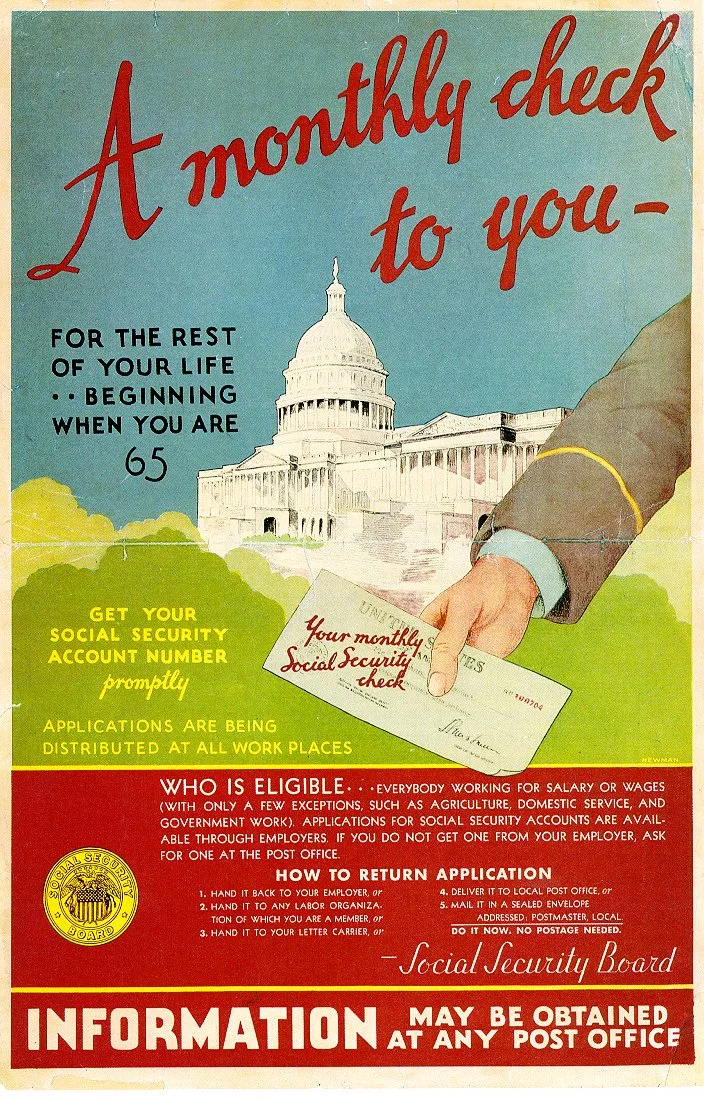
Social Security's trust fund will be empty by 2032, and when it goes, benefits get cut by 22% automatically — no vote required, no further warning. Congress has roughly six years to do something about it. Based on Congress's recent track record, you should probably be nervous.
The Clock Is Already Running
Here is the baseline reality, as reported by CBS News: Social Security already pays out more in benefits than it collects in payroll taxes. The program is actively drawing down its trust fund right now, today, to cover the gap. The trust fund does not replenish itself. It drains.
Unless lawmakers step in, that fund hits zero in 2032. At that point, the program can only pay out what it takes in — which is roughly 78 cents on every dollar of promised benefits. The other 22 cents disappears. For someone counting on $2,000 a month, that's $440 gone. For a retired couple depending on Social Security as their primary income, it's a crisis with an arrival date printed right on it.
This is not a prediction. It is a projection from the Social Security trustees themselves, backed by decades of actuarial math. The date may shift slightly depending on economic conditions. The underlying problem does not go away.
Option One: Raise the Payroll Tax. Also, Good Luck With That.
The most direct fix would be jacking up the payroll tax, currently sitting at 12.4%, to around 17%. According to the Cato Institute, that rate would fully close the funding gap and keep Social Security solvent for the foreseeable future. Clean solution. Brutal math.
CBS News reports that Cato estimates the hike would cost a median worker earning about $62,000 a year an extra $2,600 to $3,000 annually, split between the employee and their employer. Romina Boccia, Cato's director of budget and entitlement policy, called that burden "financially impossible for most workers." Her supporting evidence: most Americans don't have $400 in savings to cover an emergency. Asking them to absorb a $1,300 annual hit out of their paycheck — which is the worker's half of that split — is not a policy. It's a punchline.
This option has virtually no political support. It would hammer the exact working-class voters that both parties spend election years pretending to care about. So everyone quietly agrees it's off the table, and then we move on to the next bad idea.
Option Two: Make Rich People Pay More. Suddenly Very Popular.
Right now, the Social Security payroll tax only applies to the first $184,500 of income. Everything above that cap is untouched. A surgeon making $600,000 a year pays the same total Social Security tax as someone making $184,500. That is, in fact, how it works.
Lifting or eliminating that cap has found unusual friends. In July, according to CBS News, Senator Elizabeth Warren of Massachusetts and Senator Bernie Moreno of Ohio — a Democrat and a Republican — jointly called for removing the cap. A 2025 poll from the Bipartisan Policy Center found that 65% of Democrats and 62% of Republicans supported the idea. Even a majority of households earning more than $200,000 a year backed it. That is a genuinely rare thing: a policy that polls well across income brackets and party lines.
Boccia, speaking to CBS News, explained part of that popularity with characteristic bluntness: people like the idea of making someone else pay. She's not wrong. She also warns that removing the cap could push top marginal tax rates above 60% in several high-tax states when you stack federal, state, and Social Security levies together. Her concern is that high earners would respond by retiring early rather than hand that much income to the government. Whether that effect would be significant enough to meaningfully undercut the revenue gains is genuinely debated among economists.
Option Three: Cut Benefits and Try Not to Say It Out Loud
Boccia's preferred solution is heavy on the benefit reduction side. She argues the root problem is that Social Security benefits have grown more generous over time, and the program was designed 91 years ago — before 401(k)s, before target-date funds, before automatic enrollment in workplace retirement plans. The infrastructure of private retirement saving has changed dramatically. The Social Security formula has not kept pace with any of it.
Among the ideas floating around: gradually raising the retirement age to track increases in life expectancy, reducing benefits for higher-income retirees, or moving to a flat benefit system that every retiree gets regardless of earnings history. Boccia pointed out to CBS News that a dual high-earning household can currently collect $120,000 a year from Social Security — more than $62,000 annually for a single top-bracket retiree. She called that "excessive in comparison to most other nations' public retirement benefits." That is a defensible observation.
Raising the retirement age is the part of this conversation that tends to end conversations. The median retirement age in the U.S. is 62, according to the Transamerica Center for Retirement Studies, and most people retire earlier than planned — not by choice, but because of layoffs, health problems, or caregiving obligations. Telling those people they should have worked longer is not going to land well.
What Congress Is Actually Going to Do About It
Most policy experts CBS News spoke with believe any real fix will require a combination of approaches: some new revenue through a modest rate increase or lifting the cap, paired with some benefit trimming, probably phased in slowly enough that no current retiree notices until it's too late to vote anyone out.
That is the policy logic. The political logic is entirely different. Social Security is the third rail of American politics for a reason. Any candidate who campaigns on cutting benefits or raising taxes to save the program is handing their opponent a weapon. So Congress has spent decades approaching this deadline with the energy of someone who left a term paper until the night before it's due — except the term paper is a $1.4 trillion annual program that 70 million Americans depend on.
Six years sounds like a long time. It is not a long time. The 2032 deadline arrives in the middle of what will be a presidential election year. Do with that information what you will.
The Dingo Take
You are supposed to believe that Washington cannot fix Social Security because the problem is too complicated. That is not true. The problem is extremely simple: the program collects less than it pays out, the gap grows every year, and the trust fund that covers the difference expires in 2032. The math has been public for decades. The Trustees publish an annual report. Economists across the ideological spectrum have laid out the options in exhausting detail. The problem is not complexity. The problem is that every solution requires a politician to tell some group of voters something they do not want to hear, and American politics has largely stopped producing people willing to do that.
The cap-lifting idea is the closest thing to a viable path because it spreads the pain upward and polls remarkably well. A bipartisan Senate pairing of Warren and Moreno calling for it is not nothing. But the window to act narrows every year Congress waits, because the longer they delay, the larger the required fix. A modest payroll tax bump paired with lifting the cap, phased in over a decade, would probably get the job done without catastrophizing anyone's retirement. That is the boring, reasonable answer that has existed for years and gone exactly nowhere.
Here is what will actually happen: Congress will ignore this until roughly 2031, when the trust fund depletion becomes front-page news and suddenly everyone is in crisis mode. There will be emergency hearings. There will be dueling press releases. There will be a bill passed at 11:59 p.m. on the deadline that patches things together for another decade and kicks the structural fix down the road one more time. And then we will do all of this again. That is not cynicism. That is American fiscal policy, documented.



Comments