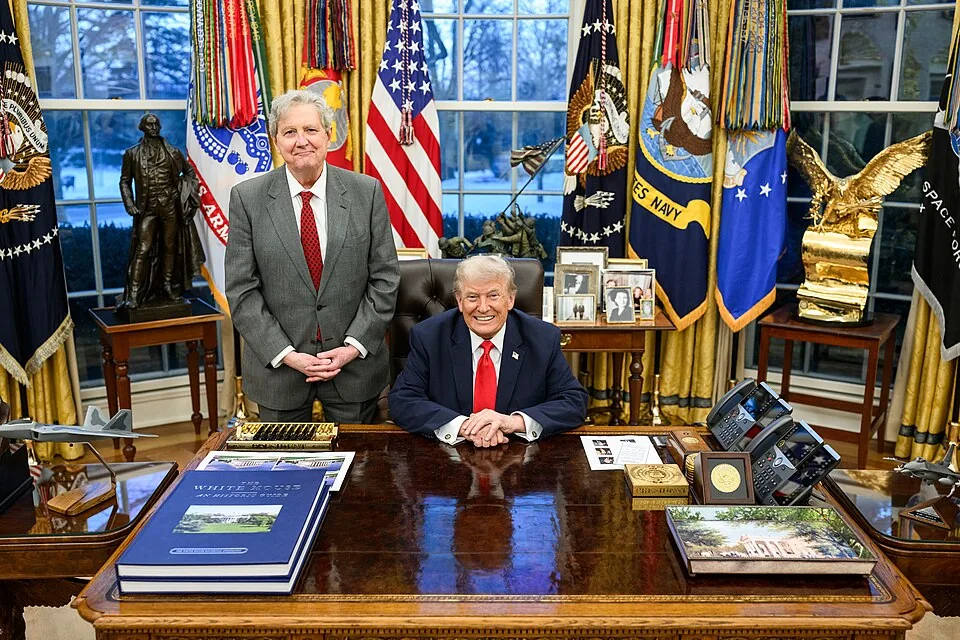
A sitting Republican senator went on national television Sunday and told the president of his own party to stop running taxpayer-funded ads about himself, explain the war he started, and maybe focus on the fact that Americans can't afford groceries. Sen. John Kennedy of Louisiana said all of this out loud, on camera, with a smile, which is either refreshing honesty or a sign that something has gone badly wrong inside the Republican Party's midterm war room.
The Midterms Are Closer Than Anyone Wants to Admit
Kennedy was on CBS News' Face the Nation Sunday, and he did not come to reassure anyone. The midterm elections are "going to be close," he said flatly, before advising that "it would help if the president would stay focused on cost of living."
This is the kind of sentence a senator says when internal polling is making people sweat through their shirts. Kennedy has been out stumping with GOP candidates in battleground states, and what he's hearing from voters is not enthusiasm for geopolitical brinkmanship. It's the cost of milk. The cost of gas. The cost of everything that has been quietly destroying household budgets while Washington argues about Iran.
The Strait of Hormuz Problem Nobody Wants to Say Plainly
Here is the part of the interview that deserves more attention than it's probably getting. Kennedy defended the administration's Iran policy in general terms, dismissed Iran's latest proposal to reopen the Strait of Hormuz as "not a serious offer," and backed the ongoing sanctions and blockade. Fine. But then he said the quiet part at full volume: "the strait is at least partially closed, and it's affected the price of oil. And oil's in everything, including gasoline, and it's painful as hell."
He then outlined his view of the options available: settle it, get the strait open, or escalate. He ruled out ground troops. What he did not rule out was the obvious implication that the current approach is hurting the exact voters Republicans need to keep showing up.
Kennedy said he wants the president to address the nation on Iran directly, or hand the microphone to Secretary of State Marco Rubio and Joint Chiefs Chairman Gen. Dan Caine to explain "why we went into Iran, why we're winning, and how we're going to get out." He made this same request back in July, according to CBS News. It apparently has not happened yet.
The Taxpayer-Funded Trump Ad That's Been Running on CBS
If the Iran stuff wasn't enough, Kennedy also weighed in on a new government-funded ad campaign that CBS News reports has been airing across the major networks, paid for with public money, and dedicated to extolling the president. Trump is not the first person to blur the line between government communications and personal promotion, but running campaign-adjacent ads on the public dime during a midterm election year is a move that has a particular flavor to it.
"I don't think any public official, including President Trump or Kristi Noem or John Kennedy, should spend public money on private ads for themselves," Kennedy said, pointedly naming himself in that list. The Noem reference was not accidental. Earlier this year, Kennedy grilled Noem at a Senate hearing over her decision to spend $220 million in public funds on an immigration ad campaign where she featured prominently. That line of questioning came just before her removal from the DHS post, per CBS News.
No, Really, Stop Putting Your Name on Buildings
Kennedy also took a swing at the ongoing Kennedy Center naming controversy, in which President Trump has been pushing to attach his name to the iconic Washington venue. Kennedy's proposed solution was elegant in its simplicity: "I think we ought to have a rule that no politician can have a building named after him while he's alive."
It's the kind of bipartisan-sounding principle that would, in practice, solve exactly one current problem. But points for framing.
What the GOP Fracture Actually Looks Like
Kennedy's interview lands against a backdrop that CBS News has been tracking: multiple Republican candidates in competitive races have broken with Trump on the Iran war outright, calling for a quick end to the conflict while hammering on the gas and diesel price issue. Kennedy hasn't gone that far. He's still broadly defending the strategy. But he's saying the quiet part: the communication has been a disaster, the economic pain is real, and the president needs to get his act together before November.
He also acknowledged, with the weary tone of a man who knows exactly what he's dealing with, that "the president doesn't take orders from me, he barely takes suggestions." He added that he's "pretty persistent" and will keep making the same recommendation anyway. This is what passing as the voice of reason looks like inside the 2026 Republican Party.
The Dingo Take
You are supposed to believe that a Republican senator publicly telling a Republican president to stop running vanity ads with public money, explain the war he launched, and get serious about the cost of living is just normal political discourse. It is not normal. This is a senator from the president's own party going on national television to deliver a to-do list that reads like an intervention.
The Iran situation is the thing that keeps getting buried under the daily churn, and it shouldn't be. Kennedy said it himself: the Strait of Hormuz is at least partially closed, oil is in everything, and it is "painful as hell." That's not an opposition talking point. That's a Louisiana Republican who has been traveling battleground states telling you what he's seeing. When your own allies start publicly workshopping your exit strategy from a conflict on Face the Nation, the communications operation has failed in a fairly profound way.
The taxpayer-funded self-promotion ads are almost a footnote by comparison, except they're not, because they represent the same underlying instinct: the belief that the machinery of government exists to serve the image of the man running it. Kennedy calling that out, by name, including his own name, is the kind of thing that sounds normal and is actually pretty remarkable given where the Republican Party has been for the past decade. Whether anyone in the White House is listening is a different question entirely. History suggests probably not.

Comments