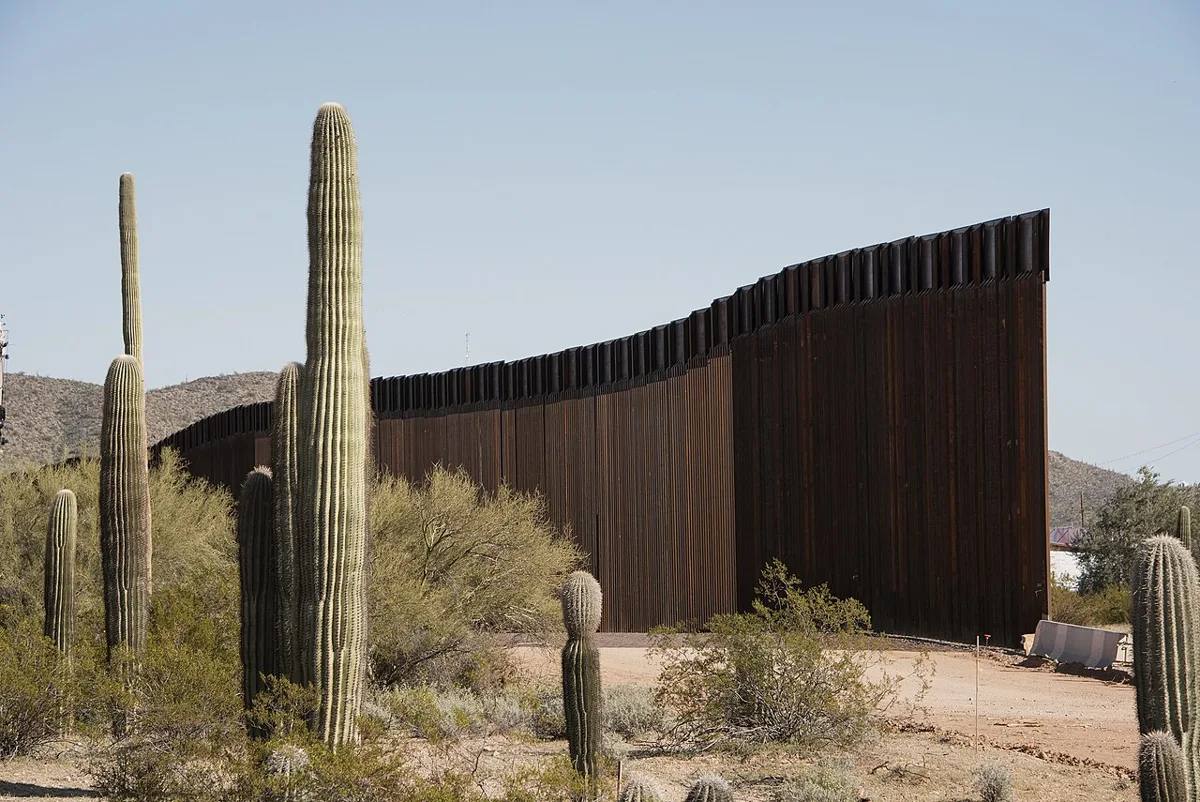
Trump administration contractors scraped a 50-foot gash through a 7,500-year-old giant fish carving in the Arizona desert, destroying part of the oldest known geoglyph in the Americas. This carving predates Egypt's first pyramid by 2,000 years. It predates Stonehenge by 1,500 years. It predates the Nazca Lines by 4,000 years. And Customs and Border Protection would like you to know it was totally an accident.
What They Destroyed, Exactly
The Las Playas Intaglio is a 272-foot fish etched into the floor of the Sonoran Desert in Arizona, carved into the ancestral homeland of the Tohono O'odham people and other Indigenous tribes. Until recently, researchers thought it was roughly 1,000 years old, which would have already made its destruction a serious federal crime and a moral catastrophe. Then new research dated it to at least 6,500 years ago, and possibly 7,500 years ago.
To put that in terms your brain can actually hold: human beings were carving art into the ground in what is now Arizona before the wheel was in widespread use, before writing existed in most of the world, before anyone laid a single stone at Stonehenge. According to researchers writing in The SAA Archaeological Record, the Las Playas Intaglio now holds the distinction of being the oldest geoglyph ever found in the Americas. It held that distinction for about five minutes before most people learned it existed, because by the time the research was publicized, contractors had already driven machinery through it.
In April, those contractors, hired by the Trump administration to build a second border wall along the Arizona-Mexico border, "scraped" a 50-foot swath directly through the carving, according to the Center for Biological Diversity, which documented the damage. Fifty feet. Through something 7,500 years old. That did not have to happen.
The Government's Response Was Exactly What You'd Expect
A Customs and Border Protection spokesperson told NBC News that the contractor "inadvertently disturbed" the site. CBP Commissioner Rodney Scott has been, the spokesperson added, "engaged directly with tribal leadership to determine appropriate next steps." Those next steps, one assumes, do not include unscrapiing a 7,500-year-old intaglio.
The agency also assured everyone that "the remaining portion of the site has been secured and will be protected in place" and that CBP is "conducting a thorough review of construction protocols." They are committed, the statement concluded, to "respecting and safeguarding cultural heritage throughout all border infrastructure projects." This is the kind of sentence you write when you have destroyed cultural heritage and need a sentence to put in the press release.
Here is the word that should be in every single sentence of that statement but is not: sorry. Here is the word that appears instead: inadvertently. "Inadvertently" is doing an enormous amount of work in that response, carrying the entire moral weight of bulldozing the oldest known geoglyph in the Western Hemisphere and not buckling once.
This Didn't Happen in a Vacuum
The Tohono O'odham Nation did not wake up on the day of the damage surprised that the Trump administration had little regard for their land or their history. The tribe is currently appealing a federal judge's decision that refused to block border wall construction through their reservation. They are fighting in court to stop the government from bulldozing Quitobaquito Springs, a desert water source inside Organ Pipe Cactus National Monument that is both a sacred site and a habitat for endangered species.
As NBC News reports, the damage to the Las Playas Intaglio site and ongoing construction across Tohono O'odham land has "strained the tenuous relationship between the tribal nation and the government." Strained. That is one way to say it. Another way to say it is that the federal government has been destroying irreplaceable Indigenous heritage sites while telling tribal leaders it is very sorry and very committed to not doing the thing it is still actively doing.
To make all of this legally possible, the Department of Homeland Security invoked authority granted under the Secure Fence Act of 2006, which allows DHS to waive federal laws, including environmental and cultural preservation statutes, to build border infrastructure. A law passed twenty years ago handed the executive branch a skeleton key to bypass protections that exist specifically to prevent exactly this kind of catastrophe. And here we are.
What Was Lost Cannot Be Overstated
Russ McSpadden, Southwest conservation advocate at the Center for Biological Diversity, called it plainly: "a cultural and historical atrocity." The researchers who published the updated dating of the intaglio said the discovery of its true age "emphasizes the significance of this site and the parallel great misfortune resulting from its damage."
The formerly 272-foot carving is now permanently, irreparably damaged. There is no fixing this. No review of construction protocols brings back what was scraped away. Whatever was in that 50-foot swath, whatever detail or meaning or story the original artists put into that ground when humans were still figuring out how to build cities, is gone. Machines ate it in the service of a wall that experts widely agree does not meaningfully reduce illegal border crossings.
This is the actual trade that was made: a 7,500-year-old piece of irreplaceable human history, belonging to a people who never stopped living on that land, destroyed to build infrastructure whose efficacy is disputed at best. That trade was made by accident, apparently. Nobody thought to check.
The Dingo Take
You are supposed to believe this was a mistake. Fine. Accept the premise entirely. Say the contractors genuinely did not know what they were driving over, that the communication breakdown was real, that no malice was involved. That still leaves you with a federal government that has granted itself the legal authority to waive cultural preservation laws, deployed that authority aggressively, and built construction operations so reckless that they scraped through a site older than written language without anyone stopping to ask what it was. A "thorough review of construction protocols" is not a response proportionate to destroying the oldest geoglyph in the Americas. It is a response proportionate to accidentally backing a forklift into a loading dock.
The Tohono O'odham people have been fighting this in court and losing. A federal judge already refused to block construction through their reservation. The legal architecture of the Secure Fence Act has made it possible for DHS to bulldoze through sacred land with near-total impunity, and the Trump administration has used that architecture enthusiastically. What happened to the Las Playas Intaglio is not an isolated accident. It is a foreseeable consequence of a policy that treats Indigenous land as an obstacle rather than a sovereign territory with its own history, meaning, and law.
Somewhere around 5,500 BC, a person or a group of people stood in the Sonoran Desert and carved a giant fish into the earth. They did it carefully enough that it lasted 7,500 years. It survived everything. Then someone decided a wall needed to go there, and nobody bothered to find out what was already on the ground.




Comments