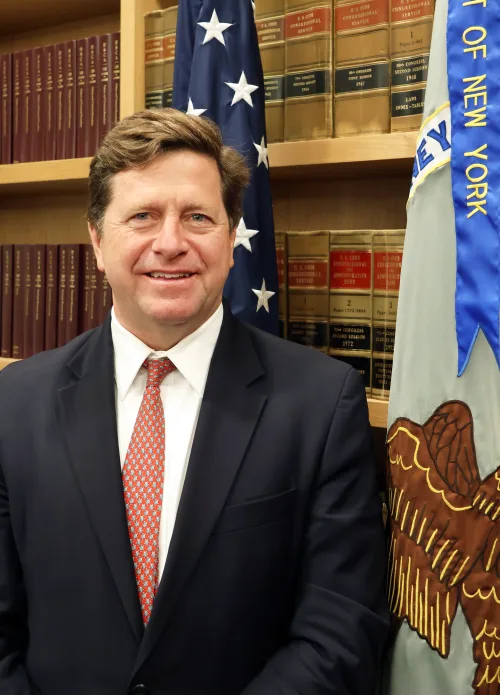
The man currently responsible for overseeing all 18 agencies of the American intelligence community might soon also be in charge of the country's artificial intelligence policy. President Trump told Axios on Tuesday that Director of National Intelligence Jay Clayton would be a good fit for the AI czar role. One job apparently not being enough for the people running this government.
One Guy, Infinite Jobs
Let's be clear about what's being proposed here. Jay Clayton currently sits atop the entire U.S. intelligence community as DNI, serving as the president's principal intelligence adviser across 18 separate agencies. That is, by any reasonable measure, a full-time job. A more-than-full-time job. A job that has consumed and exhausted some of the most capable national security minds in American history.
And yet, according to Axios, Trump floated Clayton as someone who could simultaneously take on the AI czar role the White House is actively working to fill. Because why have one person do one enormous thing when you can have one person do two enormous things and see what breaks first?
Why the White House Is Suddenly Scrambling
The push to fill an AI czar position isn't coming from nowhere. Calls for government intervention on artificial intelligence have been intensifying across the political spectrum, and the Trump administration, which has spent much of its energy dismantling regulatory frameworks rather than building them, finds itself in the awkward position of needing to actually govern something.
AI is no longer a tech-sector side conversation. It's a national security issue, an economic issue, a labor issue, and a geopolitical competition with China that the administration has staked serious rhetorical ground on. Someone, eventually, has to be responsible for it. The question is whether that someone can also simultaneously be responsible for the entire American intelligence apparatus.
What Clayton Actually Said About AI
To his credit, Clayton hasn't been entirely silent on the subject. During his confirmation hearing in July, Axios reports he drew a comparison to Treasury Secretary Scott Bessent's framing, saying that for the intelligence community it "resonates that AI is not only an opportunity but a th" -- and that's where the available excerpt cuts off, which is genuinely unfortunate timing for a quote.
What we can piece together from the fragment is that Clayton views AI through a dual-use lens: something that creates capability and threat simultaneously. That's not a wrong way to think about it. It's actually the correct way to think about it. Whether it qualifies someone to set national AI policy on top of running the intelligence community is a different question entirely.
The Czar Factory Keeps Running
The Trump administration has developed a real taste for czars. AI czar, border czar, crypto czar, energy dominance czar. The czar as a governing model has the advantage of sounding decisive and the disadvantage of frequently meaning very little in practice without actual statutory authority, staff, budget, or a clear mandate.
The AI czar role, as it's been discussed, sits in that ambiguous space where the title suggests power but the structure underneath it remains genuinely unclear. Plugging in the DNI, a Senate-confirmed official with an already overwhelming portfolio, doesn't resolve that ambiguity. It just gives the ambiguity a recognizable face.
Clayton's Actual Background, For What It's Worth
Before becoming DNI, Clayton served as chairman of the Securities and Exchange Commission during Trump's first term, where he oversaw financial regulation and became known as a relatively industry-friendly regulator. His background is law and finance, not technology or intelligence in the traditional sense.
That's not automatically disqualifying for an AI policy role. Some of the most important AI governance questions are fundamentally legal and economic ones. But it does add another layer to the portrait of a man being asked to do three jobs' worth of work with expertise that spans a different set of domains than either of the roles being discussed.
The Dingo Take
You are supposed to believe that the person running American intelligence, managing relationships with 18 agencies, briefing the president on global threats every single day, is also the right pick to set coherent national policy on the most consequential and fast-moving technology since the internet. That's the pitch. That's what's being floated as a serious governing idea.
The charitable read is that Trump mentioned Clayton off-the-cuff to Axios and this is less a formal nomination than a vibe. That's probably true. Trump has a long history of telling reporters someone would be great at something and then doing something completely different by Thursday. But even as a vibe, it tells you something about how seriously this administration is treating the AI governance question. Not seriously enough to have a dedicated, properly resourced person in place. Seriously enough to throw a name at a reporter.
AI policy done badly, or done by someone too stretched to actually do it, has real consequences. Model safety, export controls, procurement rules for federal agencies, the competitive posture against China: these aren't abstract. They're the decisions that will shape what American AI development looks like for the next decade. Whoever ends up holding this role needs to actually hold it. Not hold it in addition to the most demanding intelligence job in the country.



Comments