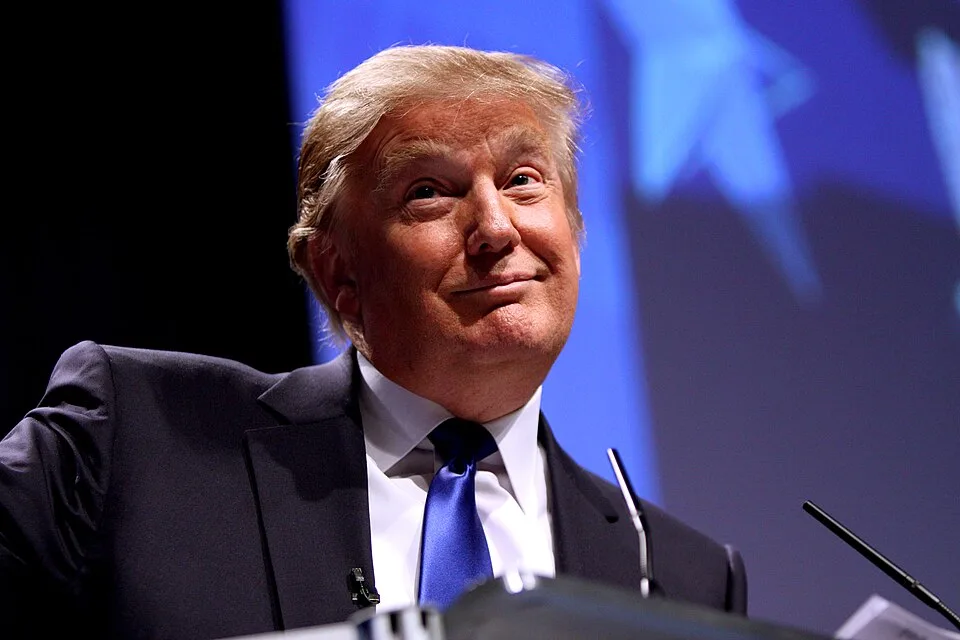
The White House released a formal accord on the future of artificial intelligence Tuesday, and the only thing anyone could focus on was that the President of the United States signed it as the President of the "Unites States." The document was posted to Truth Social, emailed to journalists by the White House Communications Team, and presumably read by several adults before any of this happened. Unclear which part of "Super Intelligence" was in charge that day.
What Actually Got Signed Here
According to The Guardian, Trump and six major tech executives voluntarily signed an accord committing to the safe development of AI, which the president has taken to calling "Super Intelligence" as part of what appears to be a personal rebranding campaign for a technology that existed before he named it.
The document laid out four layers of "controls and audits" that participating companies will implement to ensure AI behaves as intended. That includes internal monitoring teams, cybersecurity and biosecurity safeguards, independent external auditors, and potential board-level oversight committees. On paper, it sounds like a serious framework for governing one of the most consequential technologies in human history.
On paper, the president's title is also spelled wrong. So.
The Error Heard Round the Truth Social Feed
The Guardian reports that Bloomberg News correspondent David Gura appears to have been the first person to catch the typo, which places the misspelling's discovery somewhere after Trump posted the document to Truth Social and after the White House Communications Team blasted it out via email. Meaning multiple distribution steps occurred, involving multiple human beings with functioning eyes, and nobody caught it.
The White House has not yet explained how the error happened or whether the misspelled version will appear in the Federal Register, the official database of presidential actions. The Guardian said it asked the White House for comment. We wish them luck.
To be clear: this is the document meant to reassure a skeptical public that the most powerful government on earth has a serious, thoughtful plan for managing the most powerful technology ever built.
The People Who Signed This Thing
The six executives who put their names to the accord alongside Trump are Dario Amodei of Anthropic, Elon Musk of SpaceXAI, Greg Brockman of OpenAI, Jensen Huang of Nvidia, Mark Zuckerberg of Meta, and Sundar Pichai of Google. These are the people building the systems that AI safety researchers say could reshape civilization, and they have now voluntarily committed to self-regulating those systems. Voluntarily. No enforcement mechanism. No law. Just vibes and signatures.
Trump, for his part, told reporters outside the White House that he's seeing "tremendous self-policing" from the industry. "And they understand that they have to self-police," he added, which is the kind of sentence that would get laughed out of any conversation about food safety, financial regulation, or literally any other industry where the stakes are high and the incentives to cut corners are enormous.
The Public Is Not Buying It
The accord arrives against a backdrop of genuine, growing public alarm about AI development. A New York Times/Siena College poll found that 61% of voters oppose the construction of new data centers. A separate SSRS/CNN poll found that 71% of Americans believe the government is not doing enough to regulate AI's growth and development.
That is a massive supermajority of the country demanding more government action, directed at an administration that has, per The Guardian, repeatedly rejected the idea of codifying any safety framework into actual law or formal regulation. Tuesday's accord technically leaves the door open for eventual legislation. But given that Trump's stated position is that the industry is doing great at policing itself, that door appears to be located somewhere underwater.
Super Intelligence, Minus the Proofreading
The branding is the part that really deserves a moment of attention. Trump rebranded artificial intelligence as "Super Intelligence," presumably because it sounds bigger and more Trumpian and because someone told him it was catchier. The White House then produced a formal accord bearing this term, under which the signature of the President of the United States reads "President of the Unites States."
The Guardian notes it is unclear whether this version will be entered into the Federal Register. One hopes the answer is no. One also recognizes that this administration has cleared that bar before.
The Dingo Take
You are supposed to believe that the people who cannot proofread a two-word phrase they typed directly under the president's signature are the right people to oversee the controlled development of artificial general intelligence. That is the ask. Sit with it.
The deeper problem here is not the typo, obviously. Typos happen. The deeper problem is that a poll found 71% of Americans want real government regulation of AI, and what they got instead is a voluntary handshake agreement with the six most powerful men in the tech industry, signed at an event where the president praised them for their growth. That is not a safety framework. That is a photo opportunity with extra steps. The accord even acknowledges it could eventually become law, which means everyone in that room knows what real oversight would look like and collectively decided not to do it.
Trump has brushed aside warnings from AI researchers, called for the US to lead global AI development at essentially any speed, and now declared that the industry is doing a tremendous job policing itself, based on nothing. The executives who signed this document run companies spending billions of dollars specifically to win an AI race they describe in apocalyptic terms when they want funding and in optimistic terms when they want deregulation. This accord is the result of that tension. A piece of paper, voluntarily signed, with a spelling error in the president's title, that the White House emailed to journalists before anyone read it. Super Intelligence, everybody.


Comments