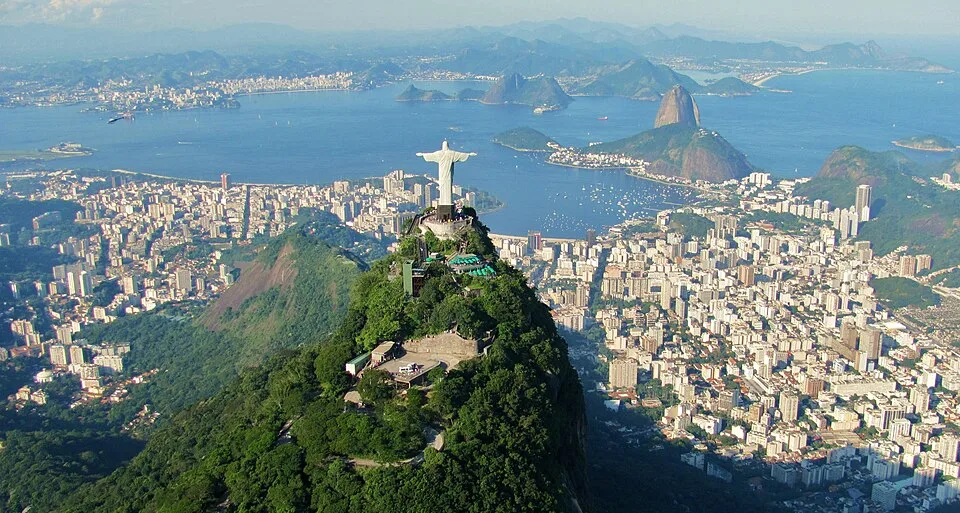
The man convicted of plotting a coup to stay in power is sitting in a prison cell while his son runs for president on an explicit promise to set him free. That is the actual ballot question in Brazil this Sunday, dressed up in the language of a normal democratic election. It is not a normal democratic election.
A Coup, a Conviction, and a Very Convenient Son
Jair Bolsonaro lost the 2022 Brazilian presidential election to Luiz Inácio Lula da Silva by a narrow margin. He then, according to police, orchestrated a plot to overturn that result, which included a plan to assassinate Lula. He is now serving a 27-year sentence for it. His son Flávio, a 45-year-old senator, is running in Sunday's election with one of the most brazen campaign promises in recent political memory: elect me, and Dad walks free.
As NPR reports, Flávio has made the pardon a centerpiece of his campaign, turning his father's criminal fate into a live political question. The message to Brazilian voters is almost admirably blunt: the rule of law is negotiable if you vote correctly. Democracy has a reset button, and Flávio has his hand on it.
Flávio describes himself as "a more moderate Bolsonaro," a phrase that is doing extraordinary heavy lifting given that he also denies human responsibility for climate change, wants to make it easier to buy guns, and has pledged to free a man convicted of plotting murder and sedition. Moderate compared to what, exactly, is a question worth sitting with.
Lula at 80, Running for His Fourth Term and His Life's Work
President Lula, who turns 81 next month, is seeking a fourth presidential term. He is not a clean political figure, and the Dingo Daily is not going to pretend otherwise. He was jailed in 2018 on corruption and money laundering charges, though the Supreme Court annulled his convictions in 2021 on procedural grounds. His opponents have never let that go, and they have a point worth acknowledging.
What is also true, as NPR notes, is that Lula's government reduced poverty and increased protections for the Amazon rainforest. His embrace of public spending drove real economic growth early in his term, even if that growth has since slowed. Whatever his legal history, the contrast between a flawed incumbent and the son of a convicted coup plotter running on a pardon pledge is not exactly a coin flip.
The stakes here go well beyond Lula versus Bolsonaro as personalities. The next president will nominate four of eleven Supreme Court justices, which means the winner shapes Brazil's highest court for a generation. They will set environmental policy for the world's largest rainforest. They will determine how close Brazil aligns with Washington under Trump. This is one of the most consequential elections happening anywhere on Earth right now, and it is getting a fraction of the attention it deserves.
Trump Is at This Party Whether Brazil Invited Him or Not
Flávio Bolsonaro's rallies have featured American flags. Not Brazilian flags with an American flag somewhere in the crowd, but American flags as a deliberate signal, a brand alignment. A September cover of a leading Brazilian political magazine depicted a giant U.S. spaceship hovering over the country, which is both funny and genuinely alarming as political imagery goes.
As NPR reports, Flávio has explicitly pledged to align Brazil more closely with the Trump administration if elected. Supporters at an Independence Day event in São Paulo paraded an effigy of Trump holding a doll of Lula dressed as a prisoner. The American president is a character in Brazilian campaign theatre in a way that has no real modern precedent. The Trump administration has made clear it has a favorite in this race, and that favorite is the guy who will pardon the coup plotter.
This is the global MAGA playbook in its clearest form yet: find a local strongman, wrap him in American flags, promise to demolish institutions, and call it freedom. Brazil is not a small test case. It is the largest country in Latin America, the seventh-largest economy in the world, and home to a rainforest the entire planet depends on. What happens there Sunday has consequences that extend well past its borders.
What Voters Are Actually Worried About
Lost in the soap opera of the Bolsonaro family drama is the fact that Brazilian voters have real, grinding concerns that have nothing to do with which oligarch gets pardoned. Crime is a top issue, according to NPR. Flávio supports a hardline approach that he has suggested could involve joint operations with the U.S. military, which is a remarkable thing to propose in a sovereign country. Lula has focused on targeting gang financiers and has voiced skepticism about foreign governments meddling in Brazilian security policy.
Corruption is also on voters' minds, and for legitimate reasons on multiple sides. Recent media and police investigations have revealed allegedly improper ties between a jailed ex-banker known for bribery and Supreme Court justices and senior politicians. Flávio Bolsonaro himself took money from this banker and is under investigation for money laundering, charges he denies. Nobody in this race is campaigning from a spotless perch.
The economy rounds out the top concerns. Lula's spending-driven growth has cooled. Flávio's team is promising an austerity agenda modeled on Argentina's Javier Milei, which is either a bold economic vision or a threat, depending on your view of what Milei has actually done to Argentina. Either way, Brazilian voters are being asked to make choices about their daily lives while a constitutional crisis hums in the background.
How Sunday Actually Works
Brazil uses electronic voting machines and counts fast. NPR reports that by Sunday night, it should be clear who is advancing to a potential runoff. If no presidential candidate breaks 50% of valid votes, the top two head to a second round on October 25.
Polls show a tight race. That alone is the story. In a functioning democracy, a man running to pardon his father who is serving time for plotting a coup should not be polling within striking distance of the incumbent. The fact that he is tells you everything you need to know about how successfully the Bolsonaro movement has muddied the waters, cast doubt on institutions, and weaponized polarization. Federal University of Paraná political scientist Fábio Vasconcellos told NPR that since the political and economic crisis of the mid-2010s, "it became very difficult for any president to reach the higher approval ratings of previous decades." Polarization has been the operating system ever since.
The Dingo Take
Twenty-seven years. That is what a Brazilian court decided a coup attempt was worth, the sentence currently being served by Jair Bolsonaro for a scheme that, according to police, included planning to kill the man who beat him at the ballot box. And here we are, four years later, watching his son run for president on the explicit promise to make that sentence disappear. If you needed a cleaner definition of what democratic backsliding looks like, you will not find one.
The Trump connection is not incidental, and it should not be treated as colorful local flavor. American flags at Flávio Bolsonaro rallies are not organic grassroots enthusiasm for a foreign country. They are a signal, a team jersey, a declaration that this candidate is part of an international political franchise that sells the same product in every market: strong man, weak courts, free guns, fossil fuels, and a pardon waiting for whoever the last guy was. The fact that the Trump administration appears comfortable with this, even enthusiastic about it, should be part of every conversation Americans have about what their own government is exporting to the world right now.
Brazil votes Sunday. The Amazon, the court, the economy, and the basic principle that losing an election does not entitle you to a get-out-of-jail card are all on the table. Pay attention.



Comments