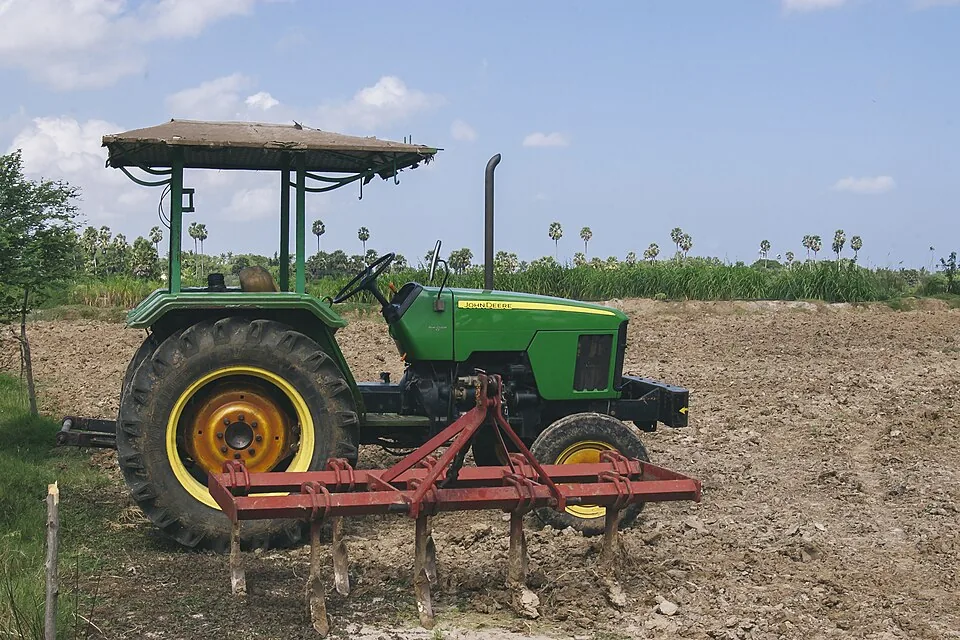
Joe Hamilton is about to fire up four tractors, two combines, and five semi-trucks on his 2,500-acre Indiana farm, and the fuel bill alone will be a record 9,000 gallons of diesel. That's before the soybeans have left the field, before the trucking costs, before the seed and chemical invoices. The war with Iran didn't just blow up foreign policy. It blew up harvest season.
A $3-Per-Gallon Gut Punch, Right at the Worst Possible Time
The midwest soybean harvest is underway right now, and an estimated 20 billion bushels of soybeans and corn are headed to market between now and the end of November. That is an enormous amount of diesel-powered machinery running for a very long time at very bad prices.
According to The Guardian, four of the five states with the highest weekly diesel price increases in September were in the midwest: Illinois, Michigan, Ohio, and Indiana. The fuel is up more than $3 per gallon compared with a year ago. Estimates suggest the combination of the Iran war, damaged Russian refineries, and regional supply disruptions could add $12,500 in extra fuel costs for every 1,000 acres harvested. Hamilton is farming 2,500 acres. Do that math yourself.
This is not a normal price spike driven by one bad refinery week. It is a cascade. The war with Iran sits at the top of that cascade, and everything downstream is getting soaked.
The Midwest Has Nowhere to Run
Here is a structural problem that does not get enough attention: the midwest is uniquely bad at absorbing fuel supply shocks. Kurt Lykins, a lecturer at Otterbein University, explained it plainly to The Guardian. The coasts and the Gulf can bring in tankers when things get tight. The midwest cannot. No water access, fewer refineries, fewer options.
Then pile on the regional disasters. An ExxonMobil refinery in Joliet, Illinois, suffered a power outage and flooding last month and went offline for more than a week, pulling over 80 million gallons of diesel and gas out of the regional supply. A six-month union dispute between workers and BP at the massive Whiting, Indiana, refinery has also constricted supply. Two facilities, two different crises, one region already stretched thin by a war on the other side of the planet.
"The midwest is different from the coasts," Lykins told The Guardian. "It's hard for the midwest to respond." That is an understatement on the scale of calling a combine harvester a "big tractor."
The Strategic Reserve Is Running on Fumes
The Strategic Petroleum Reserve was supposed to be the buffer for exactly this kind of moment. It is 714 million barrels of capacity held in salt caverns in Texas and Louisiana. The Guardian reports it is currently lower than at any point in the past 43 years, after 172 million barrels have been drawn down.
Lykins is not comforting about what comes next. "Although the prices for gasoline and diesel have been rising, drawing down from the reserve has given some stability to prices," he said. But that stability has a hard limit. "The issue is when we are no longer able to do that, the stability will no longer be there. We're getting ready to go into a high diesel demand season in winter."
So we are entering the highest diesel demand months of the year with a Strategic Reserve at a 43-year low, a war still burning, two regional refineries compromised, and a bunch of Hoosier farmers watching their profit margins evaporate in real time. Great. Everything is fine.
Farmers Are Price Takers, Not Price Setters
Hamilton put it clearly to The Guardian: "Farmers are price takers. It's not just fuel, it's chemicals, it's seed, it's the cost of equipment. Everything has increased along with the commodity prices."
The commodity prices have gone up, technically. Soybeans are at $12.88 per bushel, up from $10.14 a year ago. Corn is $5.23 versus $4.22 last year. Those sound like wins until you factor in that his diesel is $3 more per gallon than it was twelve months ago, and he needs 9,000 gallons just for harvest. The margin is getting murdered from both ends, and there is nothing Hamilton can do about either of them.
He has already switched to no-till and cover crop methods to reduce machinery use, cutting his fuel consumption to between two and four gallons per acre. But you cannot no-till your way out of a war-driven fuel crisis. At some point, the trucks have to roll.
Schools Are Cutting Field Trips. And Then Jobs.
The diesel crunch is not just a farm problem. It is landing on school districts already operating at the edge. Ohio alone has 15,000 school buses running on diesel, moving roughly 800,000 students every school day. The Guardian reports that Columbus, the largest public school system in the state, is already staring down a potential $157 million financial deficit by 2031. It has already cut nearly 300 jobs, closed four schools, and started limiting busing.
Nationally, almost 40% of school districts that participated in a survey published in May said they are consolidating bus routes to cut diesel costs. Twenty percent have cut "non-required trips" like field trips. The kids who lose field trips first are, reliably, not the kids whose parents can drive them places on weekends.
Lykins made the equity dimension explicit to The Guardian: "The sad thing is that this increase is not the same across school districts. Rural districts are going to be even more impacted because they transport more students over further distances." The people with the fewest resources are absorbing the most damage. As usual.
No Off-Ramp in Sight
Do not hold your breath for prices to fall back quickly. Lykins told The Guardian that even in the best-case scenario, where everything stabilizes tomorrow, rebuilding the Strategic Reserve will itself slow any price drop for consumers. "That's the best-case," he said.
Hamilton has limited fuel storage at his farm, which means he will have to buy more diesel at current prices to cover the second half of his harvest. He has no choice. Nearly half his harvesting fleet runs on on-road diesel, which carries the federal fuel tax that agricultural diesel avoids. He is paying the expensive version of an already expensive fuel to get crops to market that the country needs to eat.
This is what happens when energy policy, foreign policy, labor disputes, and climate-driven refinery flooding all collide at once during the two months of the year when the midwest needs diesel most. The prices were already climbing. The war was the last domino.
The Dingo Take
"Farmers are price takers," Hamilton told The Guardian, and that sentence should be tattooed somewhere visible in every energy policy meeting in Washington. Farmers cannot pass costs upstream. They cannot call a time-out on harvest season. They cannot renegotiate the price of corn once the combines are already in the field. They absorb. Every bad decision made in foreign policy, every Strategic Reserve drawdown, every refinery that floods or goes on strike, every barrel of chaos produced by a war the United States chose to fight lands on Joe Hamilton's 2026 diesel bill.
The midwest is now paying $3 more per gallon than it was a year ago, the Strategic Reserve is at a 43-year low, the region has fewer refineries than the coasts, and we are about to enter peak diesel demand season in winter. The people responsible for energy policy built a system with no slack in it and then lit the slack on fire with a war. School kids are losing field trips. Farmers are watching margins get hollowed out. Trucking companies are eating surcharges. And the absolute best-case scenario, according to one of the experts quoted in The Guardian's reporting, is that prices drop slowly because we need to refill the reserve we burned through trying to keep them from being even worse.
That is not a plan. That is a controlled fall. Someone in Washington should probably have a conversation about whether starting a war while the Strategic Reserve is already stressed and two major regional refineries are compromised was a wise sequencing of events. They will not have that conversation. But they should.





Comments