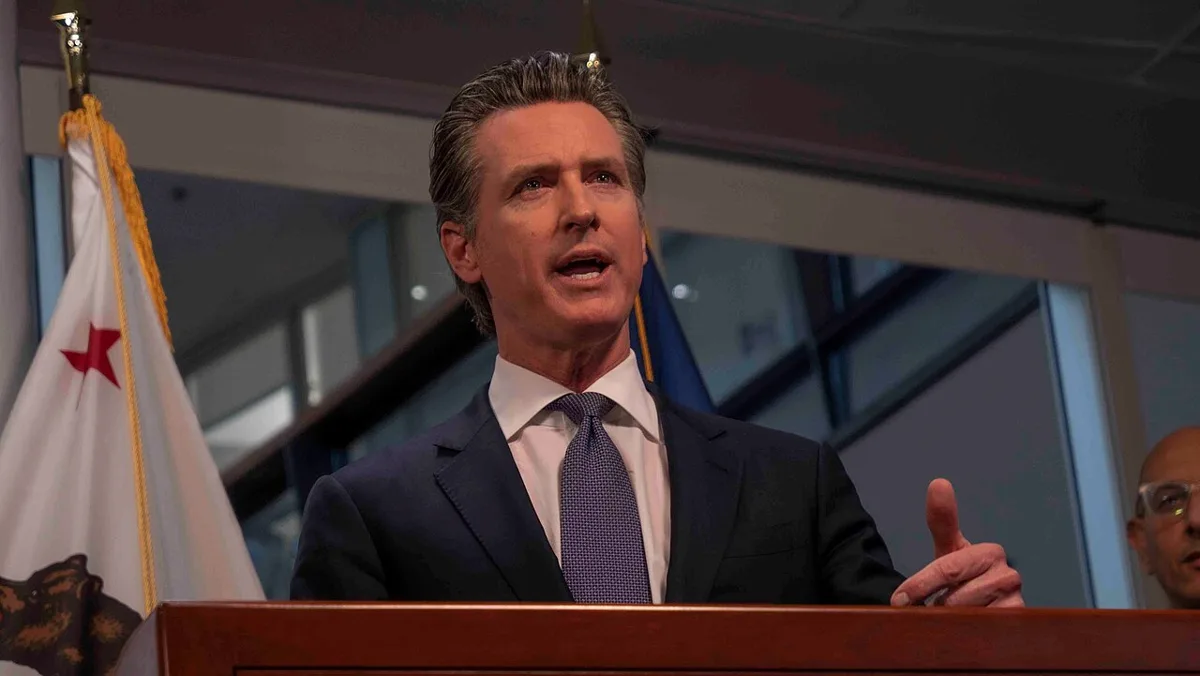
California Governor Gavin Newsom just signed a law slapping a 25% tax on every dollar private detention centers earn from their ICE contracts, and he did it with a quote that belongs on a bumper sticker. "If we can't kick out private facilities, we'll go after their profits," Newsom said in a press release. Whether that bravado translates into fewer immigrant detention beds or just a lot of noise from Sacramento is the question nobody wants to sit still long enough to answer.
What AB 1633 Actually Does
The bill, AB 1633, is one of 20 that Newsom signed Tuesday. It imposes a 25% tax on the gross income of any private detention center operating in California, and it applies across the board to federal, state, and local contract recipients. Every dollar earned through an ICE partnership gets taxed at that rate.
Revenue from the tax flows into something called a Due Process for All Fund, which is earmarked for immigration-related legal services. The law does not take effect until July 1, 2028, which means it lands in the final year of Trump's second term, assuming Trump doesn't find some creative way to make that sentence more complicated.
Also in the package: a ban on electric shock gloves used in immigration enforcement, which shouldn't even need to be a law that exists but here we are. "We're also banning the Orwellian practice of using shock gloves in enforcement activity," Newsom said, apparently needing to specify that California will not allow people to be electrocuted into compliance with deportation orders.
California's ICE Detention Infrastructure, Explained
California currently has eight ICE detention centers, according to reporting from the Department of Homeland Security. All eight are privately operated. Not one is a government-run facility.
The GEO Group, one of the largest private prison companies in the country, owns five of them. Imperial Valley Gateway Center LLC holds one. Two more were purchased by DHS in July but are managed by CoreCivic, another major prison company, under contracts running through 2027 and 2029 respectively.
That last detail matters. The two CoreCivic facilities technically belong to DHS now, which means California's tax may not reach them the same way it reaches the fully private operators. The law targets private detention center income, and the legal wrinkle of federal ownership with private management is exactly the kind of thing that ends up in court for years.
The Conservative Counter-Argument
Hans von Spakovsky, senior legal fellow with Advancing American Freedom, a conservative-leaning think tank, told Fox News Digital that Newsom's real goal is not tax revenue. It's bottlenecking the system. "It's very clear that there's only one purpose to this California gigantic tax increase, and that is to make sure that the federal government cannot find any private property owners, any private contractors in California that are willing to lease space to the federal government," he said.
He's not entirely wrong about the mechanism. If the tax makes California contracts unprofitable enough, private operators walk. ICE's total national detention capacity sits at roughly 66,000 beds, according to Spakovsky's reading of ICE's own reporting. If California's eight facilities go dark, that number drops. The federal government then has to scramble to find space elsewhere.
Spakovsky's proposed solution was that ICE should look at converting federal properties like warehouses and office buildings into detention facilities, or move detainees to neighboring states. "I'd go to Arizona. I'd potentially go to Nevada," he said, suggesting states that might be "eager for federal government money" from private contractor employment.
What Newsom Says He's Doing
Newsom has been explicit that this is a resistance play, not a fiscal policy. "We may not be able to dictate federal immigration policy, but we can make clear that activities taking place in California will be subject to California law," he said in his press release accompanying the signing.
That framing is politically useful. It positions California as a bulwark against federal overreach without having to actually physically stop anything. The tax doesn't remove anyone from a detention facility today. It doesn't cancel a single ICE contract in effect right now. What it does is set a timer, ticking down to July 2028, at which point private operators will have to decide whether profit margins still make sense.
This is the Newsom playbook in concentrated form: make things more expensive, more complicated, and more legally fraught for the federal government, without a direct confrontation that could end with the feds cutting California's funding or invoking the Supremacy Clause in some aggressive new way.
What Happens If the Facilities Walk
The worst-case scenario Spakovsky outlines is that all eight California facilities decide the 25% tax makes operations untenable and suspend contracts. Fox News Digital reports that this could meaningfully reduce ICE's overall detention capacity, not just in California, since the agency relies on private contractors partly to avoid the capital costs of building federal facilities.
The countermove is what Spakovsky described: the feds find federal land in California that no state law can touch, or they move operations to Arizona and Nevada. Both options take time and money, which is presumably the point of the original tax. Newsom doesn't expect to stop deportations. He expects to make them slower and more expensive, and to make the Trump administration own the optics of scrambling to set up detention infrastructure in the desert.
None of this helps a single detained person today. The law takes effect in 2028. The people currently in those eight facilities are still there, still in privately operated centers, still subject to ICE's authority.
The Dingo Take
Fox News is framing this as Newsom "slapping" a tax on detention centers like he just sucker-punched a war hero, but the actual facts buried in that same coverage tell a quieter story: the law doesn't kick in until July 2028, every facility is still open, and ICE has an uninterrupted runway of nearly two years to do whatever it wants in California. The bragging and the outrage are both running way ahead of the reality.
That said, there's a legitimate version of the conservative criticism here that has nothing to do with immigration politics. When a state uses its tax authority specifically to make federal law enforcement operations economically impossible, it is testing something about federalism that the courts have not fully answered. The Supremacy Clause exists for a reason. California is betting that profit margins, not legal mandates, will drive ICE's private partners out. That is a clever workaround. It is also the kind of move that, if a red state tried it on a federal environmental or firearms program, Newsom would call it nullification.
What this actually is: a 2028 problem dressed up as a 2026 fight. Newsom gets the press release. The detained immigrants get nothing today. The GEO Group keeps cashing its checks until further notice. Everybody's playing their position, the cameras are rolling, and the people inside those eight facilities are waiting for something more than a bumper sticker.





Comments