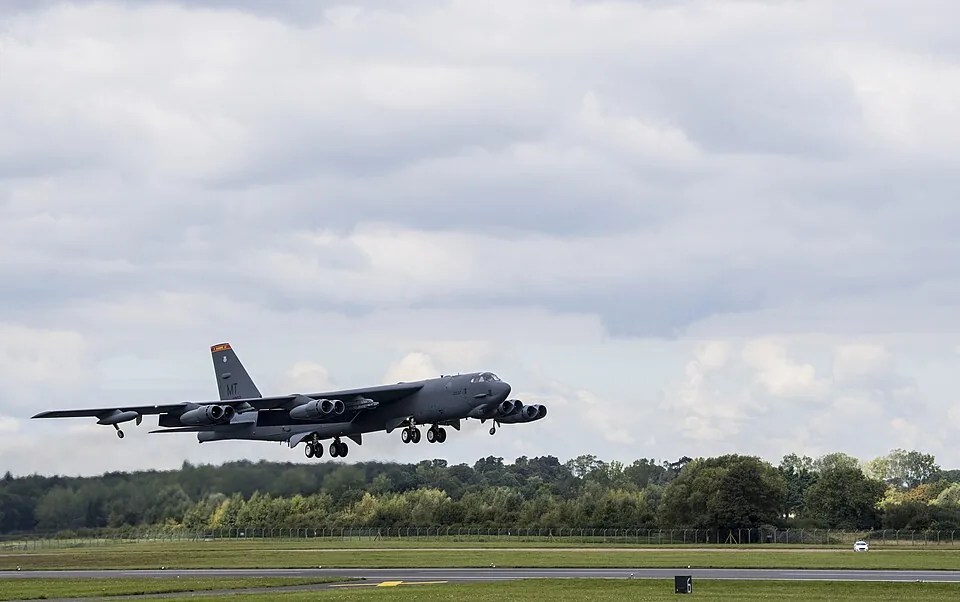
The U.S. Air Force has scrambled every single bomber out of its British base in England after a suspected Iranian-linked terror plot targeted the runway those same bombers were using to hit Iran. At least 12 aircraft, including B-1s, B-2s, and B-52s, are gone. The war that was supposed to last a few weeks just followed the planes home.
What Actually Happened at RAF Fairford
In the early hours of September 27th, police were alerted to three suspicious vehicles travelling toward RAF Fairford, a U.S.-operated airbase in Gloucestershire, about 100 miles west of London. Five men, all UK nationals from London aged between 23 and 25, were arrested on suspicion of explosives offences and later on suspicion of preparing a terrorist act, according to the BBC.
They were released on bail in what counter-terror police described as an "investigative decision grounded in experience and strategy." A sixth man, a dual British-Iranian national aged 25, was arrested in central London the following Thursday on suspicion of preparation of terrorist acts. He too was released on bail by Saturday.
That's six people arrested, six people out on bail, and one of the most strategically significant U.S. air bases in Europe now empty of the aircraft it was specifically housing to prosecute an active war.
The Bombers Are Gone, Pentagon Says Everything Is Fine
NBC News, citing Pentagon officials, reports that the withdrawal of at least 12 bombers was rushed, and included several aircraft that had just arrived as part of a scheduled rotation. Aviation trackers with the Military Air Tracking Alliance had been monitoring dozens of B-52s and B-1s operating out of Fairford since the opening days of the Iran war. Observers noticed a mass of B-1 bombers departing the base on Sunday.
A Defense Department official put out the kind of statement the Pentagon issues when it wants to project calm while quietly freaking out: "The Airmen that operate America's bomber force, including B-1s, B-2s, and B-52s, remain ready to deliver precision global strike capabilities, including through operations that launch and recover from the continental United States, anywhere, anytime." Translation: we still have planes, they just aren't in England anymore.
The BBC reports that Whitehall sources have not disputed that the U.S. withdrawal was a direct response to the Fairford incident. British officials also told the BBC this was a military rather than a political decision, taken at an operational level and communicated from the U.S. military to its British counterparts. The UK's Ministry of Defence has declined to comment.
Iran's Fingerprints, Iran's Denials
British Prime Minister Andy Burnham said there were "strong indications" that Iran played a part in the plot, though he did not provide details, according to the BBC. Tehran has strongly denied any involvement.
U.S. Secretary of State Marco Rubio, appearing on Fox News in the days after the incident, said the plot "clearly involve[d] the hands of a foreign actor," before adding that he was limited in what he could say on air. That tracks: Rubio rarely leaves himself room to say something concrete when vague is available.
This isn't a bolt from the blue. In July, Iran publicly warned, per the BBC, that "any base used for aggression against Iranian territory constitutes a legitimate target for our forces." RAF Fairford was being used, with UK government approval, for what British officials called defensive strikes on Iran. Iran apparently took that statement seriously. It's unclear whether anyone in Washington or London took it equally seriously at the time.
Trump's Reaction: Furious About Bail, Silent on the Bigger Picture
President Trump, true to form, zeroed in on the bail releases rather than the broader security implications. "We know everything about them, we would not have released them," Trump said, per the BBC, adding that the UK had worked "very closely" with the U.S. on the investigation. Which is a slightly odd thing to say right before criticizing the UK's handling of it.
On Saturday, Trump was asked about Iran more broadly and delivered this: "We have decisions that I'll make about Iran. Iran's been decimated. So the only question is, it'll either be the easy way, or the hard way." He said this as he left the White House for a rally in Ohio, which is the appropriate venue for that level of geopolitical analysis.
This is the same president who promised Americans the Iran campaign would last a matter of weeks, NBC News notes. That was not accurate. The USS Theodore Roosevelt carrier strike group and the USS Malkin Island amphibious readiness group, carrying over 7,000 sailors and 2,000 Marines, are now heading for the Middle East. A U.S. official told NBC News that the U.S. could have three carriers in the region by the end of October.
What This Means for the War That Was Going to Be Quick
RAF Fairford has been a forward operating base for U.S. bombers for decades. It sits on allied soil, 100 miles from London, inside a country with some of the most sophisticated counter-intelligence services in the world. And Iran, or people acting in Iran's interest, reportedly got close enough to force a full evacuation of the base's entire bomber fleet.
That is not a minor footnote. That is the war coming to England. The strategic logic of stationing bombers at Fairford was proximity: shorter flights, faster response times, less wear on aircraft and crews. Launching those same missions from the continental United States is possible, but it is a significant operational step back. The Pentagon's statement that the U.S. can strike "anywhere, anytime" from home stations is technically true and also somewhat beside the point.
Six suspects are out on bail. The bombers are on planes back to the U.S. The war that was going to take weeks is now, by NBC News's own framing, an open-ended conflict with a president still "weighing options" months in.
The Dingo Take
Does anyone remember being told this war would be over fast? Because it has now reached the point where a suspected Iranian terror cell got close enough to a key U.S. air base on British soil that the entire bomber fleet had to be rushed home. That is not a sign of a conflict winding down. That is a sign of a conflict expanding in ways the people running it either didn't anticipate or didn't tell you about.
Iran said in July that any base used to strike Iranian territory was a legitimate target. The U.S. kept flying missions from Fairford anyway. Now six people are on bail, British counter-terror police are running a live investigation, and the Pentagon is trying to convince you that evacuating 12-plus warplanes from a strategically important allied base is just a normal rotation. It is not a normal rotation. Planes that just arrived as part of a scheduled deployment don't get turned around mid-rotation unless something went badly wrong.
Three carriers potentially converging on the Middle East by October. Bombers recalled from England. A president threatening the "hard way" from the tarmac of a campaign rally. This is what an open-ended war with no exit strategy looks like in month, however many it's been. The weeks are really stacking up.



Comments