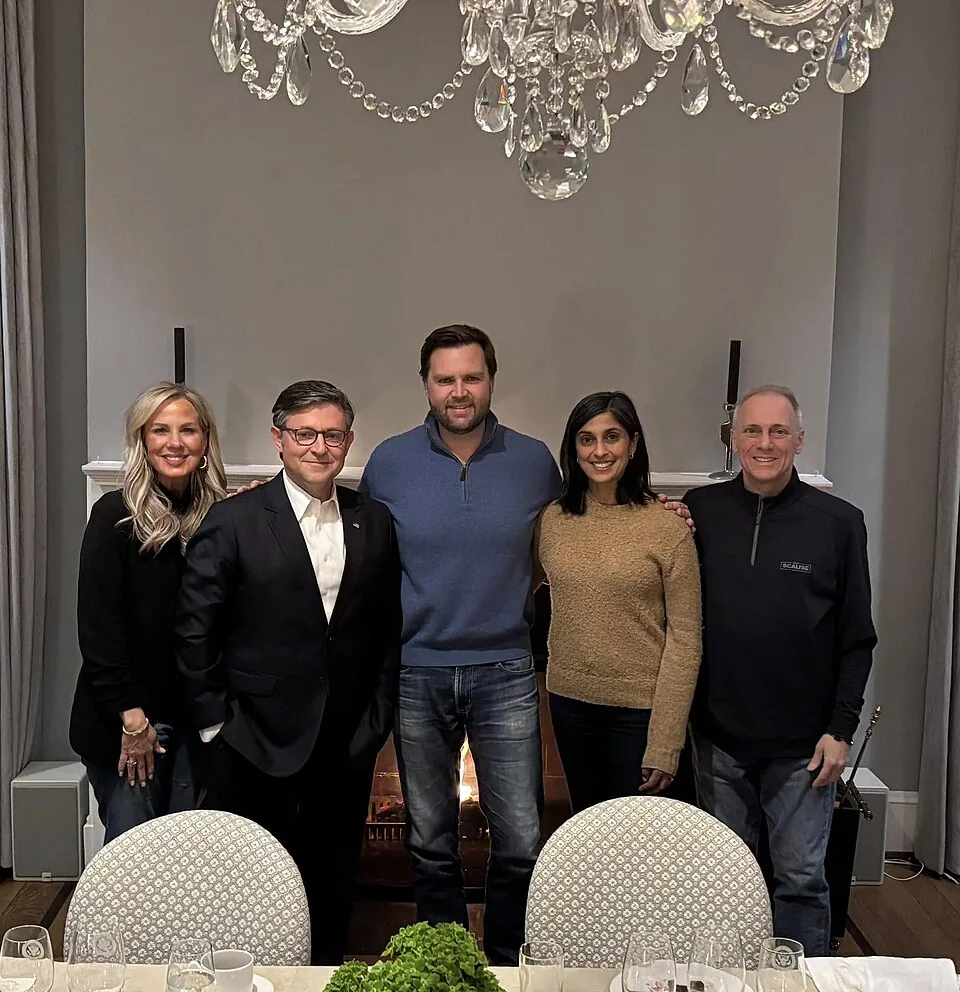
JD Vance is trying to save the Republican Party's midterm prospects by asking voters to give Trump "another chance" — without apologizing for anything, acknowledging any failure, or explaining why the next two years would look different from the last two. He also, in the same breath, told House Republicans to attack Democratic opponents as dangerously crazy, and then immediately admitted that some of those opponents are "not that crazy." This is the rescue mission.
The 'Give Us Another Chance' Speech Nobody Asked For
On September 15th, Vance rolled out what The Guardian's Sidney Blumenthal describes as an executive summary from a risk management consultant. The pitch: "There's a lot of good that's been done, but there's a lot of work left to do. Give us another chance, or give us another couple of years, to continue to work on the amazing things that we've been doing for the past two years."
Read that again. "Amazing things." Vance is running as the guy who will do more of the amazing things. No list of what those things are. No acknowledgment that a significant portion of the country is furious. No apology, no course correction, no indication that anyone in the administration has read a single approval poll. Just: more, please.
The Guardian notes that skipping the apology is a deliberate choice, letting Trump and Vance maintain the posture of unwavering strength. Which is a generous way of saying they've decided denial is their best electoral strategy. It is not a great sign when your midterm message is structurally identical to what your average toddler says after breaking something.
Senate Republicans Are Already Jumping Ship
Here's where it gets interesting. Vance's carefully calibrated message of strength and continuity is being detonated from inside his own party.
Mike Rogers in Michigan had previously dismissed concerns about fuel costs during the Iran War with a breezy "We're going to be fine, we got plenty of oil." Then, as The Guardian reports, Rogers reversed himself completely: "I think the best option now is to wind it down. The time is now." Senator Ashley Hinson in Iowa, who had voted repeatedly against invoking the War Powers Resolution, followed Rogers out the door, suddenly declaring that "the war needs to be brought to a successful and immediate end."
To be clear about what's happening here: these are not people who have seen the light. As Blumenthal points out, not one of them has offered a single reason why any Trump policy was wrong, damaging, or counterproductive. They just want out. They want the political off-ramp without the intellectual honesty of explaining why they're taking it.
Their proposed solution, an export ban on diesel, has already been dismissed by the Financial Times as something that "wouldn't be workable" and would ultimately lead to fuel price spikes. So the escape hatch they're running toward is also on fire. Great plan.
Vance's 'Not That Crazy' Gaffe Is a Gift
Now for the part that should be a campaign ad by sundown. Speaking to House Republicans, Vance tried to give his caucus a useful attack line. "And if you are one of the few Republicans who's running against a Democrat who's not that crazy, then just talk about Abdul El-Sayed," he said, according to The Guardian.
Let's unpack that. Vance's entire midterm pitch rests on the argument that Democrats are consumed by dangerous, irrational craziness. He literally told a crowd to "put them in the mental hospital." And then, in a private pep talk to House Republicans, he acknowledged that some Democrats are "not that crazy" and advised members to just invoke a different Democrat's name as a workaround.
This is not a strategy. This is a magic trick where the magician explains how the trick works while doing it. And it's worse still because El-Sayed, the Democrat Vance wants used as a boogeyman, is currently polling ahead of Rogers in Michigan. The guy Vance told Republicans to fearmonger about is beating one of their incumbents.
What the Republican Panic Actually Tells Voters
Blumenthal makes an argument in The Guardian that's worth sitting with. The fracturing of Senate Republicans does not just hurt those individual candidates. It validates every anxious voter who looked at the Trump status quo and thought: this feels risky.
Rogers and Hinson can't be dismissed as Democratic complainers. They're Republicans. They voted for these policies. And now they're running away from them without being able to say what went wrong. That's not a reassuring look. That's the behavior of people who know something is broken and are hoping you don't ask follow-up questions.
The Republican crack-up makes the Trump administration, not the Democratic opposition, look unpredictable and untrustworthy. Vance wanted this election to be a choice between steady competent Republicans and radical chaotic Democrats. His own party's panic attacks have made it a referendum on Republican governance instead. That is an unforced error of spectacular proportion.
The 2028 Math Underneath All of This
None of this is purely about the midterms. As The Guardian notes, Vance is simultaneously auditioning to be Trump's successor in 2028. Every speech he gives is a two-part message: hold the line now, and remember who held it when the time comes.
The problem is that the identity he's building in real time, the loyalist who calls failure "amazing" and asks for another chance without explaining why it will be different, is going to follow him. That's the bet he's making. That Republican primary voters will reward the performance of steadfastness even as the evidence of what they were steadfast about accumulates.
It has worked before in Republican politics. It might work again. But right now, in October 2026, Vance is not the commanding front-runner consolidating a party. He's a vice president telling candidates to lie about opponents being crazy while admitting they're not, watching Senate incumbents sprint away from the administration he's defending, and asking the American public to call the last two years amazing. The rescue mission is struggling to rescue itself.
The Dingo Take
Imagine if Barack Obama had told Democratic senators in 2010, privately, to call their Republican opponents dangerous extremists, and then added: "unless your Republican isn't actually that extreme, in which case just make something up about a different Republican." Every cable news network would have looped that clip for a week. It would have been Exhibit A in the case that the entire Democratic message was manufactured nonsense. JD Vance said exactly that about his own party's strategy, on the record, and is still somehow being treated as a disciplined political operator.
The Rogers and Hinson reversals are worth more attention than they're getting. These are not mavericks or moderates. These are senators who spent two years in total lockstep with the administration. The fact that they're now sprinting for the exit without being able to say a single critical word about what they're fleeing tells you everything. They know. They just can't say it out loud, because saying it out loud means admitting what they voted for.
Vance asked voters for "another chance" while refusing to say what the first chance produced that was worth preserving or what needs to change. That's not a pitch. That's a hostage negotiation where the hostage-taker forgot to bring demands. The American electorate has been asked to do a lot of heavy cognitive lifting over the past several years, but being told that abject failure is "amazing" and that criticism is craziness while watching Republican senators run screaming from their own record might finally be the lift that's too heavy.


Comments