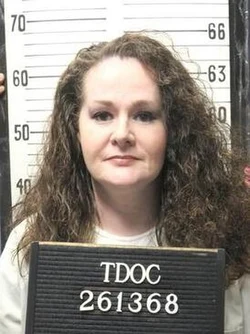
Tennessee tried to kill Christa Pike with two separate lethal injections last week. According to her lawyers, she is now conscious, speaking, and recovering in a Nashville hospital, where she is also handcuffed and shackled. The state has not said what went wrong, and it has not said whether it plans to try again.
Two Injections, Zero Executions
Let's start with the basics, because the basics are insane. Prison officials in Tennessee administered pentobarbital on Sept. 30 in an attempt to execute Pike for the 1995 murder of Colleen Slemmer, NBC News reports. When the first dose failed to kill her, they gave a second one. That failed too.
The BBC reports that Pike survived two lethal injections and was transferred to a hospital in Nashville. Her attorneys previously said she was placed on a ventilator while medical staff worked to clear the drug from her system.
This was supposed to be a historic moment for the state. Pike, 50, would have been the first woman executed in Tennessee in 200 years, according to NBC News. Instead it became a historic moment of a different kind.
Awake, Talking, and Still in Handcuffs
On Tuesday, Pike's lawyers, Randy Spivey and Kelly Gleason, released a statement saying she is "conscious and speaking," per the BBC. They described her recovery as "medically unprecedented" and said she is the only person known to have survived a completed execution attempt in the US.
Her prognosis is unclear. "At a minimum, we expect a long recovery," the attorneys said, according to NBC News. They also said she suffered significant injuries to her arms.
Now here's the detail that should make you put your coffee down. NBC News reports that despite those injuries, Pike remains handcuffed and shackled in her hospital bed. A woman who just survived the state's attempt to kill her, with serious arm injuries, is being kept in restraints. Her lawyers thanked the first responders and hospital staff for treating her "like a human." That they felt the need to say it tells you plenty.
What Went Wrong? Nobody's Saying
The BBC reports that authorities have not offered any explanation for what happened. Not a technical one, not a procedural one, not even a vague "we're looking into it" that doesn't commit to anything.
Pike's attorneys have a theory. NBC News reports they believe problems with the IV lines may have caused the pentobarbital to flow into her body instead of her bloodstream. That would mean the drug went somewhere it was never supposed to go, which would fit with the arm injuries her lawyers describe.
That is their account, not an official finding. The state has not confirmed or denied it. What we know for certain is that two doses of the drug Tennessee chose for this job did not do the job.
The Governor Hits Pause and a Top Official Hits the Door
Gov. Bill Lee suspended all executions in Tennessee for the rest of the year, the BBC reports. He also ordered an independent review of the botched attempt, according to NBC News.
Then came the resignation. On Saturday, Lee announced that Frank Strada, the state's top prison official, was stepping down. In a statement, Strada said he believed the Department of Correction had carried out its responsibilities "in accordance with the established protocol." But stepping aside, he said, was in the "best interest of Tennesseans as the independent review moves forward."
Read that again. The man in charge says everything was done by the book and he is leaving anyway. Either the book is the problem, or the book is a work of fiction. Neither is great when the subject is killing human beings.
The Crime at the Center of It All
None of this erases what Pike did, and we're not going to pretend otherwise. According to the BBC, Pike was 18 when she and her then-boyfriend, Tadaryl Shipp, beat, tortured and killed 19-year-old Colleen Slemmer. The three had met at a job training camp for troubled teens.
Slemmer's murder was brutal, and a jury sentenced Pike to death for it. People can hold two thoughts at once here. She was convicted of a horrific killing, and the state's attempt to carry out the sentence went catastrophically wrong.
The attorneys say they will speak at a news conference Wednesday. The BBC reports that authorities have not yet said whether they will try to execute Pike again. Think about the machinery behind that question. A state is weighing whether to take a second run at a woman who just survived its first two.
The Dingo Take Is Coming, But First: Prayers From Around the World
Pike's attorneys said thousands of people from all over the world sent messages offering prayers and support, per NBC News. That is a striking thing for a woman convicted of a torture murder, and it says something about how the botched attempt landed with people far beyond Tennessee.
Whatever anyone thinks of the death penalty, a state failing to carry out its own execution twice in a row tends to focus the mind. The question stops being abstract. It becomes a question about competence, about restraint, and about what exactly a government is willing to do in the name of its citizens.
The Dingo Take
In 1946, Louisiana put Willie Francis in the electric chair and the chair didn't work. He survived, and the state argued it could simply try again. The Supreme Court agreed, and Francis was executed a year later. Eighty years on, Tennessee is staring at the same ugly question with a pharmacy cabinet instead of a generator.
The lesson of that case isn't that machines fail. It's that the state's appetite for finishing the job survived the failure, and the courts waved it through. Gov. Lee has paused executions through year's end, which is the bare minimum. A pause is not an answer. Tennessee owes the public a plain account of what went wrong with those IV lines, who signed off on the protocol, and why a woman with injured arms is lying shackled in a hospital bed.
If the state's answer to "it didn't work twice" is "let's go for a third," then we are not talking about justice anymore. We are talking about a government that cannot admit it broke something. And a government that can't admit it broke something probably shouldn't be trusted with a procedure that has no undo button.



Comments