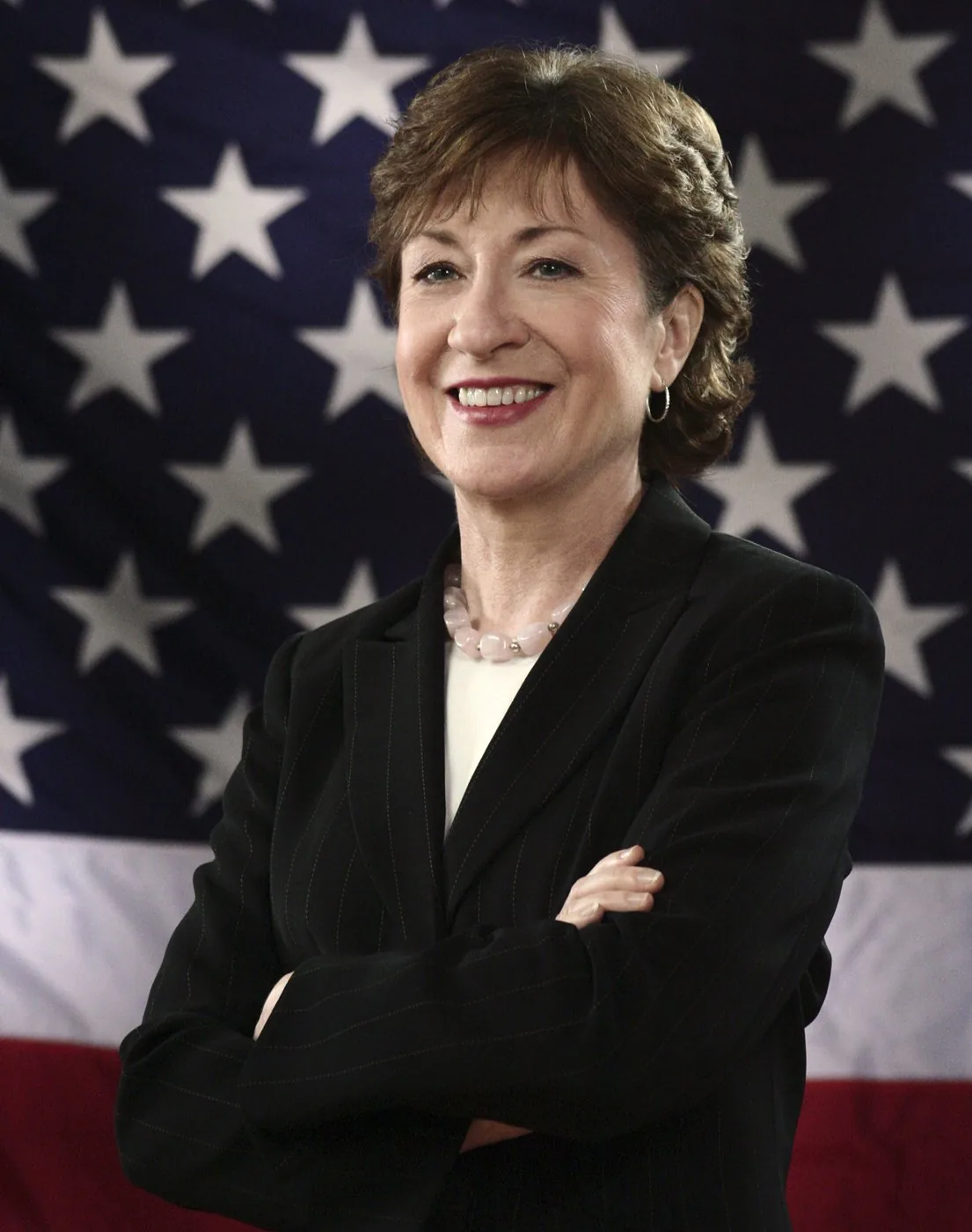
Susan Collins, the Republican senator from a state Donald Trump lost, was asked twice on live television whether she would stand with the president if he visited Maine. She answered neither time. Her best offer was that she's "not exactly his favorite senator," which is the political equivalent of telling your landlord you're not exactly his favorite tenant while hoping he renews the lease.
Twenty Trumps in Sixty Minutes
NBC News reports that Democratic challenger Troy Jackson said Trump's name at least 20 times during the one-hour debate on WGME-TV on Tuesday. That's one every three minutes. Jackson wasn't running against a senator so much as running against the man whose party she caucuses with, and he made no effort to hide it.
"It matters who you stand with," Jackson said in his opening statement. "I don't owe Donald Trump and the billionaires anything. I don't fight for billionaires like she does."
The strategy is not subtle, and it's not meant to be. Maine is one of the most closely watched Senate races in the country, and Democrats need it to get to a Senate majority. Trump's unpopularity is the whole engine of their pitch.
The 96 Percent Problem
Jackson leaned hard on a number: he repeatedly said Collins votes in alignment with Trump 96 percent of the time. Collins responded by questioning the methodology of the study he cited.
Notice what she did there. She didn't say the number was wrong. She said the study was flawed. That's the move of someone who knows the real figure is not going to make her look like an independent thinker, so the best available option is to argue about the ruler instead of the measurement.
Collins did point to multiple instances where she opposed the Trump administration. That's her whole brand, and it has carried her through five terms. Whether it carries her through a sixth is the question that has both parties spending tens of millions of dollars.
The Question She Wouldn't Answer
Here's the moment that will end up in the ads. Collins reportedly dodged two separate questions about whether she would stand with Trump if he visited Maine, which he has recently teased. She said only that she doesn't expect him to come and that she's "not exactly his favorite senator."
Jackson grinned. Of course he did. He had just watched a sitting U.S. senator treat a hypothetical photo op with her own party's president like a request to donate a kidney.
The backdrop makes it funnier. Trump has reportedly called Collins "not my favorite person," but he endorsed her for re-election anyway. Vice President JD Vance has traveled to Maine to back her at events. So the party is all in on her, she is all out on the party, and everybody is pretending that arrangement is normal.
Seniority, Earmarks, and 672 Projects
Collins' counter-pitch was local and practical. As chair of the powerful Senate Appropriations Committee, she says she has brought $1.5 billion in federal funds to Maine for 672 projects over the last five years, "from Madawaska to Kittery, from Eastport to Rumford," as she put it. (A transcript spells the first town "Madawaksa," which is presumably a typo, but we're going with the geography.)
"I've been able to bring home federal dollars to help ease the burden on our taxpayers," Collins said.
It's a real argument. Appropriations chairs matter, and Maine voters know it. It's also an argument that depends entirely on Republicans holding the majority, which depends on Republicans winning seats like hers, which depends on her being a Republican. The pitch is that she can bring home the bacon, and the fine print is that the butcher is Trump's party.
Kavanaugh, Roe, and a Very Specific Brag
Jackson also went after Collins' pivotal 2018 vote to confirm Brett Kavanaugh, who was part of the majority that overturned Roe v. Wade and ended the federal right to abortion. Tuesday's debate fell on the anniversary of that confirmation vote in the Senate. Nobody on that stage needed a calendar reminder.
Collins said she judges all nominees by their qualifications and noted she also backed justices who voted to uphold Roe. "In fact, I am the only Republican senator to have voted for Justice Sotomayor, Kagan and Jackson, who were nominated by a Democratic senator," she said.
Then she swung back. Referring to Jackson's more conservative stance on abortion earlier in his career, Collins quipped, "There's only one of us on this stage who has always been pro-choice, and that's me." Jackson didn't engage in the moment, though he noted in his closing statement that he pushed for progressive abortion policies in the Legislature.
A Dead-Heat Race in a Blue-Leaning State
Polls show a neck-and-neck race, often within the margin of error, as Collins tries to defy gravity again and win a sixth term. She is the only GOP senator representing a state Trump lost in 2024.
That last fact is the whole story in one sentence. Every other Republican in the Senate sits in a state that went for the president. Collins sits in the one that didn't, and she needs the voters who rejected him to keep believing she's something other than a vote for him. A Collins win would constrict the Democrats' path to the majority. A loss would be the end of one of the longest-running acts in Washington.
The Dingo Take
Collins says she's not exactly Trump's favorite senator, and Trump says she's not his favorite person, and yet the president endorsed her and the vice president is out campaigning for her. Everyone involved knows the endorsement is a transaction and the distance is theater. The facts on the stage Tuesday were a 96 percent alignment number she couldn't refute, only quibble with, and a Kavanaugh vote she can't take back no matter how many Sotomayor votes she stacks on top of it.
The dodge was the confession. If Collins truly believed her independence was a selling point, she would have said "No, I wouldn't stand with him, and here's why" and watched Jackson's grin evaporate. Instead she said she doesn't expect him to come. That's not a position. That's hoping the weather holds.
Maine voters get to decide whether bringing home 672 projects is worth giving the majority to a party that treats her as an inconvenient necessity. Jackson's bet is that they won't. Collins' bet is that they've always given her the benefit of the doubt before. Both of them are spending a fortune to find out which one is right.




Comments