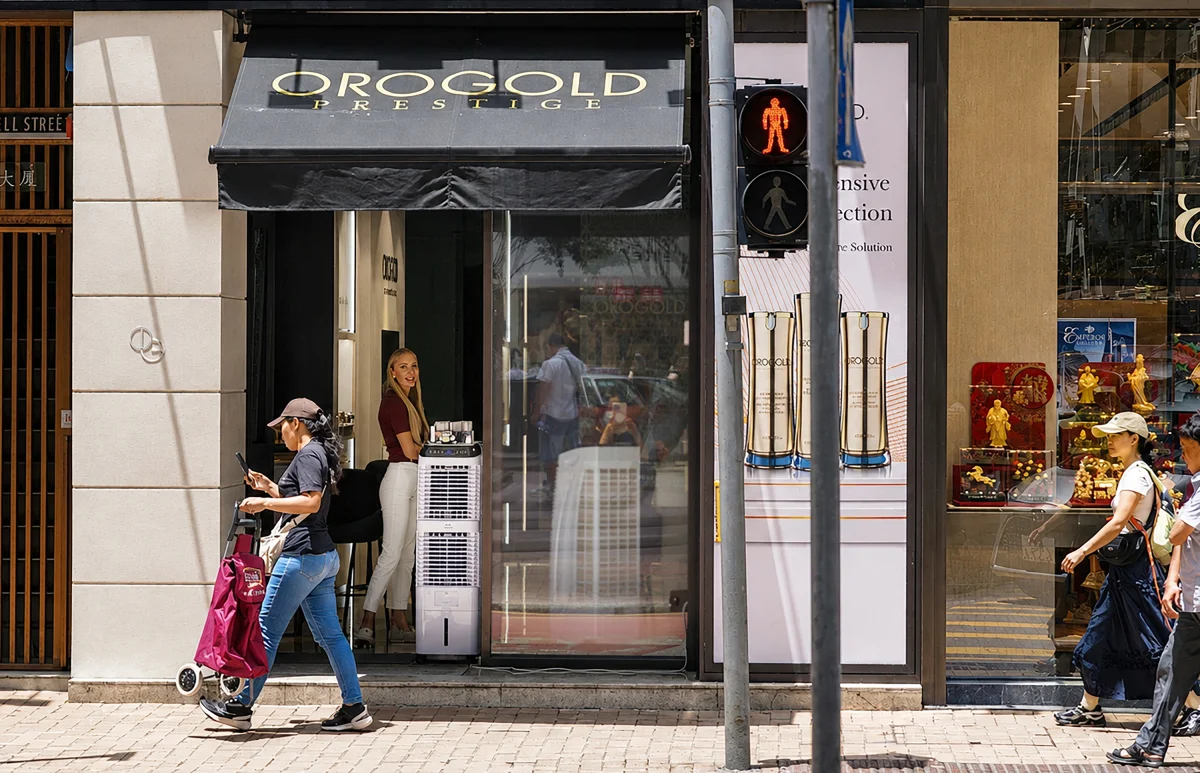
A man with dementia in Michigan got charged $42,000 for skincare products and devices, and his family only found out when his credit score cratered. That is not a freak accident at the mall. According to an NPR investigation, it is the business model.
The Free Sample Is the Bait, and You Are the Fish
You know the guy. Friendly. Young. Standing outside a mall kiosk holding a little pot of cream and complimenting your handbag like he's known you for years. Most of us keep walking. Some of us stop. NPR spent a year talking to more than 50 people who stopped, and the ending of their stories is not a free sample.
The investigation, led by Caley Fox Shannon and Monika Evstatieva, draws on state and federal lawsuits, hundreds of online reviews, and nearly 500 consumer complaints obtained through Freedom of Information Act requests. NPR staff also visited stores in Virginia, Maryland, and California, plus the company's headquarters in Chatsworth, California.
The common thread is Mazal Group, a California company that manages dozens of skincare brands sold in thousands of stores worldwide. Every one of those brands is owned by one family. The stores in these stories all have contracts to buy products from the group.
Walkers Confiscated, Zeros Added
Let's go through the cases, because the details are the whole point. In New Mexico, a woman alleges in a lawsuit that a spa employee sold her a $30,000 red-light therapy device. She says he also charged her $78,000 for what he called sales tax, without her consent. That is $78,000 in tax on a $30,000 purchase. Math is hard, apparently, unless you are the one holding the card reader.
In Hawaii, a disabled woman went to the back room of a spa for a "free" facial. She wrote in a complaint to the state that the salesperson took her walker and wouldn't let her leave for hours until she spent $2,600. Read that again. They took her walker.
One shopper told authorities the salesperson added a zero at checkout, turning $1,300 into $13,000. Others said employees claimed their card had declined when it hadn't, then charged a second card on top. These are not misunderstandings. These are techniques.
The Playbook Is Eerily Consistent
Across hundreds of complaints filed with state attorneys general, the FTC, the Consumer Financial Protection Bureau, and the Better Business Bureau, customers describe the same script. A young salesperson offers free samples outside the store. If you stop, they escort you inside. In some accounts, they physically pull you in.
Then comes the hour-plus pitch, sometimes in a back room, with salespeople who refuse to take no for an answer. The products carry no price tags, which lets the salesperson invent "special sales" and throw in "free gifts" to close the deal on a cream, a facial, or a red-light device.
At checkout, shoppers say they were told to sign a tablet without being told it was a final-sale policy that could be used against them in credit card disputes. Some were signed up for a "payment plan" that was really a high-interest loan. Some were told to authorize charges their own bank had flagged as potentially fraudulent. The whole thing is engineered so that every exit is already blocked before you realize you're in a room.
Visa Fraud, Guilty Pleas, and a Decade of Silence
This is not just a consumer protection problem. Federal agencies have investigated individual operators for employing young Israelis on tourist visas to sell these products. That produced more than a dozen guilty pleas for visa fraud and money-laundering schemes. A decade ago, federal agents called the business model a "credit card overcharge scheme."
It is still running in malls and shopping districts from Honolulu to Annapolis. NPR reviewed social media posts and messages suggesting some stores connected to Mazal Group still employ salespeople on tourist visas. The government hasn't brought similar charges in ten years. And Israel's admission to the U.S. Visa Waiver Program in 2023 removed a key barrier to entry for unauthorized workers.
So the enforcement stopped, the barrier fell, and the kiosks kept multiplying. Funny how that works.
The Family Says It's the Franchisees' Fault
Mazal Group and the family behind it have publicly shifted responsibility onto individual store owners. Bad apples, in other words, in a barrel they sell to thousands of stores.
But NPR obtained documents showing the brands suggest stores sell products at abnormally high markups, while adhering to a strict refund policy set by the group. You cannot set the markup guidance and the refund rules and then act shocked about what happens at the register.
There's one more wrinkle. A lab test commissioned by NPR raises questions about whether some of the products contain the ingredients their labels promise. So the $13,000 cream may not even be what it says it is. At that point you're not being overcharged. You're being robbed in a nice font.
The Dingo Take
$78,000 in "sales tax" on a $30,000 device. That is the number to sit with, because nobody mistakes that at a register. It's the kind of figure that only exists when the person behind the counter has stopped pretending the customer is a customer and started treating them as an account to be drained.
Now look at who gets drained. A man with dementia. A woman with a walker. Older adults and people with disabilities, the shoppers least able to push back and most likely to be ignored when they report it. The system works exactly as designed, and it has been working for a decade while the feds who once used the phrase "credit card overcharge scheme" apparently found other things to do.
The family at the top says it's just the store owners. Sure. And the casino says it's just the slot machines. If you set the markups, write the refund policy, and collect the checks, you don't get to be a bystander. Somebody with subpoena power should stop by Chatsworth and ask some questions, preferably before the next grandfather gets his credit score wrecked by a free sample.



Comments