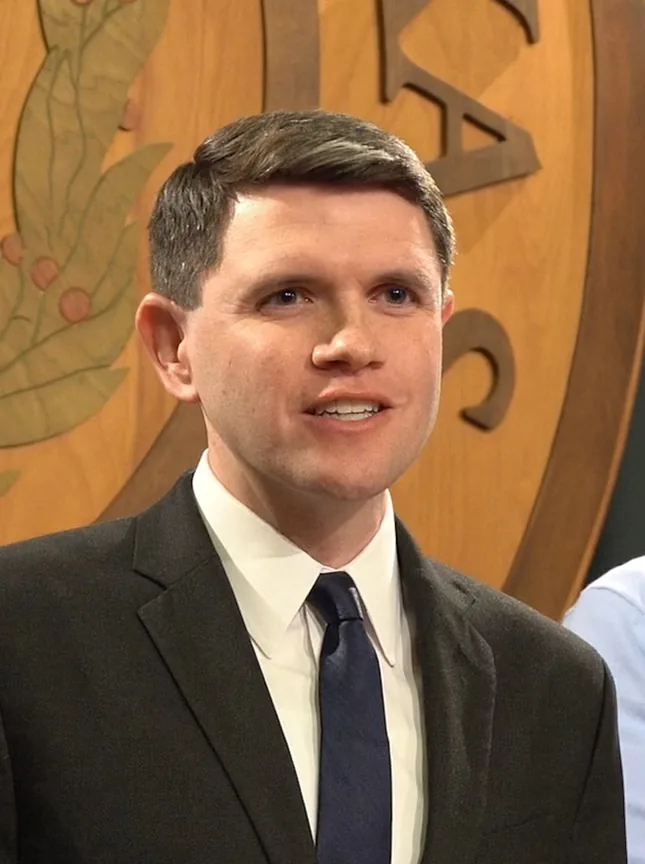
When a sitting Republican senator hears a number and responds with "Oh my god, holy crap," you can safely assume the number is not good for his party. The number was $64 million, the amount Texas Democratic Senate nominee James Talarico hauled in during the third quarter alone, compared to Ken Paxton's $18 million.
The Reaction Says Everything
Sen. Bernie Moreno of Ohio was informed of Talarico's total and delivered what may be the most honest sentence a Republican has uttered this cycle. "That's a number that's mind-blowing," he told Axios, which broke down the fundraising data using FEC filings.
Republican senators are not usually in the business of praising Democratic fundraising. They are in the business of calling it dark money from coastal elites, right up until the moment the money is landing in Texas at a pace that makes the incumbent party's candidate look like he's running a bake sale.
Sixty-four million dollars in three months. In Texas. Where Democrats have been told for roughly thirty years that the state is a mirage, a rumor, a fairy tale told by consultants who need billable hours.
Hard Dollars Versus Hose Money
Here's the distinction that matters. Republicans are drowning in super PAC cash, which is the kind of money that comes from a small number of very rich people writing very large checks. Democrats, meanwhile, are winning on hard dollars, the money candidates raise directly from donors under strict contribution limits.
That difference is not a technicality. A super PAC check tells you a billionaire has an opinion. A flood of small and mid-sized donations tells you a lot of regular people care enough to open their wallets in a year when everything costs too much.
Axios framed it as a yawning enthusiasm gap, the kind of energy money can't buy. That's the point. Super PACs can buy ads. They cannot buy people who are excited to vote.
Paxton's $18 Million Problem
Ken Paxton raised $18 million in the same quarter. Eighteen million dollars is a lot of money for you or me. For a Senate race in the second-largest state in America, against an opponent pulling in more than three and a half times that, it's a rounding error with a podium.
Paxton is a man who has spent years as the state's attorney general, a job that comes with a built-in platform, a loyal base, and the kind of name recognition most candidates would sell a kidney for. And he still got lapped by a state legislator and seminarian who most of the country had barely heard of a year ago.
Maybe the GOP's super PAC money will close that gap. Maybe it'll buy enough television to drown out the fundraising story. But you don't get to a $46 million deficit by accident, and no amount of outside spending makes a candidate more exciting than he is.
Money Is Momentum, Until It Isn't
Let's not get carried away. Fundraising advantages do not automatically translate into wins, and Democrats have a long, painful history of raising absurd amounts of money and then losing anyway. Ask anyone who remembers a certain Kentucky Senate race, or a certain Florida gubernatorial contest, or really any election night where the cash was great and the results were a funeral.
Texas has been the white whale for years. Democrats keep chasing it, the map keeps humbling them, and the party's donors keep pouring in money anyway. This time the numbers are different enough that a Republican senator is saying "holy crap" out loud on the record.
That doesn't win a race. But it does mean the Republican Party is now defending turf it assumed was permanently theirs, and every dollar spent shoring up Texas is a dollar not spent elsewhere.
What the Cash Gap Actually Buys
A giant war chest means more than ads. It means field offices in places Democrats usually write off, organizers on payroll in counties that have not seen a Democratic canvasser since the Bush administration, and the ability to run a real operation instead of a symbolic one.
It also changes the story. Candidates who raise this kind of money get coverage, get attention, and get the kind of free media that turns a long shot into a conversation. Talarico's haul is now the headline in a state where the national press usually shows up only to write the obituary for Democratic hopes.
The flip side is pressure. Raise $64 million and you are no longer an underdog darling. You are a frontrunner-adjacent target with the entire Republican machine pointed at your head.
The Dingo Take
Imagine the situation reversed. A Democratic Senate candidate in a deep-red state raises $18 million while the Republican nominee pulls in $64 million, and a Democratic senator reacts with "oh my god, holy crap." The headlines would read like a eulogy for the party's entire strategy, every cable panel would diagnose a crisis of messaging, and a dozen consultants would suddenly discover they'd been warning about this for years.
When it happens to Republicans, you get a quote in a news story and a shrug from the super PAC set, because the fallback is always the same: we have the billionaires, we'll be fine. Maybe they will. Money from a few giant donors can paper over a lot of enthusiasm problems, right up until the people who were supposed to be excited just stay home.
Here's what should worry Republicans. You can buy the airwaves. You can't buy the part where regular people hand over their money because they actually want you to win. That's what $64 million in one quarter looks like, and Bernie Moreno knows it, which is why he said what he said before anyone could tell him not to.




Comments