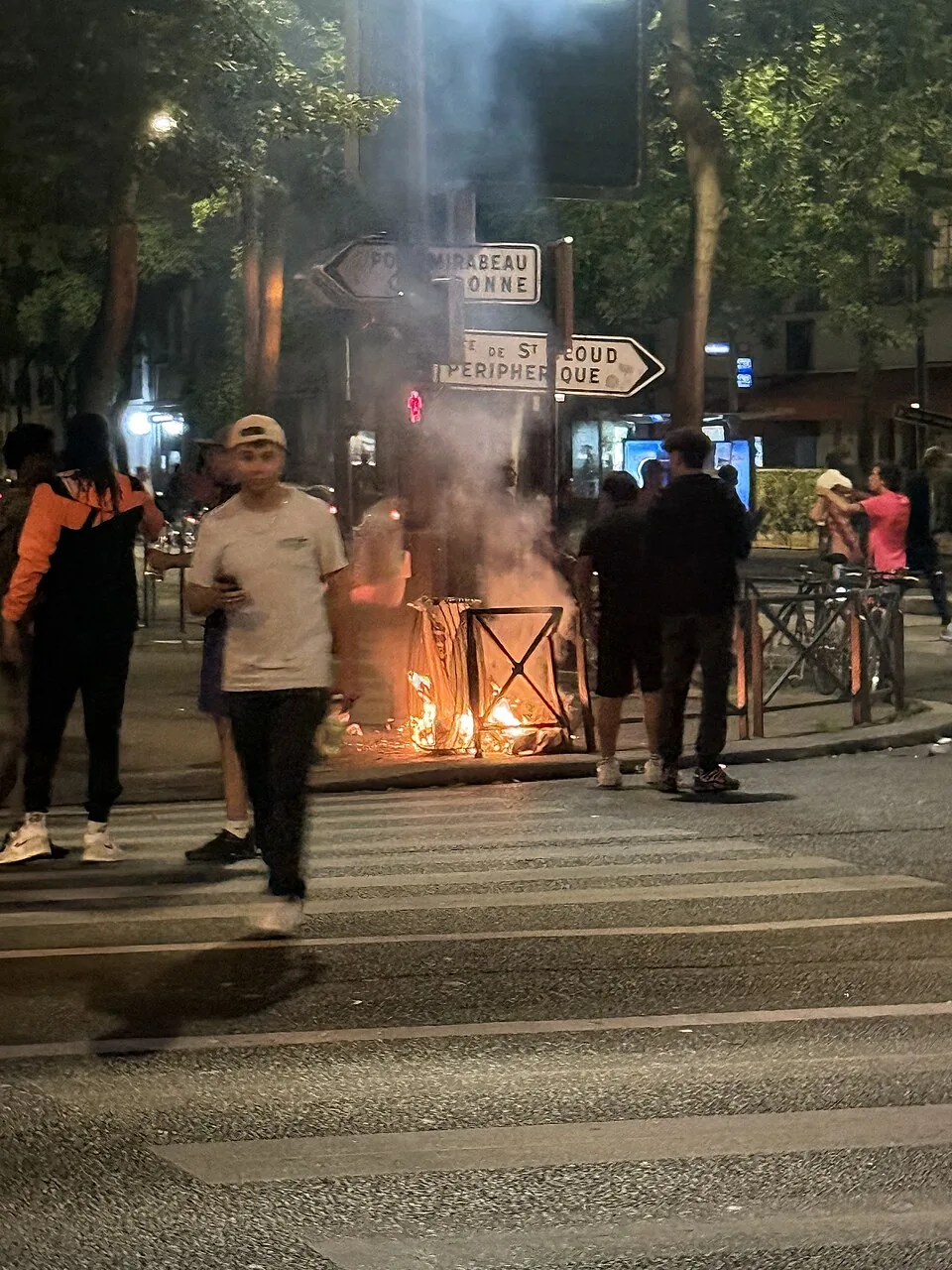
A car and a newspaper kiosk burned in Paris on Saturday while police fired tear gas and water cannons at masked groups throwing fireworks. It was the nationwide boil-over of a student revolt that started with school blockades in mid-September and has now swallowed the whole country's anger about the price of gas, energy, and groceries.
From Blockades to Bonfires
Here's the basic arc. High school students began blockading their schools in mid-September to protest the lack of resources in their classrooms. Weeks later, adult France showed up to the party, angry about a cost of living that has spiked in recent months across gasoline, energy, and food.
According to NPR, citing the Associated Press, the Interior Ministry counted at least 272 arrests nationwide on Saturday alone. That is just one day. In the preceding weeks, the country has racked up thousands of arrests, hundreds of injuries, and schools set on fire.
Schools. On fire. That is not a metaphor about the education system. That is the literal state of the new school year in the sixth-largest economy on Earth.
Paris Sets Fire to a Saturday
In the Place de la République, riot police faced off with people in hoods and masks hurling fireworks and other objects. The police answered with tear gas and water cannons. A car burned. A newspaper kiosk burned. The Interior Minister's office described "a growing number of violent incidents," including assaults on officers, looting or attempted looting of shops, and damage to public buildings.
Meanwhile, the peaceful majority marched toward northwestern Paris singing the national anthem, waving flags, and playing trumpets and violins. Yes, violins. France has managed to stage both a riot and a chamber recital within the same square mile on the same afternoon.
Many metro stations were closed at police request, including those near the Champs-Élysées, the presidential palace, parliament, and government offices. When you shut down the subway around the seat of government, you are telling everyone exactly how worried you are.
Lyon, Marseille, and the Rest of the Map
This was not a Paris problem. In Lyon, where about 20,000 people marched, fire broke out inside a tourist office, with smoke and flames visible from the street. Nothing says "we love our country" like torching the building that tells visitors where to find the good bakery.
In Marseille, shops and a municipal police station were damaged, and protesters briefly pushed their way into the lobby of City Hall. Mayor Benoît Payan called it "unacceptable" but described the damage inside as "limited," which is the kind of phrase a mayor reaches for when a crowd has just been in his lobby.
The Interior Minister's office also reported violence by masked groups in Rennes, Toulouse, Montpellier, and Grenoble. That is a long list of cities for a movement that began with teenagers sitting in front of school doors.
The Yellow Vests Get the Band Back Together
Protesters answered social media calls to revive the "yellow vest" movement, which emerged in 2018 against social injustice. If you remember how that one went, you know why the government is not enjoying this.
The CGT, one of France's major labor unions, backed the protests too, demanding "higher wages and pensions, lower prices and the protection of public services that meet people's needs." Read that again. It is not an exotic ideological program. It is a grocery list.
Student groups have urged supporters to join them, and the supporters showed up. Greta Thunberg even visited a high school in Saint-Denis on Tuesday, which tells you the story has gone global. Presidential campaign season is also underway, and the unrest is now shaping it.
A 15-Year-Old Lost a Hand
Now for the part that should stop everyone cold. Gruesome wounds suffered by teenage protesters have been blamed on police riot-control weapons. Interior Minister Laurent Nuñez suspended the use of one type of police stun grenade against young demonstrators after a 15-year-old lost a hand.
A fifteen-year-old. A hand. The suspension came only after a child was maimed, which is the usual order of operations when a government decides a weapon is too dangerous to point at kids.
None of this excuses the arsonists or the looters. Burning a tourist office helps no one afford a tank of gas. But a state that responds to student blockades with weapons that take a teenager's hand has lost the right to lecture anyone about proportionality.
The Dingo Take
France is having a rough autumn. Schools are burning, a teenager has lost a hand to a police weapon, and the Interior Ministry is tallying arrests by the hundreds. Other than that, the government says things are fine.
What gets lost in the footage of burning cars is how small the original ask was. Students wanted more resources in their schools. Their parents want groceries and gas they can afford. These are not revolutionary demands. They are the minimum a functioning country is supposed to deliver, and when a government fails at the minimum for long enough, it eventually discovers that people will deliver their own reminder in the form of a bonfire.
The violence deserves condemnation, and the peaceful majority marching with trumpets and violins deserves better than to be defined by the masked minority. But the lesson for every politician watching, here and abroad, is not hard to read. When prices spike and public services wither, you can ignore the people for a while. You cannot ignore them forever, and the bill for waiting always comes due in a public square.




Comments