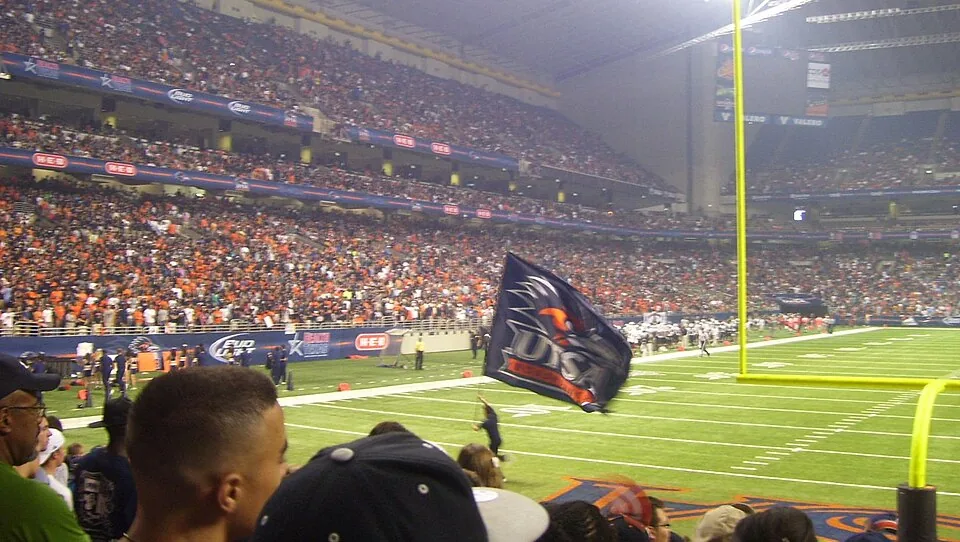
A 15-year Air Force veteran fell to the turf of the Alamodome in front of more than 23,000 people on Saturday night, and then a college football game was played. Tech. Sgt. Ian Patterson died at a local hospital after what was supposed to be a rappelling demonstration to open UTSA's annual Salute to Armed Forces and Veterans game.
What Happened Before Kickoff
Patterson was one of four service members scheduled to rappel from the stadium ceiling during the pregame ceremony ahead of UTSA's matchup with Navy, according to CBS News. A video posted on social media shows him in combat fatigues descending quickly, feet first. Then he falls. He landed near the middle of the field, a KENS photographer said, with fans in the stands and a band assembled nearby.
He was treated on the field for several minutes and carried off on a gurney. He later died at a local hospital.
The incident is under investigation. No cause has been publicly identified, and nobody should pretend to know one yet. A rope, a harness, an anchor point, a procedure, a person: any of those could be the answer, and the people qualified to figure it out are the ones doing the investigating.
Who Ian Patterson Was
Patterson was a Tactical Air Control Party instructor assigned to the 6th Combat Training Squadron, Detachment 2, at Joint Base San Antonio. Nellis Air Force Base Public Affairs said he was originally from Fort Stewart, Georgia, and had served 15 years in the Air Force.
TACP airmen are the specialists who embed with Army and Marine units and help direct air and artillery strikes from forward ground positions. Part of their training involves learning to drop rapidly by rope, sometimes from helicopters 100 feet or more off the ground.
So this was not a novice doing a stunt. This was an instructor in a skill set that is a core piece of his job. Which is exactly why the questions are going to be hard ones.
The Statements, All of Them
Brig. Gen. Scott C. Mills, the 57th Wing commander, said the tragedy is "felt deeply across the 57th Wing" and that Patterson "mattered immensely" to his wing, family, friends and teammates. The wing is now focused on standing beside Patterson's family and fellow airmen.
UTSA president Taylor Eighmy said a day meant for "camaraderie, tradition and celebration" had been "marked by profound sadness." Lisa Campos, the vice president for intercollegiate athletics, said moments like this "remind us that we are all part of something much greater than a game."
The university is also activating wellbeing services for faculty, staff and students who may be affected. That is a sensible thing to do after more than 23,000 people watched a man fall.
The Game Went On
Here's the part that will keep people arguing. The game was played. UTSA beat Navy 38-34.
The American Conference said in a Sunday night statement that the decision to play was made before Patterson's death had been confirmed. It cited conference bylaws, the support of both schools, respect for the family's privacy, and the military's notification process. The stated logic: continuing the game would "mitigate speculation about the service member's medical status and avoid additional distress for his family."
That is an actual argument, and it is not a stupid one. Nobody wants a stadium announcer informing 23,000 people that a man is dead before his family has been told. At the time of the decision, the conference says, nobody knew whether he would survive. But you can accept every word of that and still understand why a lot of people watched a football game kick off after a man hit the field and found it deeply strange.
A Crowd That Felt It
UTSA coach Jeff Traylor called the accident "heartbreaking" and "tragic." He said his team could see how the crowd had been affected as soon as players took the field. Traylor said he had only been told there had been an "incident" that would push the start back about 10 minutes.
"You could tell the energy was just gone," he said. "It just really puts things in perspective. It really does."
That detail is the whole story in miniature. The players knew something terrible had happened and not how terrible. The fans knew exactly what they had seen. And a game with a final score of 38-34 got played in the space between those two kinds of knowing.
The Dingo Take
Ten minutes. That is how long the delay was before kickoff, according to the coach, who had been told only that there was an "incident." A man had been carried off the field on a gurney, and the schedule absorbed it like a rain shower.
We are not going to pretend the conference acted out of malice. Its explanation, that the decision was made before anyone knew whether Patterson would live, and that the military's notification process needed to run its course, holds together on its own terms. Tragedy does not come with a clean decision tree. But a decision that is defensible in the moment can still be worth asking hard questions about afterward, and "bylaws" is not a satisfying answer to why a stadium full of people was asked to cheer.
The bigger question belongs to the investigators. Tech. Sgt. Patterson was a 15-year veteran who taught this skill for a living, and he died during a pregame show whose purpose was to honor people like him. The military ceremony as entertainment spectacle is a fixture of American sports, and nobody should be asked to risk their life for a halftime visual. Find out what failed. Say it publicly. And then think very hard about whether a rope demonstration over a football field is worth it at all.



Comments