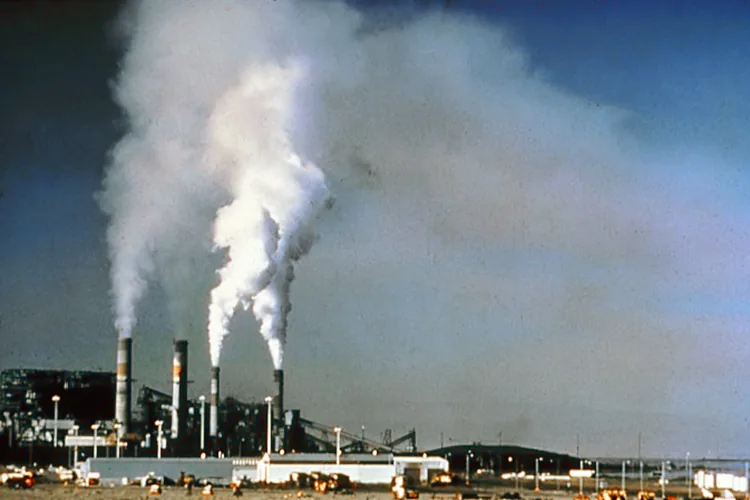
The world's emissions held flat last year. The United States, in a feat of bold national individualism, decided to go the other way. A new United Nations report, covered by NPR, finds the U.S. was the only major economy where planet-warming pollution rose dramatically, and the cause has a name, a policy agenda, and a very specific fondness for coal.
Congratulations, You Beat Russia
Here's the leaderboard nobody wanted to top. The U.N. report finds the U.S. tied with Russia for the highest per capita emissions of carbon dioxide and other planet-warming gases among G20 countries. Let that sink in. We are tied with a petrostate that is currently busy bombing a neighbor.
China still emits more in total, which the report acknowledges. But China has more than four times our population. Per person, the average American is out-polluting the people running the world's biggest coal habit. That's not a rounding error. That's a lifestyle.
And while global emissions were basically unchanged from the year before, ours climbed. When the whole class is holding steady and one kid is lighting his desk on fire, you don't need a statistician to tell you who the problem is.
The Burn Was Not an Accident
The report ties the increase to two things: rising electricity demand and Trump administration policies that actively prop up fossil fuels. The second part is the one with fingerprints on it.
The administration ordered coal-fired power plants to stay open longer than planned. It rolled back fuel-efficiency standards for vehicles. It ended tax credits for solar and wind projects. Read that list again. Keep the dirty stuff running, make cars guzzle more, and kneecap the clean stuff. If you were designing a policy package to raise emissions on purpose, you'd have trouble improving on it.
Inger Andersen, the executive director of the U.N. Environment Programme, said those policies make the U.S. an outlier on escalating greenhouse gas emissions. Outlier is the polite diplomatic word. The impolite one is arsonist.
Everyone Else Found a Way to Cut
Andersen acknowledged that everybody is scrambling a little over energy security, pointing to the oil and gas disruptions from the wars in Ukraine and Iran. Fair. It's a rough moment to keep the lights on and the bills low.
But she also noted that several G20 members have shown sustained emissions reductions despite the chaos. The European Union is the prime example. It poured money into energy-efficient appliances and wind and solar, partly in reaction to Russia's invasion of Ukraine. Europe looked at a energy emergency and decided to build its way out. We looked at the same emergency and decided to dig deeper.
So the excuse doesn't hold. The crisis is global. The response is a choice. Other countries made a different one.
Denial With a Government Seal
The administration has pulled out of the 2015 Paris Climate Agreement and is working to remove the U.S. from all U.N. climate work, arguing the international system imposes unfair burdens on Americans. The EPA now says greenhouse gases do not pose a threat to human health and welfare. That reverses the agency's previous position, which was, you know, science.
When the U.N. report came out, it included a statement from the U.S. government saying it does not endorse or agree with the analysis or conclusions, and has not provided comments to this report. Not provided comments. They didn't even show up to argue. The State Department also ignored NPR's questions.
Next month, world leaders gather in Turkey to work out how to speed up clean energy investment and who pays for climate damage. The Trump administration will not be in the room. Our seat will be empty, which is at least a more honest representation of our commitment.
The Math Is Getting Ugly
The planet is already about 2.7 degrees Fahrenheit warmer than it was in the mid-1800s, according to the World Meteorological Organization. That's the engine behind deadly heat waves, floods, bigger storms, and wildfires. And the report says we're on track for upwards of 5 degrees Fahrenheit of warming this century, which means massive sea level rise and the mass extinction of plants and animals.
For the first time, this annual report concedes that even the lower warming targets are now out of reach. That's a grim milestone. Keeping warming below 3.6 degrees Fahrenheit is still possible, but it requires global emissions to fall about 25% in the next decade.
Current national plans, if every country follows through, get us about 15%. And that assumes everyone shows up with a plan. About two thirds of countries have submitted up-to-date ones. The rest, including the country now running its coal plants past their expiration date, are not helping the math.
The Dingo Take
Imagine China, the country we love to lecture about pollution, ordered its aging coal plants to stay open, scrapped its vehicle efficiency rules, killed its solar and wind incentives, and then declared that carbon dioxide poses no threat to human health. The op-eds would write themselves. Cable news would run a countdown clock. Congress would hold a hearing with a very serious chart.
When we do it, the response is a shrug and a State Department that won't return a phone call. That's the double standard. We demand accountability from everyone else's emissions while our own government treats the thermometer like a political enemy.
Here's the thing. The U.N. isn't guessing. The numbers are in, the cause is on the record, and the planet doesn't care whether the EPA believes in it. We are the only major economy moving backward, and we got there on purpose, with executive orders and a lot of confidence. Every fraction of a degree matters, as Guterres put it. Someone should tell the administration that physics doesn't take the fifth.





Comments