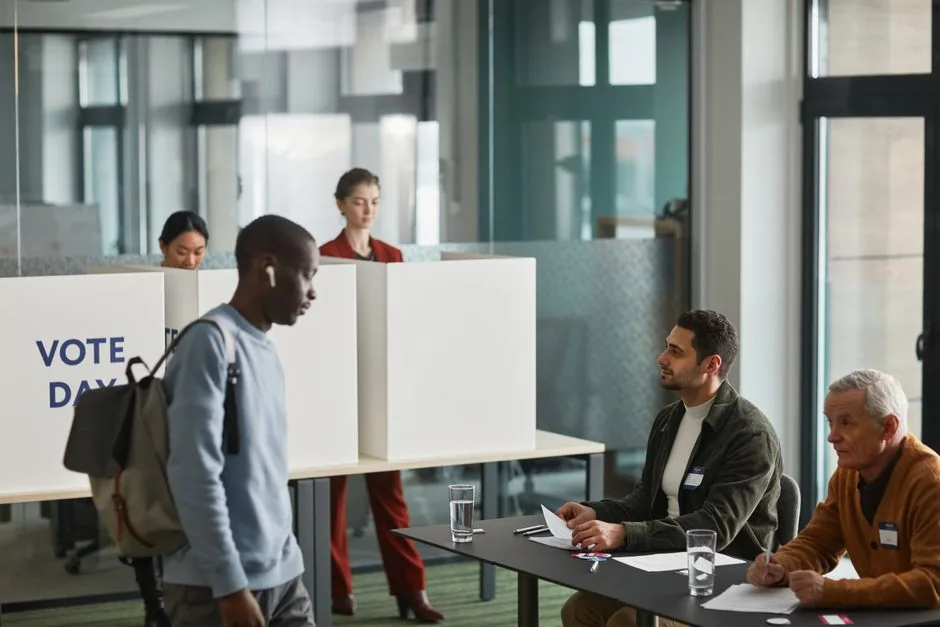
The Trump administration says it is sending about 1,000 federal monitors to polling sites in what it calls the "biggest DOJ election observer effort in history." It has also declined to rule out sending ICE agents. So thousands of ordinary Americans are spending their Monday nights on video calls learning how to watch the people who are watching the voters.
Welcome to the Watchers Watching the Watchers
The Guardian spoke with volunteers across the country who are training to serve as poll observers for the November 3 midterms. The Justice Department says its giant monitoring operation will make sure elections are "carried out fairly." Critics who are suing the government over the plan say it could intimidate voters. Both things can be true at once, if you define "fair" the way a bouncer does.
Notice what has to happen here. A federal agency announces the largest election-monitoring push in its history, and in response, grassroots nonprofits, state parties, and the ACLU have to build a counter-surveillance network. We have reached the stage of American democracy where the referee needs his own referee.
And the referee's referee is mostly a woman sitting on the back hatch of her SUV.
Stevie Lyn Just Wants to Be Bored
Stevie Lyn lives in Phoenix, and she is angry. ICE raids have swept her west side neighborhood for the past year, and her Latino neighbors have been hiding in their homes, too scared to shop for groceries, go to work, or vote. So she trained with Living United for Change in Arizona and the Arizona Center for Empowerment and took a post at her polling place for the July primary.
She sat 75 feet from the entrance, the legal distance for observers in Arizona, for ten hours. Her big catch of the day: a campaigner for a local legislative candidate who kept walking voters past the legal line. She reported it, poll workers told the guy to back off, and that was that.
She has taken election day off work to do it again. Her goal, in her own words: "I just want to be bored to death on 3 November." That is the entire ambition. A patriot asking for nothing more than a dull afternoon, and having to burn a vacation day to protect it.
The Heat Map Tells the Story
Here is where it stops being abstract. When the Arizona Center for Empowerment started mapping ICE activity in Maricopa and Pima counties, the pattern was ugly. The neighborhoods hit hardest by raids were often the same ones already dealing with barriers to voting, including polling place closures.
In the two weeks before the July primary, the group logged a spike in reported raids, plus ICE activity near a few polling places in West Phoenix, a primarily Hispanic neighborhood. Organizer Karime Rodriguez said that alone discouraged some people from voting. Turning Point USA also had a presence at a voting center in south Phoenix, and some voters told the groups they felt intimidated.
Nobody has to arrest anyone for this to work. "Even people who are citizens are afraid that they'll be taken if they go to vote," said César Fierros of Lucha. "We see the trucks driving by, the unmarked vehicles driving by. And we're scared because we never know who is going to be in that vehicle." The intimidation is the product. The unmarked truck idling down the block does the job on its own.
Republicans Wanted ICE at the Polls. In Writing.
This is not paranoia dreamed up by organizers. As raids surged across Arizona earlier this year, Republican state lawmakers introduced a bill to station ICE agents at polling places. That is why the Arizona Center for Empowerment decided to train volunteers for double duty: tracking ICE activity in vulnerable neighborhoods and keeping watch at the polls.
Rodriguez put it plainly to trainees: "These aren't abstract polling places. These are our schools, our churches, our community centers where immigration enforcement has already been taking place." The plan is three or four observers at every site, with one job: observe and report. If ICE shows up, they alert leadership, who ping the group chat, post to social media, or call neighbors to come out. Volunteers who can't be on site will staff phones and texts.
This is a civilian early-warning system for federal agents at the ballot box. Let that sink in for a second, because we are now treating it as a normal thing to build.
Pennsylvania Brought 250 People and a Lawyer
The same Monday night in September, more than 250 people joined a poll watcher training hosted by the Pennsylvania Democratic Party. They flooded the chat with questions. Could an ICE officer challenge a voter's eligibility? Almost certainly not, a party lawyer said. Law enforcement can't come within 100 feet of a Pennsylvania polling place unless they are voting or the site is in a police building. The one exception he could imagine was an off-duty agent casting a ballot in his own precinct.
The state party's communications director, Jack Doyle, said Democrats are building "an unprecedented voter protection program" with thousands of volunteer observers at priority locations, volunteer attorneys in every county, and a hotline staffed in English, Spanish, Mandarin, Vietnamese and Korean.
The legal guardrails are real, and credit where it's due: the law is on the voters' side here. But the administration doesn't need to win a legal argument at 7 a.m. outside a precinct. It just needs someone to hesitate in the parking lot.
The Professor Says Don't Panic, Pay Attention
Justin Levitt, a Loyola Law School professor and former Obama Justice Department official, offered some perspective. "I am not naive about this administration and have my eyes wide open," he said. "But this administration wants to project power that it doesn't have and finds it in their interest to get the electorate freaked out."
He may well be right, and plenty of observers expect election day to be business as usual. But look at what that theory concedes. The strategy is the freak-out. A bluff that works because it scares people out of voting is still working, even if every legal protection holds when someone finally tests it.
So the volunteers train anyway, because the cost of preparing for a quiet day is a folding chair and a lost shift, and the cost of being unprepared is a neighborhood that stays home.
The Dingo Take
One thousand. That is how many federal monitors the Justice Department says it is sending to polling places, while declining to promise that ICE won't tag along. Against that, we have Stevie Lyn, a folding chair, a phone, and a vacation day.
The administration's defenders will say monitors are routine and that wanting fair elections is not a crime. Fine. Then explain why an administration that says it wants fair elections will not simply rule out armed immigration agents near the ballot box. It would take one sentence. "ICE will not be at the polls." Easy. Free. They won't say it, and the silence is the message, delivered with all the subtlety of an unmarked truck idling outside a community center.
Here's what should embarrass everyone involved. The people doing the real work of protecting this election are unpaid volunteers burning anger into spreadsheets and group chats because the government is a threat they have to plan around. They shouldn't have to be heroes. They want to be bored. Give Stevie Lyn her boring Tuesday. Make the administration say the sentence.

Comments