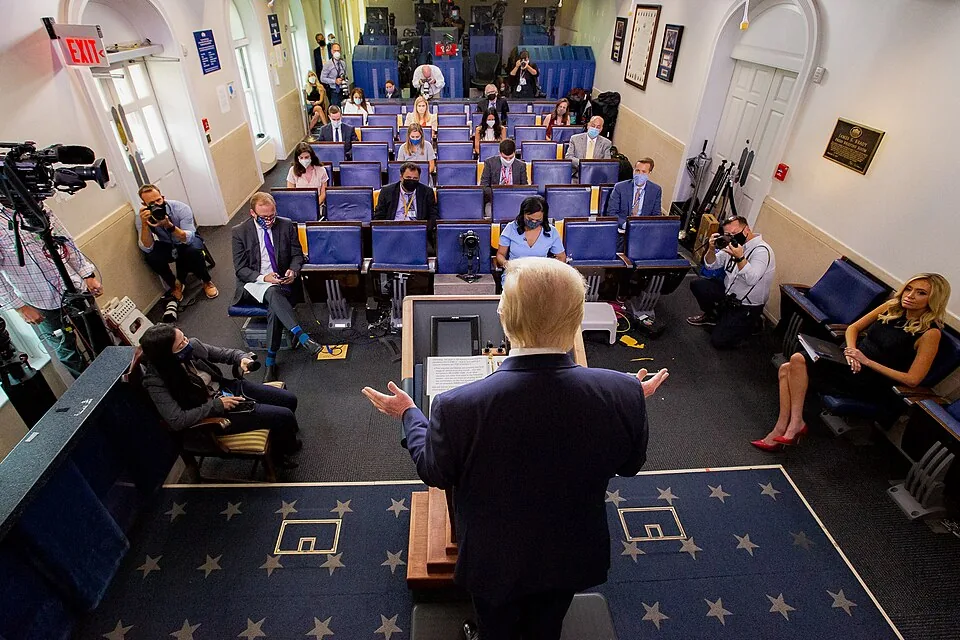
In late August, Donald Trump told his outgoing press secretary that evicting reporters from the White House would be her "last legacy." The room they would be evicted from has a second life in the president's imagination: an indoor swimming pool. He has even posted a picture of it, captioned "FDR Pool." The free press is being asked to vacate so the building can have a spa.
A Going-Away Present Nobody Asked For
During one of Karoline Leavitt's final meetings in the Oval Office, with several senior aides watching, Trump told her to move reporters out of the James S. Brady Press Briefing Room. That would effectively remove news organizations from the White House. He called it her "last legacy."
According to The New York Times, the proposal went nowhere while she was there. But he had asked her several times over a period of months, per three people with knowledge of the discussions who weren't authorized to speak publicly. Leavitt officially stepped down as press secretary on Aug. 27.
Most people get a card and a sheet cake on the way out. She got an invitation to be remembered as the press secretary who helped throw out the press.
The Pool Has a History
Franklin D. Roosevelt added an indoor pool to the White House in 1933 as therapy for legs damaged by polio. Richard Nixon later covered it over to make room for the news media. Reporters have worked out of that space ever since, in a small office connected to the briefing room.
Trump has told aides he would like the pool back. On Sept. 27, he posted two images to Truth Social: the briefing room as it looks today, captioned "Fake News," next to the same space reimagined as a gilded swimming pool, captioned "FDR Pool." That is a real before-and-after, posted by the President of the United States, on purpose.
It isn't even a new fantasy. In 1993, according to George Stephanopoulos's memoir, Hillary Clinton wanted to turn the press quarters back into a pool. When word of the plan leaked, the blowback ended it fast. That was more than 30 years ago, and no president has seriously tried since.
A Foam Board and a Golf Club Weekend
One of the people pushing the pool idea is Bill Pulte, the director of the Federal Housing Finance Agency, according to two people familiar with the discussions. Pulte has no formal role in White House operations. He did, those people said, make a foam board rendering of the briefing room restored as an in-ground pool.
This is how it happens. Pulte often spends weekends with Trump at his golf clubs, where the president has only a tiny staff around him. That gives Pulte freewheeling access to pitch whatever he's got. Senior White House officials say he arrives with foam boards, and the other topic on those boards is potential targets for revenge prosecutions. Pulte didn't respond to multiple messages seeking comment.
Boris Epshteyn, the president's longtime lawyer and outside adviser, is another voice in Trump's ear. He pushed several of the lawsuits the president has filed against news outlets and individual journalists, and officials and people close to Trump say his influence has grown in recent months. Epshteyn declined to comment.
The Idea That Keeps Coming Back
Trump has floated pushing the press out since his first term and has never quite dropped it. During the 2016 transition, Stephen Bannon suggested moving reporters to a townhouse near Lafayette Square, with the Eisenhower Executive Office Building as the fallback. Reince Priebus publicly confirmed in January 2017 that the team was weighing a move for press briefings, framing it as a way to fit more reporters. They dropped it as too disruptive and impractical.
It came up again that summer while the West Wing was under renovation. With the space torn up anyway, why let the reporters back in? Sean Spicer and Sarah Huckabee Sanders raised the logistics, and it died again. It came up once more during the 2024 transition, and most of Trump's advisers talked him out of it. They knew he likes calling cameras into the Oval Office at a moment's notice, and several suspected that if coverage got worse after an eviction, he would blame them for his own idea.
What's different now is the staff. Trump's core team has shrunk from the already-tight group he brought in last year, and advisers of growing influence are encouraging drastic measures to punish journalists. The Wall Street Journal reported last month that advisers had so far pushed back or waited for him to move on. Communications director Steven Cheung's answer on the record was: "All options remain on the table, and we will make an announcement when appropriate."
The Buffer Is Already Going Up
The administration doesn't need to move the room to push reporters back. Last fall, Trump's team barred reporters from "Upper Press," the area near the press secretary's office, without an appointment. Earlier this year, the Defense Department required credentialed reporters to sign a pledge that included not soliciting unauthorized information. Nearly every major news organization, Fox News included, refused and gave up their work space in the building instead.
Then came September, when Trump announced on social media that he was banning CNN, MS NOW and Politico from the White House over coverage he called "fiction and lies." The administration quickly revoked the credentials of more than 70 journalists. A judge Trump appointed, Timothy Kelly, ruled last week that the president violated the outlets' First Amendment rights and ordered their passes restored. The administration is appealing.
On Oct. 9, the Justice Department sent letters demanding information from ABC, CBS, CNN, NBC and Fox News after the five networks temporarily halted pooled White House TV coverage in solidarity with CNN. People with knowledge of the effort described it as an antitrust investigation. Months earlier, F.B.I. agents had turned up at the homes of Times reporters with grand jury subpoenas. They were withdrawn within weeks after a judge scolded federal lawyers for using subpoenas as a first option instead of a last resort.
The president also filed lawsuits against ABC, CBS and The Des Moines Register early in his term, and his aides made clear the point was a chilling effect on negative coverage.
Why Where They Sit Matters
Yes, in a list of attacks on journalists that includes subpoenas and antitrust letters, a change of office space ranks low. Nobody goes to jail over a floor plan. But the symbolism is the point. Reporters being close to the seat of executive power has long been a recognition that a free press matters in a constitutional democracy.
And this one would be hard to take back. A pool can be refilled and drained. A press corps can't easily be moved back in after the room has been repurposed and a precedent set. Every future president, of either party, would inherit an executive branch that already shrugged off the idea of reporters in the building.
The pressure against it is thin. Trump currently faces no comparable pushback, since a news media that so many of his supporters despise is not a sympathetic cause, and he has received relatively little backlash for his anti-media moves so far, even from Democrats. That's the real reason this idea keeps surviving.
The Dingo Take
You are being asked to treat this as a story about a swimming pool. It isn't. The pool is the punchline, and it's a good one: a foam board, a gilded rendering, an "FDR Pool" caption. You laugh, you share it, and you move on while the actual move, getting the press out of the building, rides along behind the joke.
Notice how small each step is. Nobody is banning every reporter. Nobody is arresting one. They're moving some desks across the street, and who could object to that? That's how it works. Nobody abolishes the free press in one dramatic act. You make it a little harder to reach and a little easier to ignore, one appointment requirement and one pledge at a time, and each step sounds too minor to fight over. The sad part is that a lot of those steps have already happened.
So fight over it. The press room is not a perk. Karoline Leavitt letting the order die on her way out the door is not a victory, because the man who wants it done is still in the Oval Office, still asking, with a shrunken staff and a growing list of people willing to nod along. The next press secretary may not be so reluctant. And somewhere there's a foam board, waiting for the right weekend.

Comments