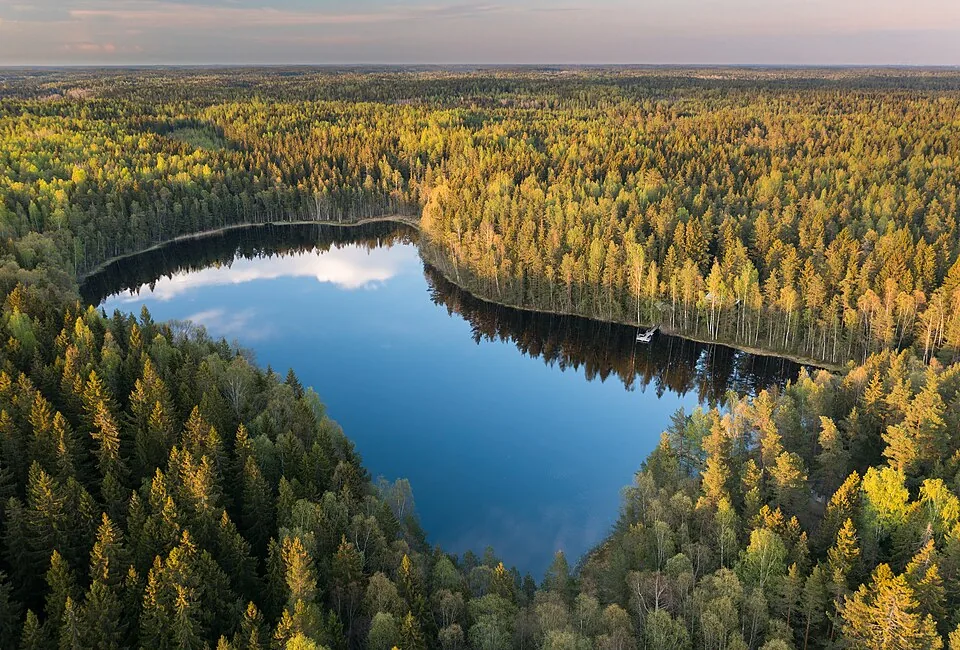
Google allegedly leveled an estimated 250,000 trees across 816 acres of Finnish woodland to build an AI data center, and it did so before getting the legally required environmental review. The result, according to local residents, is a field of mud, brown streams, and wolves wandering into a village 50 miles away because everything they used to eat is gone.
Cut First, Ask Later
Finnish law is not complicated on this point. Before a company starts large-scale operations, it completes a mandatory Environmental Impact Assessment. You study the damage before you do the damage. That is the whole idea.
Google, according to The Guardian's reporting as relayed by the New York Post, appears to have treated the process as more of a suggestion. The Finnish Licensing and Supervision Agency says extensive preparatory work had already happened at the project sites: trees removed, topsoil stripped, construction roads laid, ditches and culverts altered, stormwater arrangements changed.
Tommi Muilu, the agency's head of environmental matters, put it in the dry language of a regulator who is clearly furious. Those measures, he said, "will change the environment and cause impacts, the identification and assessment of which are among the key objectives of the EIA procedure." Translation: you did the thing the study was supposed to evaluate, before the study.
Wolves at the Door
Here is where the story leaves the realm of paperwork and wanders into something out of a bad fable. When you remove a quarter of a million trees, the animals that lived in them do not file a change-of-address form. They leave.
Anni Ranta, a resident of Otanmäki, told The Guardian that wolves started showing up in her village. "We had wolves coming into the village because all the wild animals moved out of the forest," she said. "They fled." The village sits roughly 50 miles from the site, which gives you a sense of how far the shockwave traveled.
Then there is the water. The tree removal reportedly turned nearby water sources brown and polluted streams that feed the Oulujoki River. So the forest is gone, the predators are hungry and relocating, and the rivers look like chocolate milk. All for a building full of servers.
Suspended, Finally
Finnish officials did not take this quietly. The licensing agency suspended all development at two Google data center sites, near Muhos and Kajaani, which sit about 90 miles apart. Google's project subsidiary, Tuike Finland Oy, had until October 23 to halt operations.
Those two sites are part of a $15 billion Google investment in Nordic AI infrastructure that was announced just last month. Fifteen billion dollars. And apparently not one of those billions went toward waiting for a permit.
Google's top executive in Finland, Antti Järvinen, said the company believed it had the legal approval to start the large-scale tree cutting. He later apologized and said Google would work to protect water sources and replant trees on about 321 of the 816 acres. Do the math on that. Replanting less than 40 percent of what you cleared is the corporate equivalent of returning half the money you took and calling it restitution.
Pure Arrogance, Said the Locals
The reaction on the ground was not subtle. Hanna Halmeenpää, chair of the Finnish Association for Nature Conservation, said Google "bought the vast land area and they just started to cut it, just like that." She called it "pure arrogance and it's amazing."
Antti Jakonen, a Muhos resident, was blunter still. "It has been done in the wrong way. American style. No sense. No sense at all." He also asked Google to help restore the local salmon population, which was already wiped out by hydropower years ago. This community has been through the extraction wringer before, and it is tired.
Ranta raised a different worry: that a data center in Finland makes a juicy target for Russian aggression. Whether or not you buy that, notice what she is describing. Locals are being asked to host the infrastructure, absorb the noise (she compared the hum on that hard rock soil to a drum), and now accept a new geopolitical risk, with no say in any of it.
Racing the Regulators
Opponents of the project believe Google was hurrying to build before Finnish regulation caught up with AI's appetite for land and power. That is an accusation, not an established fact, and Google says it believed it was authorized. But the pattern fits an industry that has made speed its religion.
Elsewhere, governments are starting to push back. In July, New York Gov. Kathy Hochul signed an executive order pausing new permits for hyperscale data centers that want to tap the state's grid, the first such move in the US. "I don't want New York to just be first," she said. "I want New York to be first in the right way."
So the choice, at least for now, looks like this: a pause on permits, or a mud pit with wolves in it. One of those is the grown-up option.
The Dingo Take
In the 1800s, railroad barons laid track first and sorted out the land rights later, because by the time anyone sued, the train was already running and the town already existed. Move fast, apologize slow, and let the facts on the ground do the lawyering. Google, with a trillion-dollar parent company, appears to be running the same playbook with a new coat of paint and a chatbot.
Look at the sequence. A $15 billion AI push announced in September. Hundreds of thousands of trees gone before the environmental review that exists specifically to decide whether they should go. A regulator forced to hit the brakes after the clear-cutting, not before. And an apology that comes with a promise to replant roughly a third of what was torn out. That is not a mistake. That is a business model with a press release attached.
The tell is the one Hanna Halmeenpää nailed: they bought the land and just started cutting, like that. No hearing, no study, no patience. Finland has rules because forests, rivers, and wolves are not renewable on a product roadmap. If the AI boom needs to ignore the law to hit its timeline, then the timeline is the problem, and the people living next to the mud get to say so loudly.





Comments