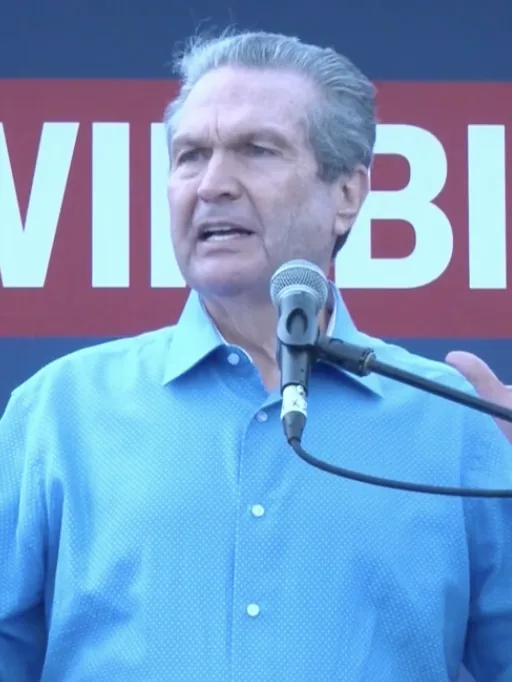
Rick Jackson, the Republican nominee for Georgia governor, ran an attack ad built around photographs of a murdered 8-year-old girl and her mother's anguished 911 call. The family of Secoriea Turner demanded he take it down. This is where the 2026 midterms have landed: other people's worst days, repurposed as 30-second spots.
The Ad That Started the Conversation
Here's what happened, per Axios. Jackson's campaign went after Democratic rival Keisha Lance Bottoms, the former mayor of Atlanta, with an ad that used images of Secoriea Turner and the 911 call her mother made after the shooting.
Secoriea was eight years old. She was killed in Atlanta, and the call in that ad is the sound of a mother learning in real time that her child is not okay. That is the raw material. Not a statistic, not a crime-rate chart. The actual sound of a parent coming apart.
The family's reaction was not subtle. They demanded the ad come down. When the people whose tragedy you are using tell you to stop, you have wandered past politics and into something else.
This Is Not Just a Georgia Problem
The Georgia spot is the sharpest example, but the broader pattern is the story. Campaigns across the 2026 cycle are reaching for victims of violent crime as props, with photographs of murdered children and recorded emergency calls showing up in attack ads.
The logic is simple and cynical. Crime polls well as an attack line, and nothing makes the case like a real face and a real voice. A policy white paper doesn't make anyone's stomach drop. A dead kid's picture does.
And that is exactly why it works, and exactly why it is grotesque. The effectiveness is the problem, not the defense.
Nobody Asked the Families
Consent is the whole ballgame here, and in at least some of these cases it was simply not part of the process.
Think about what a grieving family goes through when a campaign picks up their loss. They did not choose to be in a political fight. They did not sign up to be a talking point in a governor's race. One day they are turning on the TV and there is their daughter, there is their own voice or their own sister's voice, being played to sell a candidacy.
They get to relive the worst moment of their lives on a loop, during the ad breaks, between a car dealership and a mattress sale. Some of them have said so, loudly, and the ads have kept running.
The Attack on Bottoms Is Its Own Kind of Cheap
Set aside the tactic for a second and look at the target. Jackson is pinning a child's murder on Bottoms because she used to be mayor of Atlanta, the city where it happened.
That is a stretch with a body attached. Mayors do not commit murders. Cities of hundreds of thousands of people have violent crime, under every mayor of every party, in every decade. Crime policy is a legitimate thing to argue about. Draping a particular dead child over a particular political opponent and implying a direct line of blame is something else.
If you want to debate policing, bail, or sentencing, there are real numbers and real records to fight over. Jackson chose the version where a mother's 911 call does the arguing for him.
Both Parties Know This Playbook
Let's be fair about the history, because the Dingo Daily does not hand out free passes by jersey color. Using victims in political advertising is an old bipartisan sin. Willie Horton did not appear in the 1988 election by accident, and Democrats have rolled out grieving families on guns and other issues for decades.
The difference is that those families usually showed up on purpose. A parent standing at a podium, choosing to tell their story, is advocacy. A campaign lifting a family's trauma without their blessing and refusing to pull it when they object is exploitation. One of those is a person using their pain to make a point. The other is a consultant using someone else's pain to win a poll.
The Dingo Take
Is there a floor? Seriously, is there anywhere left for this to bottom out? A grieving mother's 911 call is now an acceptable closing argument in a governor's race, and when her family asked politely for it to stop, the apparent answer was a shrug and a media buy.
Here's the thing about "it works." Of course it works. Cruelty has always tested well. That is not a defense, it is the entire indictment. If the only reason you can give for airing a murdered child's photograph is that voters flinch at it, you have told on yourself, and everyone watching heard it.
The fix is not complicated, and it doesn't require a new law. Ask the family first. If they say no, the ad does not run. A campaign that cannot make its case on crime without conscripting an eight-year-old's mother against her will does not have a case. It has a hostage.


Comments