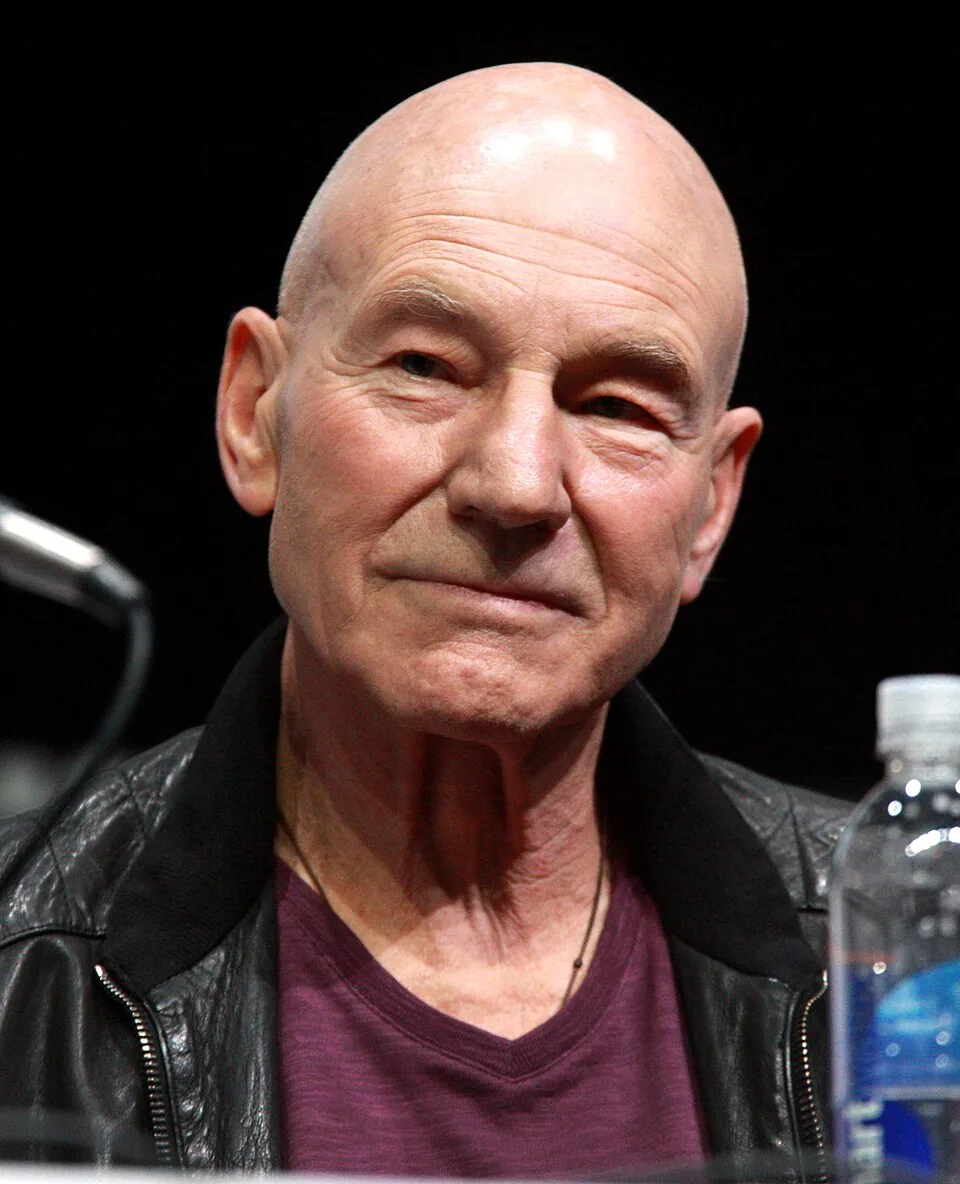
Patrick Stewart has died. He was 86. The man who spent decades on British stages, got hired to command the Enterprise over the objections of Star Trek's own creator, and signed a six-year contract because everyone told him the show would be dead in one, died Wednesday at his home in Los Angeles.
A Brief and Poignant Journey
According to The Hollywood Reporter, Stewart died after what his longtime spokesperson Kelly Bush Novak called "a brief and poignant journey with Alzheimer's disease and Lewy body dementia." Bush Novak said he was "held in the warm embrace of family and friends, surrounded by live music, prayer, tears, laughter and the kind of profound emotion that only he could inspire after a lifetime of devotion to us all."
She described "the peaceful ease and reflection on his face, an enduring reminder of his invincible grace." That is a hell of a way to go, and a hell of a thing for a spokesperson to be able to say honestly.
He was 86. He had been born on July 13, 1940, in Mirfield, Yorkshire, which is about as far from a starship bridge as a human being can get.
The Bald Brit Nobody Wanted
Here's the part that makes the whole career feel like a heist. Stewart arrived in America in the late 1980s with decades of classical theater behind him and approximately zero name recognition. Star Trek: The Next Generation producer Robert Justman wandered into a UCLA lecture, watched Stewart read Shakespeare in that patrician voice, and pulled him in for an audition.
Gene Roddenberry, the creator of Star Trek, did not want him. Roddenberry reportedly didn't think a bald Brit could be the face of the new series. The casting process was contentious. Stewart won Roddenberry over anyway and signed on to play Capt. Jean-Luc Picard.
The Los Angeles Times announced the casting by calling him an "unknown British Shakespearean actor." Brent Spiner, who played Data, made a sign for above Stewart's dressing room door in bright red letters: "WARNING: Unknown British Shakespearean Actor." Nobody has ever paid a better tribute to a coworker with a piece of cardboard.
Signing a Contract He Thought Was a Mistake
The funniest detail in the whole record is why Stewart signed up for the long haul. In 2010 he recalled that every agent, director, screenwriter, and actor he spoke to told him not to worry about a six-year commitment. "You'll be lucky to make it through the first year," they said. Reviving an iconic series after William Shatner and Leonard Nimoy was, in everyone's view, madness.
So, as he put it, "on the basis of that advice, I signed the six-year contract." The industry's collective wisdom was that the show would flop, and Stewart took the deal precisely because he figured it would be over before the paperwork dried.
The Next Generation premiered in September 1987, two months after his 47th birthday. It struggled at first with fans who saw the new cast as pretenders to the throne. Then came the season-three finale, "The Best of Both Worlds," in 1990: the first cliffhanger in Star Trek history, with Picard abducted and assimilated by the Borg. It was a genuinely shocking swing, years before television made a habit of them.
Two Icons and One Very Long Contract
The series ran seven seasons and ended in 1994 with an Emmy nomination for outstanding drama series. Stewart was at the center of episodes that rank among the best hours sci-fi television has ever produced, including "Yesterday's Enterprise" in 1990 and "The Inner Light" in 1992, in which Picard lives an entire lifetime in the blink of an eye. Four films followed, from Generations in 1994 through Nemesis in 2002, where he faced off against a then-unknown Tom Hardy as a younger clone of Picard.
Stewart knew typecasting when he saw it, so he hesitated when X-Men came calling for the role of Professor Charles Xavier. He took it anyway, working opposite his longtime friend Ian McKellen as Magneto. The film helped launch a new age of superhero cinema. Stewart played Xavier across six more appearances, including Logan in 2017.
After 17 years away, he returned to Picard in 2020 for the CBS All Access series Star Trek: Picard. Not many actors get to live inside two beloved characters for decades and keep finding new layers in them. He told The Hollywood Reporter in 2017 that he admired both men "for their morality, for their kindness, for their sensitivity, for their compassion," and that playing Jean-Luc for all those years "had a real impact on me."
Learning to Laugh on a 14-Hour Day
The Next Generation cast became known as one of the closest in television, but Stewart had to learn how. In the early years, the theater veteran struggled with the jokes that came with a typical 14-hour day on set. In 2013 he said his castmates "taught me that you can do good work and have a good time at the same time." Before that, he said, he had always thought the two were completely unconnected.
Think about that for a second. A man who could make Shakespeare sound like breaking news had to be taught by a bunch of American TV actors that work and joy could share a room. It is one of the most human things anyone has said about the job.
Born Into a House He Needed to Escape
Stewart's father, Alfred, was a semi-skilled laborer and a World War II veteran, among the last men evacuated from Dunkirk. He was a heavy drinker who was physically abusive toward Stewart's mother, Gladys, though not toward his three sons. Decades later, Stewart learned his father's violence likely stemmed from undiagnosed post-traumatic stress disorder.
As the youngest, Stewart often found himself tasked with getting between his father's fists and his mother. That childhood pushed him to advocate later in life for both veterans and domestic abuse victims. Acting, he wrote in 2009, was his refuge: "The stage was a far safer place for me than anything I had to live through at home. It offered escape. I could be someone else, in another place, in another time."
The voice that commanded starships and ran a school for gifted mutants was built, in part, by a kid learning to stand in a doorway and not flinch.
The Dingo Take
He was the best thing to ever happen to a bridge crew. That is the verdict, and it is not up for debate.
Look at the setup. Everyone with a stake in the business told him the show was doomed. The creator didn't want him. The newspaper called him unknown. And he showed up with a Shakespearean voice and a conviction that decency was worth playing straight, then spent seven seasons making a generation of kids believe that a leader could be wise, patient, and kind without being weak. In an era that keeps handing us men who confuse cruelty with strength, that is not a small legacy. It is a rebuke that has aged better every year.
He also gave us Professor X, a man who ran a school for the persecuted and believed in them anyway. Two characters, two moral centers, one actor who said both shaped him. We lose people every day who never get to be that good at being good. Make it so, Captain.




Comments