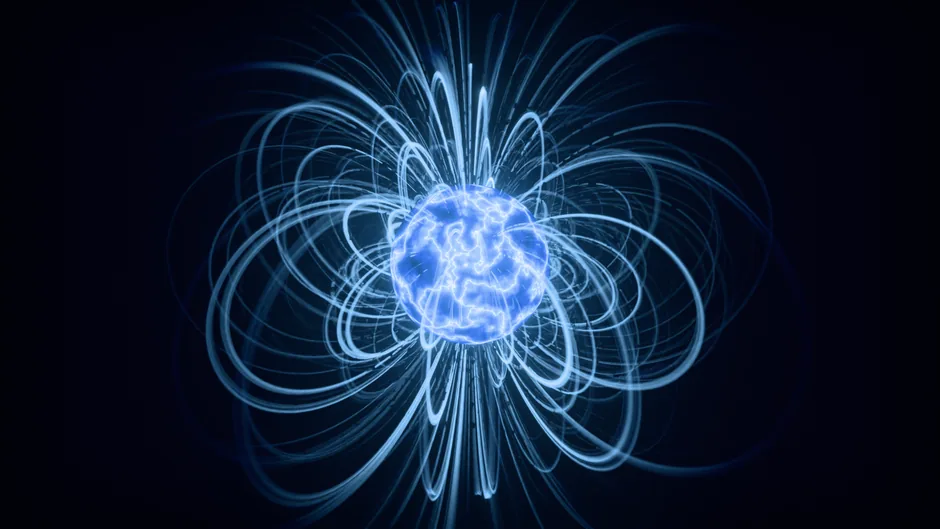
For more than a decade, scientists told us a invisible wall around Earth kept the deadliest electrons in space from getting anywhere near us. Then the Sun threw a tantrum in May 2024, and a Japanese satellite watched those electrons get supercharged inside the wall, at flux levels more than 5,000 times higher than before the storm. The mechanism, apparently, sounds like a bird chirping.
The Wall That Wasn't
Here's the setup. Earth sits inside the Van Allen belts, two donut-shaped zones of energetic protons and electrons held in place by our planet's magnetic field. The outer belt is mostly electrons energized by the Sun. The inner belt is largely protons produced when cosmic rays slam into our atmosphere.
In 2014, NASA's Van Allen Probes spotted something strange. About three Earth radii from the planet's center, there was a weirdly sharp boundary. Beyond it, the most energetic electrons were everywhere. Inside it, almost nothing. Researchers called it an "impenetrable barrier."
That is a bold word for a scientist to use about anything, and space has a long tradition of making bold words look stupid.
Why Killer Electrons Deserve the Name
These are not your friendly neighborhood particles. Ultra-relativistic electrons get accelerated to nearly the speed of light by interactions with electromagnetic waves in Earth's magnetic environment, especially during geomagnetic storms. They carry enough energy to punch through satellite shielding, fry sensitive electronics, and shorten the working lives of spacecraft.
They are bad news for people, too. Astronauts face an elevated radiation hazard from them. So the idea that a natural barrier kept the worst of them away from the inner region was a comforting one. Comforting, and as it turns out, conditional.
The Cracks Showed Up Years Ago
Nobody should be shocked that the wall had problems. As early as 2018, researchers proposed that the barrier was less a barrier and more an illusion. Energetic electrons could be pushed inward by fluctuations in Earth's magnetic field, but the storms driving that movement usually fizzled out before the electrons got far. The wall was really just a limit on how long storms last.
Then in 2024, researchers analyzing observations from 1996 to 2006 found that lightning-generated electromagnetic waves could knock killer electrons already trapped in the inner belt down toward the atmosphere. That meant megaelectronvolt electrons were already sitting well inside the supposedly forbidden zone.
So the wall had cracks, the cracks had cracks, and then the Sun showed up with a sledgehammer.
May 2024: The Sun Loses Its Mind
The Sun fired off a series of flares and coronal mass ejections that sent billions of tons of magnetized plasma screaming across the Solar System. Back here, the result was a G5 geomagnetic storm, the top category on the scale. It was so intense its effects were recorded even at the bottom of the ocean.
The storm also did something nobody had planned for. It dramatically depleted the cold plasma in Earth's plasmasphere. That mattered because cold plasma is exactly what was supposed to help scatter electrons out of their orbits and into the atmosphere. Remove it, and you get an unusually sparse environment where a different kind of wave, called chorus, can thrive.
Bird Song, But Make It Lethal
Chorus waves, when converted into audio, sound like birdsong. Space physicist Yoshizumi Miyoshi of Nagoya University said exactly that. It is a lovely detail about a deeply unlovely process.
Instead of scattering electrons away, these waves appear to have accelerated them to ludicrous energies right inside the barrier. Japan's Arase satellite, which has been watching the radiation belts since 2017, caught it happening. During the storm's recovery phase, flux of electrons at around 3 megaelectronvolts ballooned by more than 5,000 times compared to pre-storm levels.
The team, writing in Geophysical Research Letters, put it plainly: this barrier "can be breached under extreme space weather conditions."
The Timing Is the Smoking Gun
What convinced the researchers the electrons were being made on the spot is the sequence. Lower-energy electrons showed up first. About half a day later, higher-energy ones followed. Roughly a day after the initial jump, electrons carrying more than 3 megaelectronvolts had surged too.
If the electrons were just drifting in from somewhere else, you would not expect that staggered climb. The distribution also formed a distinct peak near the barrier's boundary, a pattern that is hard to explain through inward transport alone but fits electrons being accelerated locally and then spreading inward and outward.
And the aftermath was not brief. Arase kept watching levels of ultra-relativistic electrons decline until October 2024, when another solar storm rolled through. Months of elevated radiation in a place that was supposed to be protected.
The Dingo Take
You are being asked to believe that we have a handle on the environment our civilization now depends on. We do not. For a decade, a sharp line in the data got promoted to "impenetrable barrier," and it took one angry Sun and one Japanese satellite to show the line was really a set of conditions. Change the conditions, and the wall evaporates.
This matters because we have hung an absurd amount of modern life on satellites. Navigation, communications, weather forecasting, banking timestamps, all of it rides on hardware that killer electrons can cook. And we are launching more of it every year, plus putting more humans into orbit and talking about sending them farther. The people designing that hardware were working from a map that just got redrawn by a bird song.
To be fair to the scientists, this is how science is supposed to work. Somebody proposes a barrier, somebody else finds the cracks, and eventually a superstorm settles the argument. The unsettling part is how much we only learn when the Sun decides to teach us. Meanwhile, we are barely funding the monitoring that would warn us, and as a species we have a spectacular record of ignoring the quiet instruments right up until they scream. Pay attention to the chirping.



Comments