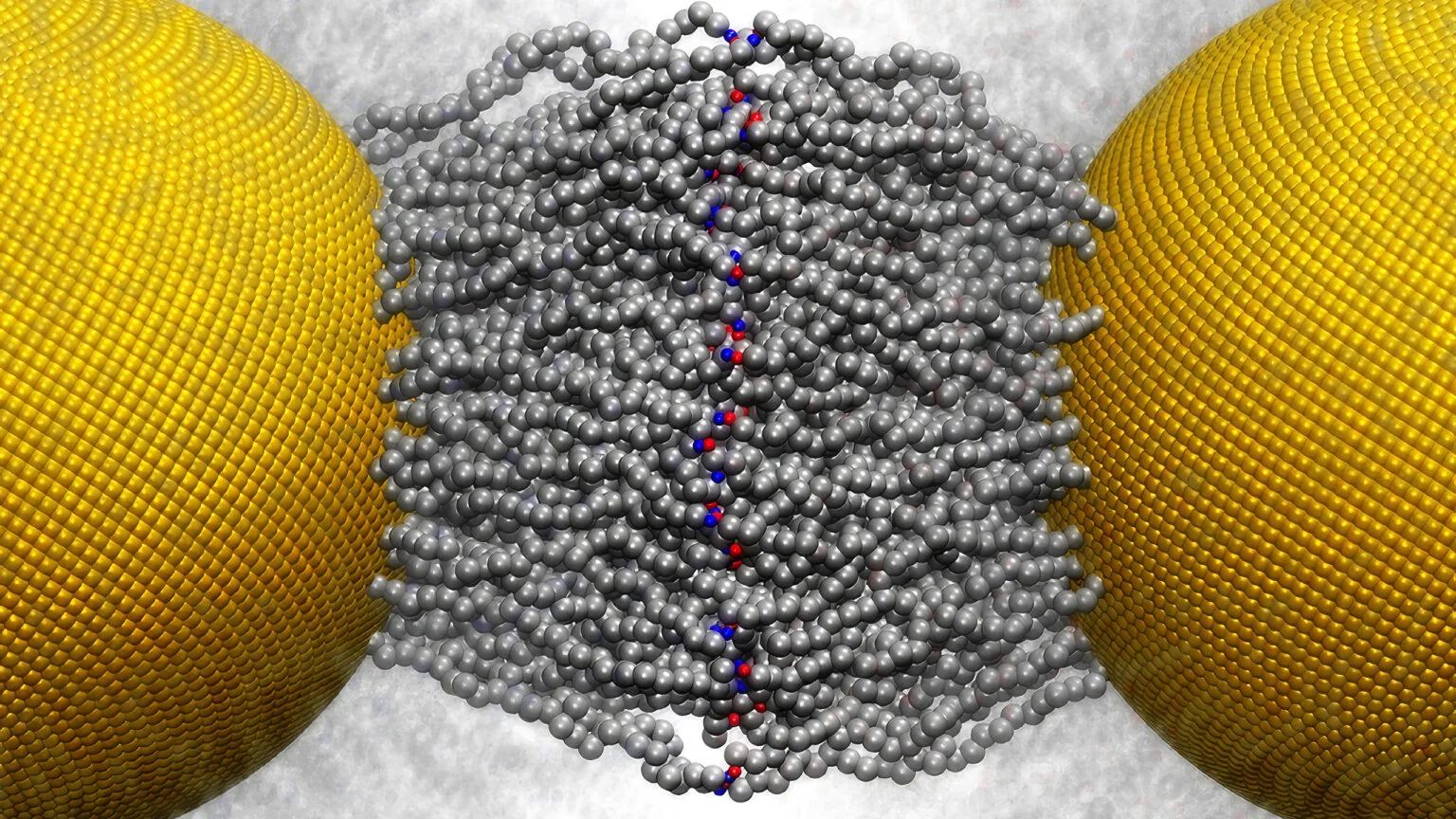
For 20 years, the accepted wisdom in nanoparticle assembly was that your connector molecules had to be rigid, and any wobble would wreck the whole thing. MIT researchers just tried the exact opposite, made the connectors floppy, and produced crystal structures nobody has seen before. Somewhere, a very stiff dogma is having a very bad week.
The Rule Everybody Followed Until Somebody Didn't
Here's the setup. Nanoparticles are tiny building blocks, and scientists build better materials by controlling how those blocks connect at the smallest scales. The connectors between particles are called ligands, and for roughly two decades they've been designed as rigid, fixed structures.
The logic seemed sound. If you want precise structures, you build precise connectors. Anything sloppy would, in theory, make assembly fail. That was the conventional thinking, and it held up for about 20 years.
Then a team led by MIT, as covered by ScienceAlert, published a study in Nature Materials that basically said: what if we just didn't do that?
Floppy Plastic, Gold Particles, and Better Results
The researchers used gold nanoparticles connected by ligands made from PEG, a common and decidedly floppy polymer. The ligands were tipped with positive or negative charges to help the particles stick together. Computer simulations ran alongside the experiments to track what was happening.
Without any rigidity in the connectors, the ligands bunched up where particles touched. That bunching limited how many connections each particle could form. There were only so many particle-to-particle chains to go around, so the particles ended up with fewer bonds.
And fewer bonds, it turns out, is the whole point. The nature of the links is determined by the nanoparticles themselves as they come together, rather than being pre-designed into the connectors.
Twenty Years of Dogma, Gone in One Experiment
MIT materials scientist Rob Macfarlane did not mince words about what this means for the field. "It's the exact opposite of what the dogma has been for 20 years: that you need to make connector ligands rigid, and any deviation causes assembly to fail," he said. "We showed if you just crank it all the way to the opposite extreme, it works just as well."
That's a pretty remarkable sentence. Not "works almost as well." Not "works in limited circumstances." Just as well, from the opposite extreme, after two decades of everyone insisting it couldn't.
Macfarlane called it "a new tool that is so counterintuitive," and he's right. Previous efforts to fine-tune nanoparticle connections focused on precisely aligning the particles or reshaping them. It turns out that relinquishing some rigidity actually brings about more order. Letting go of control gave the scientists more control. Make of that what you will.
Crystals Nobody Has Ever Seen
The team was able to create ordered crystal structures that haven't been seen before. That's the headline result, and it's a real one. Macfarlane said the approach lets researchers control how many bonds each particle has without predesigning where the particles connect or what their shapes are.
The controls are still there, just different ones. Changing the sizes of the nanoparticles and the lengths of the ligand chains still steers the outcome. Smaller particles, for example, led to fewer links. The flexibility of the polymer dictates how many bonds form.
Now for the caveat, because we deal in facts here. The functionality of these new materials still needs to be examined and tested. Making a never-before-seen crystal is not the same as making a useful one. The results are promising, which is the word scientists use when they mean "don't get ahead of us."
Why Looser Packing Matters
Materials made of nanoparticles are already widely used in a variety of fields, but they're hard to scale up. By default, the particles pack together tightly and have to be carefully engineered for each specific purpose. That's slow and expensive.
Particles that aren't packed as closely together mean a material that can be customized at scale more easily. "That's where a lot of the interesting applications are," Macfarlane said.
The researchers point to possible uses in photonics (technologies that control light), chemical catalysis, medicine, and agriculture. The next steps are to try other particle materials and ligand combinations, and then put the results through real-world tests. Until then, treat the applications list as a wish list with good odds.
The Dingo Take
"The exact opposite of what the dogma has been for 20 years." That's the lead researcher describing his own field's settled wisdom, and the settled wisdom lost to a squishy polymer you can buy off a shelf. Twenty years of careful, rigid, expensive engineering, beaten by the molecular equivalent of a wet noodle.
We should be clear about what this is and isn't. It isn't a miracle material. The functionality hasn't been tested, and the applications are projections, not products. But it's something better than hype: a clean example of a field testing its own assumptions and finding out they were optional.
That's how science is supposed to work, and it's a nice change of pace to cover a story where the people in charge looked at an entrenched rule, shrugged, and ran the experiment anyway. Contrast that with, well, everything else we cover. When was the last time a powerful institution tried the opposite of its own dogma and then said so out loud? Credit to MIT for the floppy revolution. Now somebody try it on Congress.





Comments