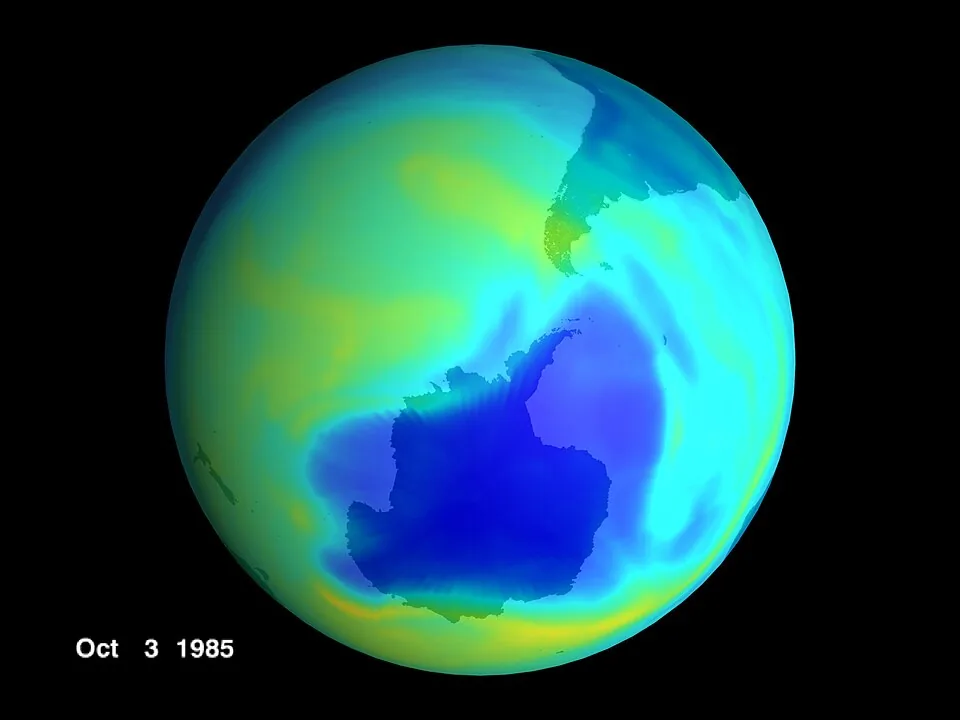
The hole in Earth's protective ozone layer just grew to its largest size in a decade, 10.5 million square miles of missing sunscreen hovering over Antarctica. And the most important detail in the whole story is the part where it could have been worse, because for once in human history, the world actually did something about a planetary-scale problem before it was too late.
Twice the Size of the United States, and Still the Good News
Let's start with the numbers, because they are genuinely staggering. According to ScienceDaily's write-up of the NASA and NOAA findings, the 2026 Antarctic ozone hole averaged about 9.6 million square miles between September 7 and October 13. That is more than twice the size of the United States.
On September 18 it peaked at 10.5 million square miles. That is roughly 90 percent of the size of the largest ozone hole ever measured, which showed up on September 9, 2000. It ranks as the seventh-largest in 48 years of observation.
So yes, the hole is big. Alarmingly, gape-at-the-satellite-image big. But the scientists are not sounding a panic alarm, and the reason why is the most interesting part of this story.
The Polar Vortex Went Full Bully
The culprit this year was an unusually strong polar vortex, the ring of fierce winds that circles Antarctica and traps brutally cold air over the region. That cold air helps form the special stratospheric clouds where chlorine and bromine atoms do their ozone-chewing chemistry.
Normally, big planetary-scale weather systems rise up from the lower atmosphere and batter the vortex apart. This year, they barely showed up. Amy Butler, a research scientist at the NOAA Chemical Sciences Laboratory, explained that weak wave action in August and September kept the strongest vortex winds several degrees of latitude further from the South Pole, which created a bigger zone for ozone destruction to happen.
Think of it as the atmosphere's bouncer taking the night off. The chemicals were already in the building. The vortex just gave them more room to work.
Healing Is Still Happening, Just Awkwardly
Here's the thing that keeps this from being a doom story. Paul Newman, a senior scientist at the University of Maryland who has long led NASA's ozone research team at Goddard, pointed out that the annual hole has been forming later in the season in recent years. That is a sign the ozone layer is healing.
The weather just had other plans this year. The vortex extended the depletion window and let the hole balloon to proportions nobody has seen in a decade.
And despite the enormous area, the depth of the damage was not record-breaking. Ozone directly over the South Pole bottomed out at 105 Dobson units on October 17. The all-time low, set in October 2006, was 92. For scale, 100 Dobson units is a layer of ozone about as thick as a dime if you compressed the whole column down to sea-level conditions. We are talking about a protective shield thinner than pocket change, and it is still better than it was twenty years ago.
The Counterfactual Is the Whole Story
Newman put it plainly. The 2026 hole is large, but it could have been 1 to 2 million square miles larger if ozone-depleting substances were as prevalent in the atmosphere today as they were at their year 2000 peak.
That is the Montreal Protocol doing its job. Decades ago, the world's governments agreed to phase out the chemicals eating the ozone layer. Industry complained. Skeptics grumbled. The treaty went forward anyway, and the atmosphere is measurably better for it.
Scientists say the layer remains on track to fully heal later this century. That is not a sentence anyone gets to write about most environmental crises.
Why This Matters Beyond Antarctica
Stratospheric ozone is Earth's natural sunscreen, blocking dangerous solar radiation that harms living organisms. When it thins, ultraviolet exposure goes up, and that is bad news for skin, eyes, crops, and ocean ecosystems.
The flip side is that ozone near the ground is a pollutant, tied to human activity, which is a confusing bit of chemistry that has launched about a million bad internet arguments. Good ozone is up high. Bad ozone is down here. Try not to mix them up at your next dinner party.
The point is that we measure all of this with weather balloons launched from the South Pole, optical instruments called Dobson spectrophotometers, and satellites that have been watching since 1979. This is slow, patient, unglamorous science, and it is the only reason we know any of this.
The Dingo Take
Imagine a different timeline. A scientist stands up in 1987 and says the chemicals in your hairspray and your refrigerator are eating a hole in the sky, and the response from the most powerful governments on Earth is to hold hearings about whether the sky is really a hole, who funded the sky research, and whether regulating aerosols is a socialist plot to destroy freedom. The hole grows. Nobody acts. By now it would not be seventh-largest in 48 years. It would be the headline of every year.
That is not the timeline we got, and the gap between the two is the most underrated victory of the modern era. A scary-sounding atmospheric problem was identified, the evidence was clear, and governments across the world agreed to fix it. The hole is still big this year because of weather, but the chemistry is moving the right way. Newman and his colleagues are telling us the repair job works.
So here is the uncomfortable question the Montreal Protocol leaves hanging in the air. If we proved we can do this, why are we acting like we can't do it again? The playbook exists. It is sitting right there, measured in Dobson units, in a hole that could have been bigger and wasn't. We just have to be willing to read it.





Comments