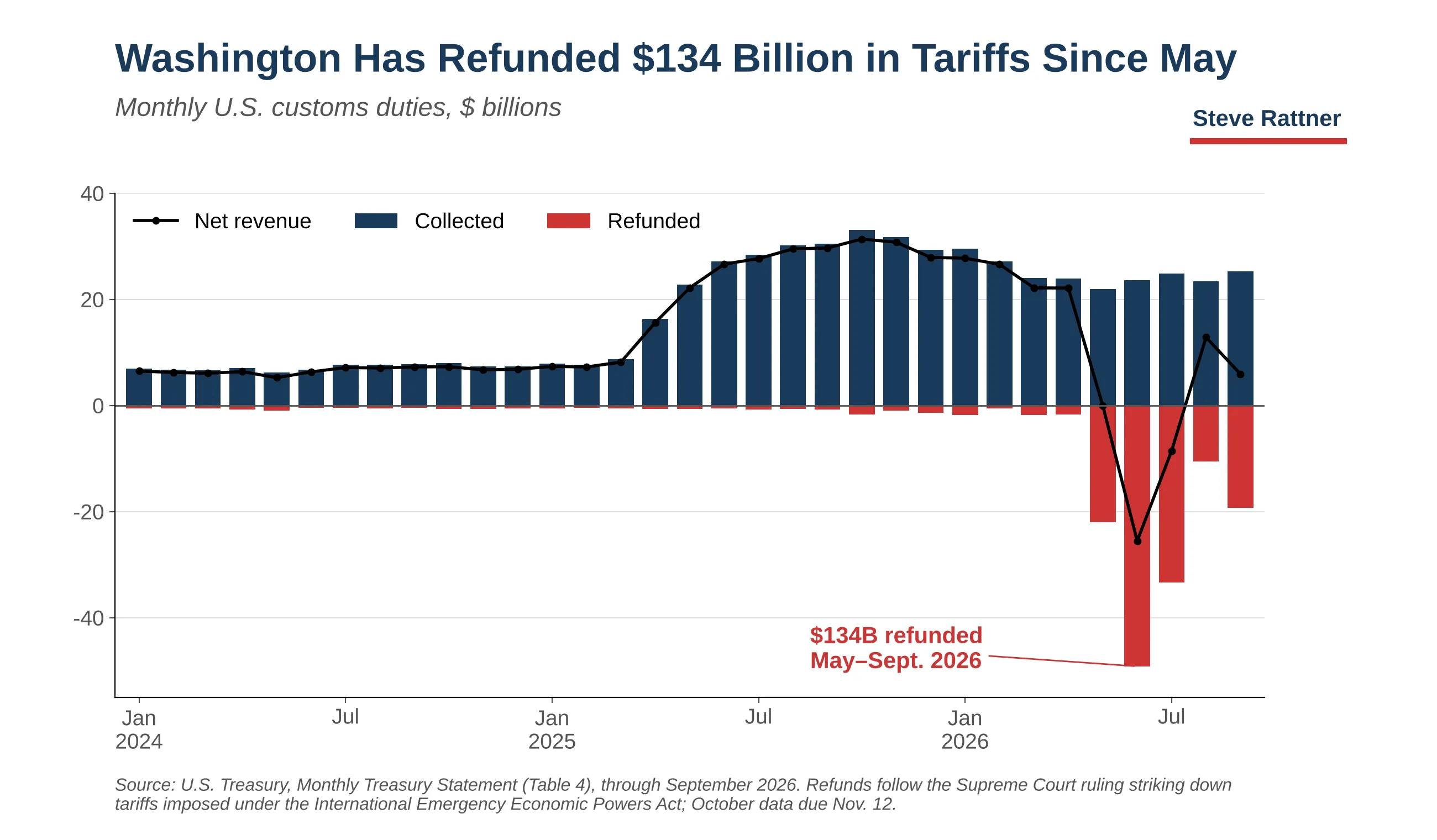
Since May, the federal government has handed back more in tariff refunds than it has collected in new tariffs. Treasury's own numbers show $134.4 billion refunded against $119.0 billion collected from May through September, which is 113 percent of new collections and a net loss of about $15 billion on customs duties. The tariff cash machine has been running in reverse.
The Numbers, Because They Are Hilarious
Financier and former Obama Treasury official Steve Rattner flagged the math on Bluesky this week, and the Treasury's own Monthly Treasury Statement backs it up. From May through September 2026, Washington collected $119.0 billion in customs duties. In the same stretch, it refunded $134.4 billion. Subtract one from the other and you get negative $15.4 billion.
Collections have settled at roughly $22 to $25 billion a month this year. Rattner's chart shows them running around $30 billion a month at the 2025 peak. The refunds are what blew a hole in the ledger. Before May they barely registered. In April, the government refunded just $1.8 billion against $23.9 billion collected.
Rattner's chart, titled "Washington Has Refunded $134 Billion in Tariffs Since May," makes the picture plain. The red refund bars start dropping below the line in May, and in June one of them is more than twice the height of that month's blue collections bar.
June Was the Month the Machine Broke
Here is the month-by-month damage, straight from Treasury Table 4. May: $21.9 billion collected, $22.0 billion refunded, net basically zero. June: $23.6 billion in, $49.2 billion out, net negative $25.6 billion. July: $24.8 billion in, $33.4 billion out, net negative $8.5 billion.
August and September turned positive again, at $12.8 billion and $5.9 billion net, because refunds slowed to $10.5 billion and $19.4 billion. That is the only reason the five-month hole is $15 billion and not much worse. Refunds outran collections in three of the five months, and one of those three was a rounding error.
The October figures are due from Treasury on Nov. 12.
How We Got Here: The Supreme Court Said No
In February, the Supreme Court ruled that President Trump lacked the authority to impose his sweeping tariffs under the International Emergency Economic Powers Act, the law behind the Liberation Day tariffs. Once the ruling landed, importers that had paid those duties became eligible to get the money back.
We have been following the refund pipeline since it opened. By late July, companies had been sent $70 billion, including $49 billion in June alone, which matches Treasury's June figure above. In early August, a court filing cited by CBS News put the total at more than $100 billion, roughly 60 percent of what the government owes. NPR has reported that the government is processing more than $160 billion in refunds.
Set Treasury's $134 billion refunded through September against that $160 billion-plus figure and, if it holds, around $26 billion or more is still to come. That is our arithmetic on two published numbers, not a Treasury forecast, and October's data will show how fast it is moving.
Who Got the Money and Who Got Nothing
The refunds go to importers, the companies that paid the duties, not to you. Senator Elizabeth Warren has cited Congressional Budget Office data showing that American families absorbed roughly 95 percent of the tariff costs through higher prices. The check goes to whoever wrote the original check to customs.
Apple reported a $2.2 billion refund, and Amazon disclosed $600 million. Walmart said it received nearly $3 billion and is putting the money into price rollbacks, which is the one corporate response in this saga that resembles good news. Warren sent letters to Apple, Amazon, Energizer, Motorola, Nike, Target, and Walmart asking where the money is going. At the time, none of them had responded to CBS News when asked for comment.
For regular people, the picture is grim. UPS, FedEx, and DHL itemized tariffs on their bills and say they will pass refunds back. As of NPR's August reporting, a woman in Tampa was still waiting on a $3,500 wheelchair surcharge. If you bought something at a store that simply raised its prices, legal experts told NPR the tariff cost was stirred into the batter, which makes it hard to see how that money finds its way back to you.
The Receipt
The outcome is a tax that Americans paid, that the Supreme Court said was illegal, and that the government is now unwinding at a net cost to the Treasury. Consumers absorbed the price hikes, and the refunds are flowing to the importers.
Three things to watch: the October Treasury numbers on Nov. 12, whether the remaining refunds keep customs revenue below zero in some months, and whether any company that raised prices on tariff cover passes the money back without being pushed.
The Dingo Take
Who is supposed to look at this ledger and call it a win? The Treasury's customs line is down $15 billion over five months, consumers paid the inflated prices, and the refunds are flowing to the companies that did the importing.
The administration will say the court overstepped, or that the tariffs worked as leverage, or that the refunds are a one-time accounting quirk. Fine. Make the case. But the Treasury's own table says what it says, and no amount of Liberation Day branding turns negative $25.6 billion in June into a triumph.
Here is the part that should bother you. This was an illegal tax collected from the public, and the public is last in line to get anything back. If Walmart can turn its refund into rollbacks, every company that raised prices on tariff cover can too. The question is whether anyone with power makes them, or whether Warren keeps mailing letters while shareholders count the cash.


Comments