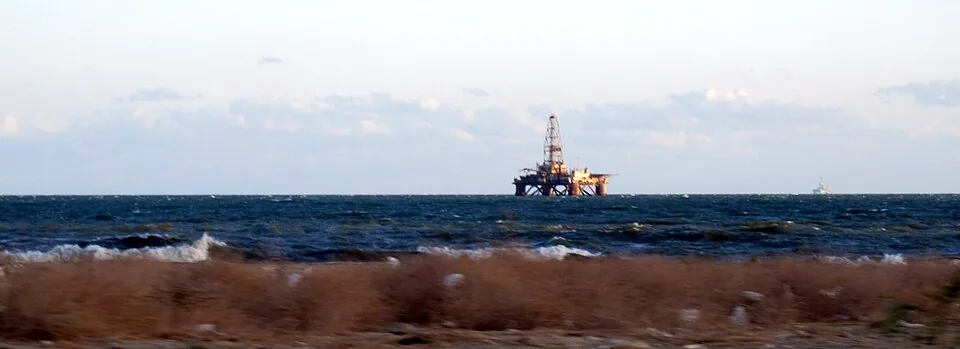
The Trump administration is considering letting oil companies shove their retired California drilling platforms over and leave them on the ocean floor, saving the industry hundreds of millions of dollars in cleanup costs. The idea was tucked into an executive order that was supposedly about recreational fishing. You know, the thing you do with a rod and a cooler of lukewarm beer.
Explain Like I'm 5 · 47-second video

Narrated and captioned. Made by The Dingo Daily from this article.
A Fishing Order With a Wrecking Ball Inside
According to the New York Post, the whole thing traces back to a little-noticed provision in a September executive order that was primarily about recreational fishing. In it, President Trump told the Department of the Interior to build a federal program that would let retired oil platforms stay underwater and serve as artificial reefs.
That alone would be a notable shift. But the administration is eyeing something bigger. A regulatory proposal scheduled for 2027 would make "toppling in place" the standard way to retire offshore platforms.
The method is exactly what it sounds like. Instead of dismantling a platform and hauling it away, crews knock over all or most of it and leave it lying on the seabed. Think of it as the maritime version of shoving your couch into the woods because the landfill charges a fee.
Two Hundred Million Reasons to Care
Here's why the industry is salivating. Federal estimates say fully removing some of the largest offshore platforms could cost more than $200 million apiece. Multiply that across California's fleet and you're talking about a staggering pile of money that companies would simply never have to spend.
California has 23 oil platforms in federally controlled waters. Eight of them are already in various phases of being retired. Another four sit in state waters.
Robert Collier, an oil industry consultant who flagged the proposal on his Substack, Offshore California, called it "a huge windfall for oil companies in comparison to full removal." He told the LA Times it would let them dodge hundreds of millions in expenses along with "complex engineering and contracting problems." Complex engineering problems. That's the polite phrase for "the part where you have to actually clean up your mess."
California Has Never Done It This Way
This would be a sharp break from how the state handles its aging rigs. Every platform in California that has been taken out of service has been fully removed. Every single one.
Toppling in place has been used in the Gulf of Mexico. It has never been done in the Pacific off California. So the administration isn't extending an existing practice here so much as exporting a Gulf shortcut to a coastline with very different politics and a very long memory for oil spills.
And the timing is something. The White House is also working to open parts of the Pacific to new offshore oil leases for the first time in more than four decades, while chasing more leasing in Alaska and the Gulf. Drill more, clean up less. It's a business model.
The Reef Argument Isn't Totally Crazy
In fairness, and we do try to be fair when the facts demand it, there's a real scientific argument on the other side. Milton Love, a research biologist at UC Santa Barbara, told the LA Times that platforms often turn into thriving habitats for marine life over their decades of operation.
"They happen to be living next to a piece of steel, and you're going to kill them for that? I just don't think that's right," Love said.
That's a legitimate point, and plenty of marine researchers share it. The problem is who gets to benefit from it. A reef program that happens to save oil companies $200 million per rig is a reef program with a very motivated lobbying constituency. Good science and a fat corporate subsidy can be true at the same time, and here they are, holding hands.
Meanwhile, Sable Is Running Out of Money
Now for the subplot that makes the whole thing funnier in the darkest possible way. Houston-based Sable Offshore Corp., which restarted pumping oil from its Santa Barbara platforms in March, watched its stock crater to an all-time low on Nov. 9 after warning investors it could soon run out of cash. Reuters reported shares fell as much as 60.5% to 76 cents.
In an SEC filing, Sable admitted "substantial doubt" about its ability to stay in business. Its main customer, Chevron, stopped buying its crude in early October because of refinery storage tank maintenance. Sable had to throttle back production to keep its own storage from overflowing, and the revenue dried up just as the bills came due. The company has since lined up three more Los Angeles-area refineries and is hunting for cash by selling stockpiled crude and seeking financing.
This is the company at the center of a bitter legal fight between California and the Trump administration. In March, Energy Secretary Chris Wright invoked the Defense Production Act to prioritize moving Sable's oil, citing national defense. California sued, joined by environmental groups and 20 other states. The pipeline in question is the same one that ruptured in 2015 from severe corrosion and fouled the coast near Refugio State Beach.
The Feds Versus Everyone Else
Maggie Hall, deputy chief counsel at the Environmental Defense Center, put it bluntly in an Oct. 22 statement: "We're facing an unprecedented situation where the federal government is brazenly undermining laws, court orders, and even state property rights for the benefit of one oil company."
One oil company. A company that just told its investors it might not exist soon. The federal government invoked wartime production powers to help it move crude, and now the same administration is weighing a plan that would let the industry walk away from its junk at the bottom of the ocean.
The Dingo Take
In 1989, the Exxon Valdez ran aground and Exxon spent years in court fighting over what it owed Alaska for the mess. The playbook has always been the same: privatize the profit, socialize the cleanup, and litigate until everyone gets tired. What's new here is that the administration is trying to skip the lawsuit and just write the exemption into the rulebook ahead of time.
Look at the sequence. A fishing order that quietly plants the idea. A 2027 rule that would make it standard. A bailout-adjacent legal crusade for a company whose own filings say it may not survive the winter. At no point in this chain does anyone seem to ask who pays when a few thousand tons of corroding steel sit on the Pacific floor for the next century. Spoiler: not the guys who built them.
The reef argument deserves a real hearing from real scientists, with real data, on a platform-by-platform basis. What it doesn't deserve is to be used as a fig leaf for a $200 million-per-rig discount. If toppling in place is truly better for marine life, make the companies prove it and keep contributing to cleanup funds. If it's mostly better for their balance sheets, call it what it is. A gift. Wrapped in a fishing license.




Comments