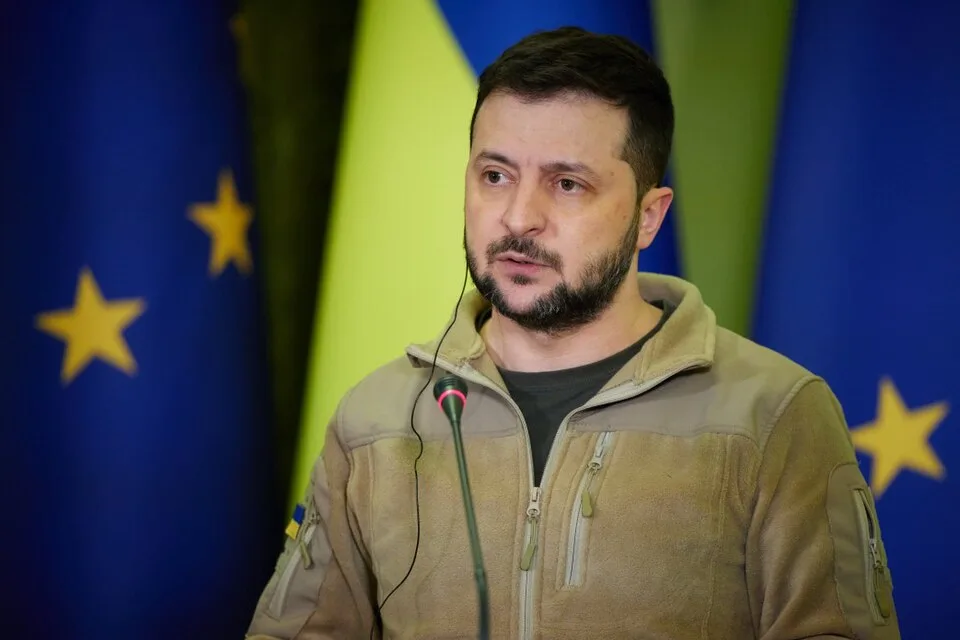
Ukraine's interceptor drones lose their connection to their operators at about 100 mph. Russia's jet-powered Shahed drones fly faster than that, so the chase ends before it starts. President Volodymyr Zelensky is now publicly asking the United States and Elon Musk to lift the speed restrictions on Starshield, the military satellite service the US government provides to Kyiv, and to be "on the right side of history" while they're at it.
Winter is coming. The substations are already burning.
Explain Like I'm 5 · 41-second video

Narrated and captioned. Made by The Dingo Daily from this article.
A Speed Limit On The Thing That Stops The Bombs
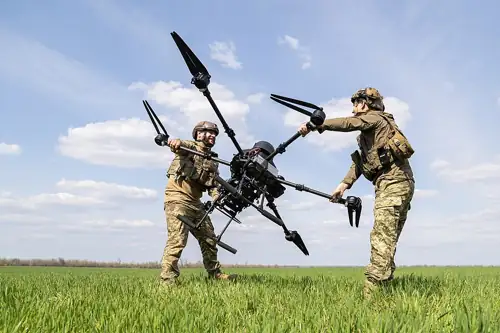
Here's the setup, as laid out by the BBC. Ukraine runs two flavors of Musk's satellite network. Regular Starlink handles battlefield communications. Starshield, the military-grade version provided to Ukraine by the US government, is what ties interceptor drones to the people flying them as they hunt incoming Russian aircraft.
The problem is that Starshield terminals have been throttled. Zelensky said Sunday that the restrictions on operating speed along the front line and in occupied territories are still in place. His interceptor drones, he posted, "lose connection with their operators at a speed of 161km/h (100mph) and simply cannot catch up with Russian jet-powered 'shaheds.'"
Read that again. The defensive weapon is tied to a connection that drops out right around the speed it needs to exceed. It's like handing a goalkeeper a pair of shoes that fall off when he jumps.
The Blame Game Nobody Wins
The speed issue first surfaced in October, and the explanation since then has been a masterpiece of nobody owning anything. Musk said the US government was responsible because Starshield is controlled by them. Trump denied responsibility and said he had told the billionaire to "put it back."
So the richest man on Earth points at the government. The president of the United States says he told the richest man on Earth to fix it. And somewhere between those two pointing fingers, a drone loses its link and a Russian aircraft flies on toward a power station.
Things appeared to return to normal after a week. Then Ukraine said the restrictions were still being implemented. Zelensky said speed limits of around 100 mph had been enforced since Monday, but only in Russian-occupied areas, not across the whole country. That detail matters, and we'll get to why.
Why A Speed Cap In Occupied Territory Is Political
Zelensky told the New York Times the restriction "already has political implications." His reasoning: "If you impose restrictions there, you are already partially recognising the temporary occupied territories as not ours."
That's a sharp point. Satellite coverage isn't just a technical feature. Who gets full service and where is a map, and maps are arguments. A throttle that applies only to land Russia has taken looks a lot like a quiet concession that the land has changed hands.
Whether anyone intended that message is unclear. The BBC has asked the White House and Starlink for comment. But the timing is hard to ignore, and the context makes it worse.
The Timing Is Not Subtle
The connection problems coincided with a tense diplomatic stand-off between Zelensky and Trump over Ukrainian strikes on oil infrastructure inside Russia. Trump complained the strikes on Russian refineries had pushed global prices higher. Kyiv says those refineries are crucial because oil is the main revenue source for Moscow's war effort.
Zelensky also said the US has floated Ukraine ceding Donbas in exchange for NATO membership. So the backdrop is a US president leaning on Ukraine over refineries and territory while a throttle sits on the system that protects Ukrainian power stations. We can't prove a link between those things. We also can't blame anyone for asking.
Add a shortage of US-made Patriot interceptors, which Russia has exploited to intensify its strikes, and Ukraine is being squeezed on the high end and the low end of air defense at once.
Meanwhile, The Power Grid Is Taking The Hits
None of this is theoretical. Overnight into Sunday, Russia hit energy infrastructure in Zaporizhzhia and the Sumy, Odesa, Zhytomyr, and Kirovohrad regions, and struck railway infrastructure in the Dnipro, Kharkiv, and Zaporizhzhia regions. Scores of people are said to have been hurt. Two people were killed in an attack on an infrastructure facility in Mena, in Chernihiv Region, according to governor Vyacheslav Chaus.
Ukraine hit back. Its military said it reached Nizhnekamsk in Tatarstan overnight and struck a petrochemical plant and an oil refinery there. Other Ukrainian strikes killed one person in Taganrog, and in occupied Luhansk a lorry driver and an elderly woman were killed, according to the Moscow-installed regional leader.
Zelensky was blunt about the stakes: "The protection of lives and Ukraine's energy infrastructure ahead of winter directly depends on this." Substations are what keep heat and light on when it gets cold. The drones he can't catch are aimed at exactly those.
Estonia Closes The Door
One more piece of the regional picture. Estonia announced it will shut its border crossing points with Russia from 1 December after a suspected sabotage attack on a defense company. Eight people were detained over an attempted arson attack on drone maker Threod Systems. Estonian authorities say Russia's GRU military intelligence ordered it. Russia has not commented.
"Russia must understand that hostile actions against Estonia come with consequences," Foreign Minister Margus Tsahkna said. That's what a government sounds like when it decides to act. Compare that to the Starshield situation, where nobody will say whose job it is to flip the switch.
The Dingo Take
In 1940, the British Army left the beaches of Dunkirk with its men and almost none of its equipment, because the guns and vehicles stayed behind on the sand. A force can survive without its gear for a while. It cannot hold a line without it. Ukraine's interceptor drones are the same problem in miniature: the aircraft exists, the pilots exist, the will exists, and a throttle on a satellite link decides whether any of it matters.
Here's the part that should make everyone furious. The man whose company built this system and the man who runs the government that supplies it are both on record denying it's their fault. Musk says it's the government's. Trump says he told Musk to put it back. Meanwhile a Shahed with a jet engine outruns a defense that was supposed to catch it, and the bill arrives as dead people and dark apartments in November.
Zelensky asked them to be on the right side of history. That's a generous framing for what's actually a plumbing request. Nobody needs a moral awakening here. Someone needs to pick up a phone, find the setting, and move it. If the answer is that a $400 billion satellite empire and the most powerful government on Earth cannot figure out which of them owns a speed limit, then the problem is bigger than any single drone.



Comments