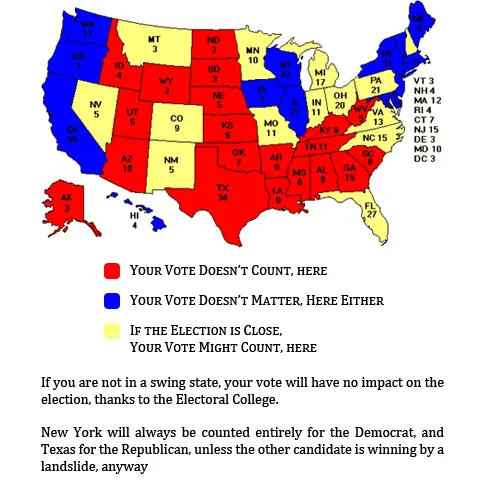
The compact to bypass the Electoral College sits at 222 electoral votes. It needs 270. Thanks to this month's Democratic midterm sweep, five battleground states are about to land fully in Democratic hands, and they carry 61 electoral votes between them. Do the math, because proponents already have.
Explain Like I'm 5 · 49-second video

Narrated and captioned. Made by The Dingo Daily from this article.
The Math Is Not Subtle
Here's how the National Popular Vote Interstate Compact works. States agree to hand their presidential electors to whoever wins the nationwide popular vote, regardless of who won inside their own borders. The deal only kicks in once the member states collectively hold 270 electoral votes, enough to decide the presidency by themselves, as NPR reported.
Right now the compact has 222. That's 18 Democratic-led states plus the District of Columbia. Virginia recently joined the party. No Republican-led state has signed on, and the GOP isn't unified on the idea.
Next year Democrats will fully control Arizona, Pennsylvania, Michigan, Nevada and Wisconsin. Those five add up to 61 electoral votes. Any combination of at least four of them pushes the compact past 270. Four states. That's the whole distance between the current system and a very different one.
Two Governors Are Already Open to It
The governors and incoming governors in Pennsylvania and Nevada have said they're open to signing legislation that would bring their states in. That's two down, at least rhetorically, and the other governors haven't publicly weighed in.
Then there's Arizona. Gov. Katie Hobbs previously supported the measure, but she hasn't commented recently on whether her state's new Democratic majorities should sign on. Her office didn't respond to NPR's request for comment. Funny how enthusiasm for a reform can cool right when you become the deciding vote.
Proponents are bullish anyway. "I've never been more confident that 63% of American voters can get what they want in the 2028 presidential election, which is a national popular vote for president," said Patrick Rosenstiel, a senior consultant to National Popular Vote, citing Pew polling.
The Swing State Sacrifice Problem
Here's the part nobody in a campaign office wants to say out loud. All five of these states are presidential battlegrounds. Their entire political value comes from the fact that candidates must grovel for their votes every four years. Sign the compact and you trade that influence for a system where a vote in Pennsylvania counts exactly as much as a vote in Wyoming.
That's the principled argument for the compact, and it's also a real ask of local politicians. Every governor and legislative leader in these states has to decide whether to give up that leverage ahead of 2028. They also have to decide whether they want their fingerprints on the move that tips the whole thing over 270.
Nobody wants to be the guy who pulled the pin. But somebody has to be.
The Constitution Has Some Questions
Now for the legal fog. Some scholars argue the compact could violate the Constitution's compact clause, which says no state may enter an agreement with another state "without the consent of Congress." Congress hasn't given that consent, and with the current partisan split, it isn't racing to.
Norman Miller, a constitutional law professor at Willamette University, raised practical objections too. States set their own rules about who votes and how. Forcing one state's electors to follow another state's tallies could create tension. He'd prefer standardized rules and a federal election authority doing the counting, and warned that entrusting a national election to 51 separate administrators could "sow discord and distrust."
John Koza, chairman of National Popular Vote, waves that off. States already issue certified vote counts, he said. "All that has to be done is add them up." No new bureaucracy required, and no presidentially appointed commission that could be manipulated.
Why Not Just Amend the Constitution?
Miller's biggest objection is about process. If you want to scrap the Electoral College, he argues, do it the honest way, through an Article 5 constitutional amendment. Only an amendment can address all the legal and practical difficulties at once.
It's a fair point and also a fantasy. An amendment needs two-thirds of Congress and three-fourths of the states. That means dozens of small, Republican-leaning states voting to shrink their own outsized influence. The compact exists precisely because that road is blocked.
Opponents like Save Our States argue that without Electoral College incentives, politics would turn more regional and deepen existing divides. Supporters would say it turns the opposite way, with candidates forced to chase votes in every state instead of ignoring 40 of them. Both sides are arguing about a future none of them can verify.
The Dingo Take
"All that has to be done is add them up." That's the compact's chairman, John Koza, and no, John, it is not that simple, as anyone who watched the 2020 certification fights remembers. Adding up certified counts from 50 states and a district sounds clean right up until a few of those states decide their counts are negotiable. A national election run on 51 separate administrators is a bigger target than the current system, not a smaller one.
But look at the other side of it. Under the current setup, a candidate can lose the national popular vote and still walk into the Oval Office. It's happened twice this century. And a handful of swing states decide everything while voters in the rest of the country get campaign ads for a different state's governor. The system everyone is so worried about disrupting isn't some sacred machine. It's an accident of 18th century compromise that happens to reward a very specific kind of map.
So here's where we land. The compact is legally shaky, politically fragile, and dependent on a few Democratic governors being willing to give away their states' power. It might not survive a court. It might not survive Katie Hobbs's second thoughts. But a plan that requires four swing-state signatures to upend how America picks its president is closer to real than it has ever been. Pay attention. The people who benefit from the current map certainly are.


Comments