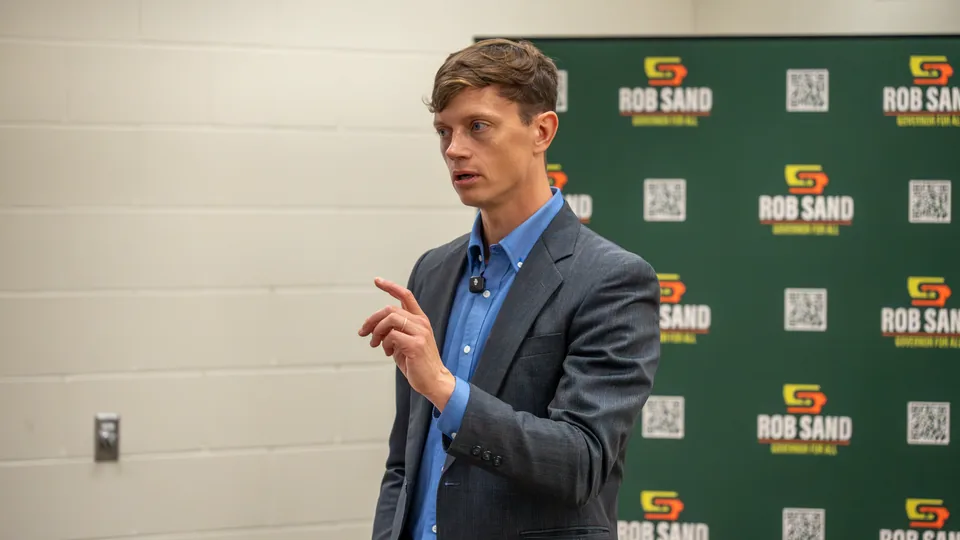
Trump has ordered the Army to hold off on blowing up roughly 9,500 pounds of unstable lead azide at an Iowa ammunition plant until a federal appeals court and Democratic Gov.-elect Rob Sand sign off. If they don't, he says, he will hold Sand responsible for "any and all death or destruction." Sand does not take office yet, and the explosives have been sitting in Iowa for more than two decades.
That is the whole move. Hand a Democrat the keys to a ticking bomb, then announce in advance whose fault it will be.
Explain Like I'm 5 · 41-second video

Narrated and captioned. Made by The Dingo Daily from this article.
Sixty-Eight Drums and a Truth Social Post
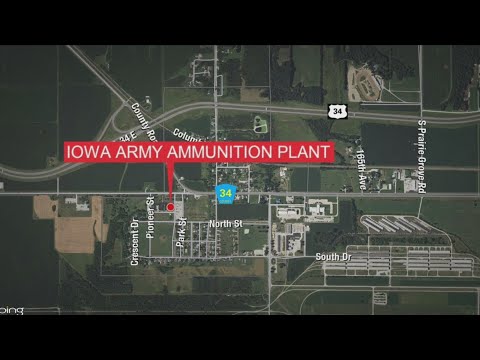
Here is what happened, per reporting from Axios and NBC News. The Army has 68 drums of deteriorating lead azide, a chemical used to make bomb triggers, stored at the Iowa Army Ammunition Plant in Middletown. The plan was to detonate it in place. The blast would send a plume of lead dust across Iowa and likely into neighboring states.
On Monday, Trump posted that he had ordered the military not to proceed "until such time as the Eighth Circuit agrees that we can go forward," and that the decision was "fully subject to the incoming Governor Elect, Rob Sand, agreeing to the operation." He also said the "Experts" believe there is a "substantial chance that this material will explode of its own volition, perhaps sometime in the near future."
So the explosives might go off on their own, but also we are going to ask permission first. Both of those things are in the same post.
The Blame Is Pre-Packaged
Read the second half of the post slowly. "If he or the Courts do not agree," Trump wrote, "we will have no choice but to not proceed with the controlled removal of these hazardous materials, and be forced to hold the incoming Governor responsible for any and all death or destruction caused by this very unfortunate, and longterm, situation."
No choice. Forced. The man who commands the Army is a helpless bystander in his own sentence.
Sand is a governor-elect. He has no authority over a federal Army installation, and the Army's own filings treat the detonation as an emergency action that does not need the usual permit. Yet the president wants the blame for a disaster assigned to a man who currently has no power to prevent it. That is not deference. That is a liability transfer dressed up as federalism.
A Schedule Written in Pencil
The detonation was first set for Friday. After public outcry and a lawsuit from the Iowa Environmental Council and the Sierra Club, the Army pushed it to Monday, then Tuesday, then Wednesday, the day before Thanksgiving. The Army said Wednesday offered optimal weather and time to put all mitigation measures in place.
The Eighth Circuit had already issued an administrative stay last week, putting the Army's environmental permit on hold. The Justice Department told the court that the Army could go forward anyway under emergency authority, citing an "immediate risk" of spontaneous explosion once temperatures fall below 30 degrees Fahrenheit. Environmental groups accused the government of sidestepping the judicial process. Earthjustice attorney Thien Chau said the Army seemed "more concerned over the weekend with finding a way to sidestep the judicial process than on meeting the public's demands for greater transparency."
Now the timeline is unclear again. Iowans trying to plan Thanksgiving travel around a toxic plume have been handed a calendar with no dates on it.
Iowa Found Out From a Press Release
The transparency problem is not a side issue. It is the story. WIRED reported that Mediapolis Mayor Charles Massner got a vague email from the Army on October 26 about an upcoming "intentional, controlled detonation." It gave no date, no quantity, and no public safety guidance. The next thing he heard was the Army's November 15 press release, which included a map of the exposure zone. His town was covered in a reddish-yellow cloud.
Gov. Kim Reynolds' office said it learned about the plan the same way, from the press release. One local official in the potential fallout path told WIRED she was leaving the area and staying at a hotel with her immunocompromised child. Peter Thorne, a University of Iowa environmental health professor and former chair of the EPA's Science Advisory Board, said of the Army's outreach: "Best practice is not what they've done. I think this is closer to worst practice, from a public health perspective."
Lead is a neurotoxin with no safe level of exposure, especially for young children. Residents near Middletown have been sealing their windows and doors. Officials are telling people to stay indoors and rinse outdoor surfaces afterward. Thorne expects exposure from the blast to be well below what communities near legacy pollution sources face, but that is cold comfort when nobody told you it was coming.
The Contract That Vanished
Why is this a crisis in late November? The material has been in those barrels for more than 20 years. Staff found the degraded lead azide in March, and the Army officially labeled it hazardous waste. According to The New York Times, as relayed by WIRED, the Army awarded a contract that same month to a private company to clean it up onsite. Two months later, the contract was pulled.
The company said the Army gave no reason. A contracting officer reportedly told the firm the decision to pursue detonation "was not based on deficiencies" with its science. The EPA says it considered alternatives such as chemical neutralization, but handling the drums raised the chance of a fatal accidental detonation. Environmental groups argue other options were not fully weighed.
Sand put the question plainly. He asked why the contract was canceled, why nothing was done, and "why we are rushing to demolition now in late November." He said no good options remain and that the situation is "more dangerous and unpredictable than it ever should have been." Iowa's incoming Democratic Sen. Josh Turek has called for a full probe into how the material was allowed to degrade.
What Everyone Agrees On
Not everyone is against the blast. Middletown Mayor Rodney Johnson said the detonation "must take place," arguing that "it doesn't matter who dropped the ball" and that lives could be at stake if the material is not disposed of safely. Army Col. Aaron Teller told the court that even a small amount of friction can break the crystal formations inside the barrels and trigger a chain reaction.
That is the real bind. A controlled detonation may well be safer than an uncontrolled one, and the people closest to the danger know it. Nobody serious is arguing the drums should be left to freeze and wait for fate.
But "it may be necessary" and "the government handled this competently" are two separate claims. The first can be true while the second is a disaster.
The Dingo Take
"The proper course is to get rid of this longterm problem," Trump wrote. Great. A longterm problem that the Army sat on for two decades, that it ruled hazardous in March, that it cancelled a cleanup contract over, and that it announced to the public by press release a week before blowing it up. The proper course was available in March. Nobody took it, and now the guy in charge is auditioning for the role of bystander.
Look at what the Trump administration has actually done here. It created a no-win situation through inaction, scheduled a toxic blast for the eve of a holiday, told Iowans almost nothing, and then, with the clock ticking, asked a Democrat who is not yet governor to sign off so the blame lands on him if it goes wrong. If the Eighth Circuit says no, that's the court's fault. If Sand says no, that's Sand's fault. If the drums go off on their own, that's also somehow Sand's fault. The only person who cannot be at fault, in this telling, is the Commander in Chief of the Army that owns the explosives.
Iowans deserve what Thorne described: public meetings, real answers, a plain explanation of why this is the only option and what it costs. What they got is a countdown, a map, and a president who wants a scapegoat in place before the first window rattles. Sand is right that safety should be everyone's top priority. It would be nice if the federal government had acted like it in March.


Comments