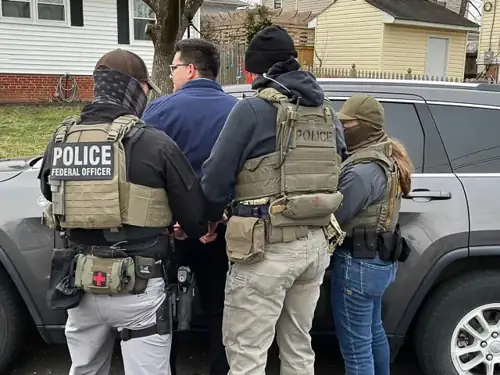
A Black father in Jackson Township, New Jersey says police pulled him over and arrested him on June 2nd for one reason: he was wearing a hoodie on a warm spring day outside his own apartment complex. He filmed the whole thing, posted it to Facebook, and now the four-minute video is doing what videos like this always do, which is make a lot of people very uncomfortable and a smaller number of people inexplicably defensive about the hoodie.
What Actually Happened Outside His Apartment
According to the New York Post, the man was outside his apartment complex in Jackson Township when officers approached him. He started recording almost immediately. The confrontation lasted roughly four minutes before it ended in his arrest.
He posted the footage to Facebook himself. That detail matters. He wasn't trying to hide anything. He wanted people to see exactly what he says happened to him, in real time, with no editing and no narration required.
The core of his account is blunt: he was stopped because he is Black and because he was wearing a hoodie when the weather was warm enough that a hoodie read as suspicious to somebody. That's the allegation. A piece of clothing. On a man. Outside his home.
The Hoodie as Criminal Evidence, Apparently
Let's just sit with this for a second. A hoodie. A garment so common it is currently being worn by approximately forty percent of people reading this sentence. The implicit logic here, if the man's account holds up, is that a Black man in a hoodie on a warm day was more suspicious than whatever else was happening in Jackson Township that afternoon.
This is not a new story, which is the most depressing part of writing it. Trayvon Martin was killed in 2012 partly because a man decided a Black teenager in a hoodie was inherently threatening. Fourteen years later, according to this man's account, the hoodie is apparently still doing investigative work for law enforcement in New Jersey.
Jackson Township has not, as of the Post's reporting, offered a detailed public account of what justified the stop or the arrest. The officers involved have not been named in the coverage. We are working, for now, with what the video shows and what the man says.
The Video Does What Videos Do
Posting the footage to Facebook was a deliberate choice. It's the move people make when they don't trust that an official complaint will go anywhere, when they've watched enough of these stories to know that the paperwork version of events and the video version of events don't always match.
Four minutes is a short window, but it's enough. These clips have a way of concentrating everything ugly about a moment into something impossible to unsee. Whether this particular video reaches the viral threshold or stays within a regional news cycle, the man who filmed it has created a record that exists outside the police report.
The New York Post report is thin on follow-up details, which means either the story is still developing or the institutional response has been the usual: say as little as possible and wait for the attention to drift somewhere else.
New Jersey's Track Record Makes This Harder to Dismiss
New Jersey is not exactly a state with a clean record on racial profiling by law enforcement. The state famously settled a landmark racial profiling case involving the New Jersey State Police back in 1999, a consent decree that dragged on for years and cost the state significant money and credibility. That was over two decades ago.
Jackson Township sits in Ocean County, a part of the state that has faced its own scrutiny over civil rights issues in recent years. Context doesn't prove this specific man's specific account, but it makes the reflexive "surely there's more to it" response a little harder to sustain.
What would "more to it" even look like here? The man was outside his apartment. He was wearing a hoodie. He is Black. He got arrested. Those are the facts on the table.
Where This Goes From Here
The man's next steps, whether that means a formal complaint, a civil rights attorney, or watching this disappear into the void of stories that briefly trend and then dissolve, are not yet clear from the Post's reporting. These situations fork in a few directions. Sometimes they result in charges being dropped, a quiet settlement, and a nondisclosure agreement. Sometimes they result in nothing at all.
Occasionally they result in actual accountability, but that outcome is rare enough that mentioning it feels almost sarcastic.
What we do know is that a man filmed his own arrest because he believed, in the moment, that having a record was his best protection. That instinct says something about the relationship between this community and the people paid to protect it.
The Dingo Take
Here's the thing about stories like this one. They're not shocking anymore, and the fact that they're not shocking anymore is itself the scandal. A Black man gets stopped outside his apartment, says he was targeted for wearing a hoodie, films the arrest, and posts it online. This is now a recognizable genre. It has a structure. We all know the beats.
Jackson Township officers have not rushed to explain themselves, which is also a recognizable beat. The institutional silence after these incidents is almost its own form of communication. It says: we don't think we owe you an explanation, and we're probably right about what happens next. That calculation has been correct often enough that it's hard to call it arrogance. It's closer to experience.
The man outside his apartment complex was not asking for a lot. He was existing near his own home in clothing that half the country owns. Whatever the full story turns out to be when more reporting surfaces, the starting premise, that a hoodie on a Black man on a warm day constitutes a reason to make contact, is not a neutral or defensible place to begin. It's a tell. And everyone watching that four-minute video already knows what it's telling them.




Comments