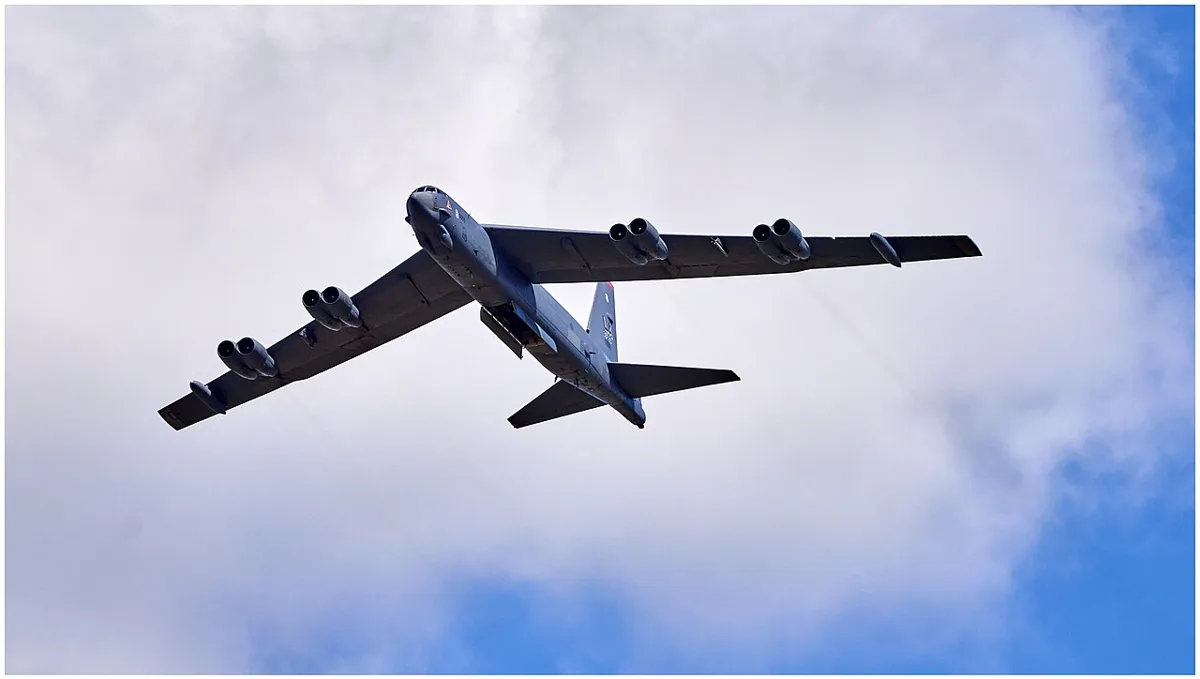
A US Air Force B-52 Stratofortress -- a nuclear-capable strategic bomber that has been actively flying bombing raids on Iran -- crashed shortly after takeoff at Edwards Air Force Base in southern California on Monday morning. A massive plume of black smoke rose over the western Mojave Desert and was visible for miles in every direction. As of this writing, the Air Force has not confirmed whether anyone on board survived.
What We Know Right Now
The crash happened at 11:20 a.m. local time on June 15th, according to Edwards Air Force Base, which released a terse statement confirming the incident. Emergency crews responded immediately, and the base described the situation as 'ongoing.' That is essentially all the official information available.
Aerial footage of the crash site showed a charred, smoking burn scar on the desert floor, which is about as grim as visuals get. CBS News reports the crash left a large smoldering mark on the land. Edwards Air Force Base sits in the western Mojave Desert, roughly 100 miles northeast of Los Angeles, which at least means this happened in one of the most sparsely populated stretches of California rather than over a city.
The Air Force has not said how many crew members were on board or provided any update on their condition. A B-52 typically carries five crew members: an aircraft commander, a pilot, a radar navigator, a navigator, and an electronic warfare officer. Five people. No word yet.
The Plane That Just Won't Die -- Until Now
The B-52 Stratofortress has been in continuous service with the US military since the 1950s. As BBC News points out, the aircraft is affectionately nicknamed 'the Buff,' which stands for 'Big Ugly Fat.' The full version of that nickname involves a word the Air Force apparently decided was unsuitable for official use.
This thing is a flying relic from the Cold War era that the military has refused to retire because nothing built since has matched its sheer payload capacity. It can fly at up to 50,000 feet, well above the cruising altitude of commercial airliners. It can refuel mid-air, giving it what the BBC describes as a 'potentially unlimited strike range.' That capability, paired with its ability to carry up to 32 nuclear cruise missiles, is what gave the United States its so-called 'nuclear umbrella' during the era of Mutually Assured Destruction.
For conventional warfare, the plane can carry 70,000 pounds of bombs. That is not a typo. Seventy thousand pounds. The B-52 is less an airplane and more a flying warehouse of destruction, and the US military has been flying them in combat operations against Iran.
The Iran Context Nobody Should Gloss Over
Here is the detail that makes this story considerably bigger than a routine military accident. According to BBC News, the B-52 is among the aircraft that has been participating in bombing raids on Iran during the ongoing US-Israeli war against the country.
We do not yet know if this specific aircraft had flown missions over Iran or was being used for testing and training at Edwards -- which is primarily a flight test base. The Air Force has not said. But the timing, and the type of aircraft involved, is not a small footnote. This is a nuclear-capable strategic bomber crashing on American soil in the middle of an active war the United States is fighting in the Middle East.
That combination of facts deserves more than a shrug and a refresh on the base's press release page.
Edwards AFB and What This Base Actually Does
Edwards Air Force Base is not your average military installation. It is home to the Air Force Test Center and has been the proving ground for some of the most significant aircraft in American military history, from the Bell X-1 that Chuck Yeager flew through the sound barrier in 1947 to the Space Shuttle landings. When a plane crashes at Edwards, there is a reasonable chance it was doing something experimental or being pushed through its paces in ways that routine operational bases do not attempt.
That context matters for understanding why a B-52 might have been taking off from Edwards specifically. It could have been a standard flight test, an upgrade evaluation, or something related to new weapons systems. We do not know. What we do know is that the base confirmed the crash, confirmed emergency crews responded, and confirmed that more information would be released as available -- which is the military equivalent of 'do not call us, we will call you.'
The Dingo Take
Let's be honest about what is happening here. The United States is in the middle of an active war with Iran, flying decades-old nuclear-capable bombers on combat missions, and one of those bombers just went down on American soil within minutes of leaving the runway. The Air Force's response so far has been a single statement that contains almost no information. The crew status is unknown. The cause is unknown. The specific mission context is unknown. In a functioning information environment, that would be considered a scandal in real time. Instead, we are all just refreshing our feeds.
The B-52 has been flying since before most of the people making decisions about this Iran war were born. The Air Force has kept these planes operational through sheer institutional stubbornness and budget inertia, patching and upgrading them decade after decade because replacing them is expensive and complicated. That calculation looked defensible when the planes were flying training missions over the American southwest. It looks slightly different when they are dropping bombs on Tehran and then crashing in the Mojave Desert.
Five crew members. That is who was likely on that plane. Their names have not been released. Their conditions have not been confirmed. Somewhere, families are waiting for a phone call. The least the Air Force can do is tell the public what happened to the people flying the missions being conducted in all of our names.




Comments