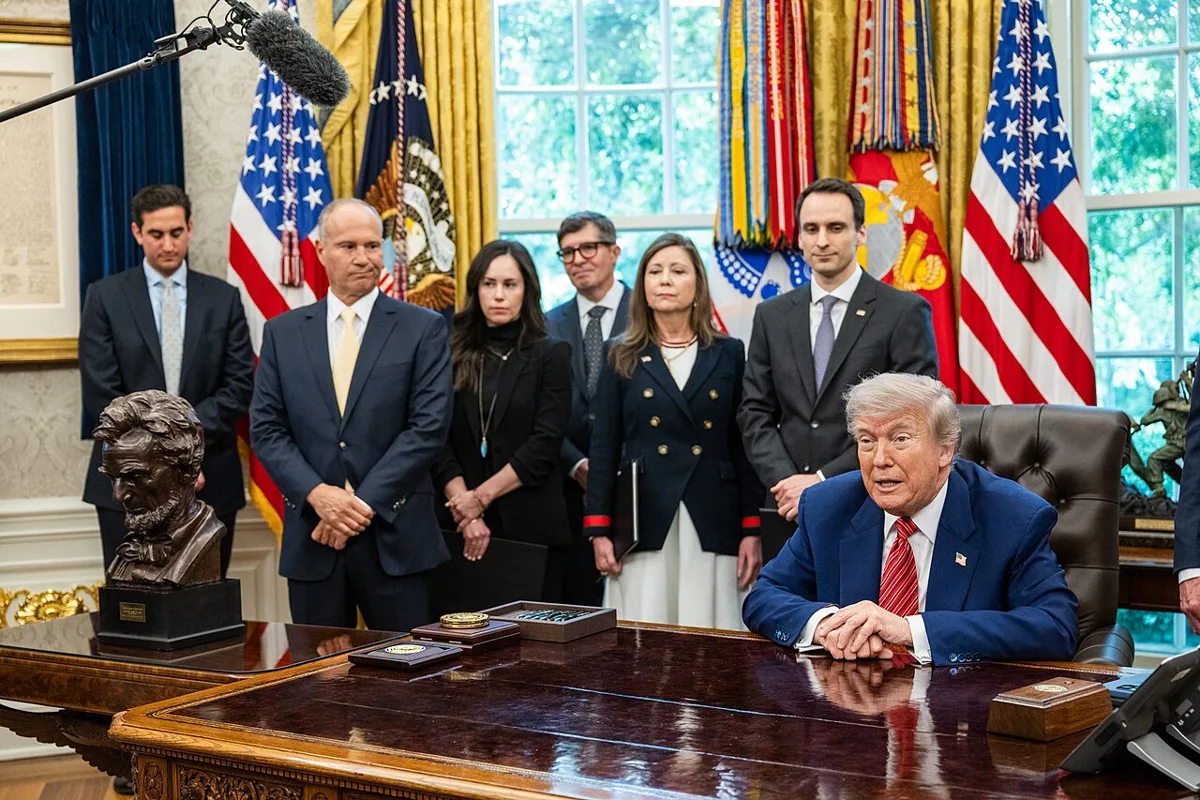
Donald Trump launched a war with Iran in February over its nuclear program, and on Sunday he announced a deal to end that war — without actually resolving anything about Iran's nuclear program. The agreement, set for a formal signing this Friday in Switzerland, will reopen the Strait of Hormuz and extend the current ceasefire for 60 days. The thing he went to war over? That's a problem for another day.
What the Deal Actually Does
According to NPR, the memorandum of understanding between the U.S. and Iran does a few specific things right away. The sporadic attacks that have continued despite an existing ceasefire will stop. The dueling blockades of the Strait of Hormuz — which have been choking off roughly 20% of the world's oil supply since the war began on February 28 — will end. And the Israel-Hezbollah fighting in Lebanon is supposed to stop too, because Iran made that a condition of any deal.
Markets liked what they heard. The S&P 500 was up 1.9% on the news, and oil prices dropped nearly 5%, per NPR. When you've had a blocked oil strait for three months, the mere promise of reopening it is apparently worth billions in immediate market relief.
Trump, never one to undersell a moment, posted on Truth Social: "Ships of the World, start your engines. Let the oil flow!" Which is, as presidential proclamations go, something.
What the Deal Doesn't Do
Here's where things get uncomfortable. Trump launched this war in February with one stated purpose: stopping Iran's nuclear program. He said so, repeatedly and loudly. He called for the complete dismantling of Iran's nuclear capabilities. That was the whole pitch.
The deal announced Sunday does not do that. Per NPR, Iran's nuclear fate will be negotiated in the next round of talks, somewhere in the 60-day window before this ceasefire extension expires. And in an interview with The New York Times, Trump said Iran would actually be permitted low-level nuclear enrichment. Which is, to put it charitably, the opposite of what he said he wanted when he started the war.
The deal also leaves unresolved Iran's demand for billions of dollars in frozen assets to be returned and broad sanctions relief. These are not small footnotes. These are the fights that have derailed every Iran negotiation for the last two decades.
Pakistan Brokered This, Apparently
Pakistan's Prime Minister Shehbaz Sharif played a central mediating role in the negotiations, according to NPR, and will host the formal signing ceremony in Switzerland on Friday. Qatar's Prime Minister Sheikh Mohammed bin Abdulrahman bin Jassim Al Thani also helped mediate and praised the breakthrough, calling for positive and constructive talks ahead.
This is worth sitting with for a second. Two nuclear-armed states went to war, blockaded a critical global oil artery for three months, and the diplomatic off-ramp was negotiated in large part by Pakistan and Qatar. The United Nations, NATO, and the broader Western security architecture barely got a seat at the table. European leaders from the UK, France, Germany, and Italy welcomed the deal, per NPR, and called for swift implementation, but they were largely reacting to something others built.
Israel Is Already Ignoring the Terms
Iran made one thing non-negotiable: a halt to the fighting between Israel and Hezbollah in Lebanon. That condition is baked into this deal. So naturally, within hours of the announcement, Israel conducted a deadly airstrike on a Hezbollah stronghold in the southern suburbs of Beirut, according to NPR. Hezbollah had fired drones into northern Israel beforehand, but the point stands: the ink on this agreement isn't dry and the fighting it was supposed to stop is still happening.
Trump actually criticized the Israeli strike, posting that the attack on Beirut "should not have happened, particularly on a special day when we are so close to a peace deal with Iran." Which is an interesting thing to post hours before announcing the deal anyway, as if the Beirut strike was a mildly inconvenient scheduling conflict.
Israeli Defense Minister Israel Katz compounded the problem by stating Israel would keep troops in southern Lebanon indefinitely. Israel was not directly involved in the U.S.-Iran negotiations, per NPR, and clearly feels about as bound by them as it wants to.
What Happens If the 60 Days Go Nowhere
Good question. Trump told The New York Times that if no permanent deal is reached during the 60-day negotiating window, he could relaunch attacks on Iran. He also floated the idea of making the United States "the guardian of the Middle East" in exchange for 20% of the region's revenues, which sounds like either a protection racket or a fever dream, depending on how generously you're reading it.
The major unresolved issues — Iran's nuclear program, the frozen assets, the sanctions — are not the kinds of things that get wrapped up in 60 days. These are issues that seasoned diplomats have spent decades not resolving. The optimistic read is that a ceasefire and an open strait buy space for real talks. The pessimistic read is that in two months we're right back where we started, except everyone has had time to reload.
The Dingo Take
Let's be honest about what happened here. Trump started a war in February with a clear stated objective: eliminate Iran's nuclear program. Three and a half months later, he's announcing a deal that explicitly does not eliminate Iran's nuclear program, actually concedes low-level enrichment, and punts all the hard questions to a 60-day negotiating window that has roughly the same odds of producing a permanent settlement as a bar bet. He is, in the most literal possible sense, declaring victory over a problem he has not solved.
That said: the Strait of Hormuz was closed. It is now opening. Oil prices dropped 5% on the news. A ceasefire that was regularly violated has at least been formalized and extended. People are not currently dying at the rate they were a week ago. These are real things. If this deal holds long enough for serious nuclear talks to happen, it could matter. The world being slightly less on fire than it was in March is not nothing. Credit where it's due, however grudgingly.
But do not let the 'Ships of the World, start your engines' energy obscure the actual ledger here. Trump went to war over Iran's nukes. Iran still has its nukes. The war cost enormous amounts of money, disrupted global energy markets for months, destabilized Lebanon further, and the final accounting on human casualties still isn't in. The formal signing is Friday in Switzerland. The 60-day clock starts ticking after that. We will be watching to see if this is history in the making or just the pause before the next disaster.




Comments