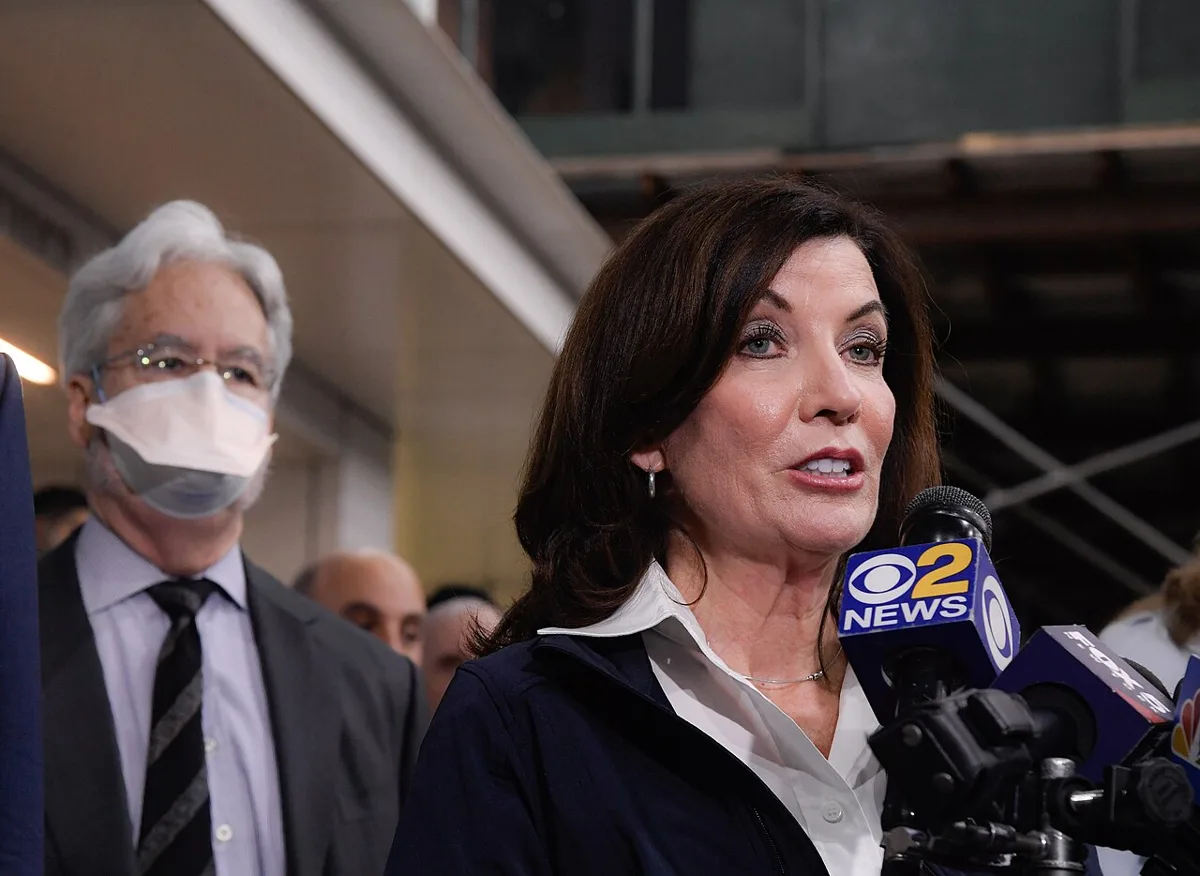
One week into New York's big Medicaid homecare transition, exactly 43 out of 214,000 people had successfully completed it. Forty-three. The Hochul administration's official response was to tell the press it was going "efficiently and effectively." Now the Department of Justice has filed a lawsuit calling the whole thing what it apparently was: a fraud.
What the DOJ Is Actually Alleging
The US Department of Justice filed a 55-page lawsuit Tuesday against New York State Health Commissioner James McDonald and Medicaid Director Amir Bassiri, both members of Gov. Kathy Hochul's administration. The complaint, filed in US District Court for the Eastern District of New York, alleges they rigged the bidding process on an $11 billion Medicaid home care program to steer the contract to a single company: Public Partnerships LLC, or PPL.
The lawsuit claims PPL was a "favored vendor" that, once handed the keys to the program, unlawfully siphoned millions of dollars in Medicaid funding while nearly 250,000 disabled New Yorkers and their caregivers got left scrambling. The New York Post reports that Brett Shumate, the DOJ's assistant attorney general for the Civil Division, called the state's failure to police PPL "egregious" and said it "betrays the public trust."
Hochul is not personally named as a defendant in the suit. But the complaint is full of emails that put her office squarely in the middle of it all, from the bidding process to the rollout to the cover-up of how badly it was going. Not named doesn't mean not involved.
The Part Where the Governor's Office Pressured Officials to Disqualify Competitors
Here is where it gets specific and ugly. According to the lawsuit, as late as September 17, 2024, Medicaid Director Bassiri was part of a last-minute email chain in which state health officials told counterparts in other states they were acting under "pressure from our Governor's Office" to dig up reasons why other qualified bidders might not actually qualify. The implication being: find a way to knock them out of the running so PPL could win.
That's not a vague allegation buried in footnotes. That's a quote, in an email, from a state official describing direct pressure from the Governor's Office to tilt a competitive bidding process. The New York Post reviewed the complaint and pulled that language directly from the lawsuit text.
If any of this holds up in court, it would mean Hochul's team wasn't just bad at running a procurement process. It would mean they actively worked to ensure a specific company won an $11 billion government contract. That's a very different thing.
Then They Refused to Give the Winning Company More Time to Not Completely Fail
After PPL won the contract, the company itself came back and said, hey, we probably need nine months to get this right instead of three. Which, honestly, is a remarkable thing to admit after you've just won a contract worth billions of dollars. But credit where it's due for the self-awareness.
Hochul's office said no. According to internal emails from a DOH staffer included in the complaint and reported by the New York Post, the message was blunt: "Chamber is coming in hard on the SFI launch, they really aren't entertaining options to move off of a path that gets this done by 4/1." No statutory changes. No regulatory changes. Full speed ahead.
So when the transition opened in January 2025 and immediately became a disaster, with disabled people spending hours on hold trying to keep their home caregivers paid, that wasn't an accident. Someone made a deliberate choice to rush it. The complaint makes clear who.
The 43-Out-of-214,000 Moment That Explains Everything
On January 13, 2025, one week after the transition window opened, PPL's own internal records showed that 43 people out of 214,000 enrolled in the system had successfully completed the transition process. Forty-three. That is a completion rate of roughly 0.02 percent.
Three days later, Health Commissioner James McDonald issued a public statement saying "the facts and data show that the transition is proceeding efficiently and effectively." The New York Post confirmed that statement. That man looked at a 0.02 percent success rate and described it as efficient.
This is the part of the story that isn't really about politics or procurement rules or legal theories. This is about 250,000 people, most of them elderly or disabled, who depend on paid home caregivers to get through their day. While Hochul's team was managing the optics, those people were on hold with a call center that couldn't help them, trying to figure out if their caregiver was going to get paid.
What the DOJ Says Happens Now
Colin McDonald, assistant attorney general for the DOJ's National Fraud Enforcement Division, was direct in his statement after the filing. Per the New York Post, he said New York's "backroom deal with PPL has cost taxpayers millions of dollars and cast countless Medicaid patients to the curb."
The lawsuit is seeking to hold the state accountable for violations of federal laws governing truthful statements and fair dealing in federal healthcare programs, and to prevent additional harm from both PPL and the state of New York. The federal government funds a substantial portion of Medicaid, which gives the DOJ standing to sue over how that money gets handled.
PPL is also named in the lawsuit. The company that won the contract, struggled to execute it, and allegedly siphoned off millions in the process is now a federal defendant. Whatever PPL's lawyers are charging, it probably isn't enough.
The Dingo Take
Let's be honest about what this lawsuit describes. It describes a state government that allegedly handpicked a winner before the bidding was over, pressured its own officials to find reasons to disqualify competitors, refused to allow more time for a safe rollout, and then lied to the public about how it was going while sick and disabled people couldn't get their caregivers paid. That is not bureaucratic incompetence. That is a system working exactly as someone intended it to work, just not for the people it was supposed to serve.
Kathy Hochul has spent years positioning herself as a competent, adult alternative to chaos. She ran on that. She governs on that. The story her administration told about PPL and CDPAP, even as the program was melting down in real time, was the story of a governor in control of her government and making sound decisions. A DOJ complaint with emails showing her office pressuring officials to tilt a billion-dollar contract is a direct attack on that entire brand.
Hochul isn't named as a defendant, and none of this is proven in court yet. But she doesn't get to put her name all over the "pressure from our Governor's Office" emails and then claim she was just a bystander when the whole thing blew up. Either she knew, or she had no idea what was being done in her name. Pick one. Neither answer is good.




Comments