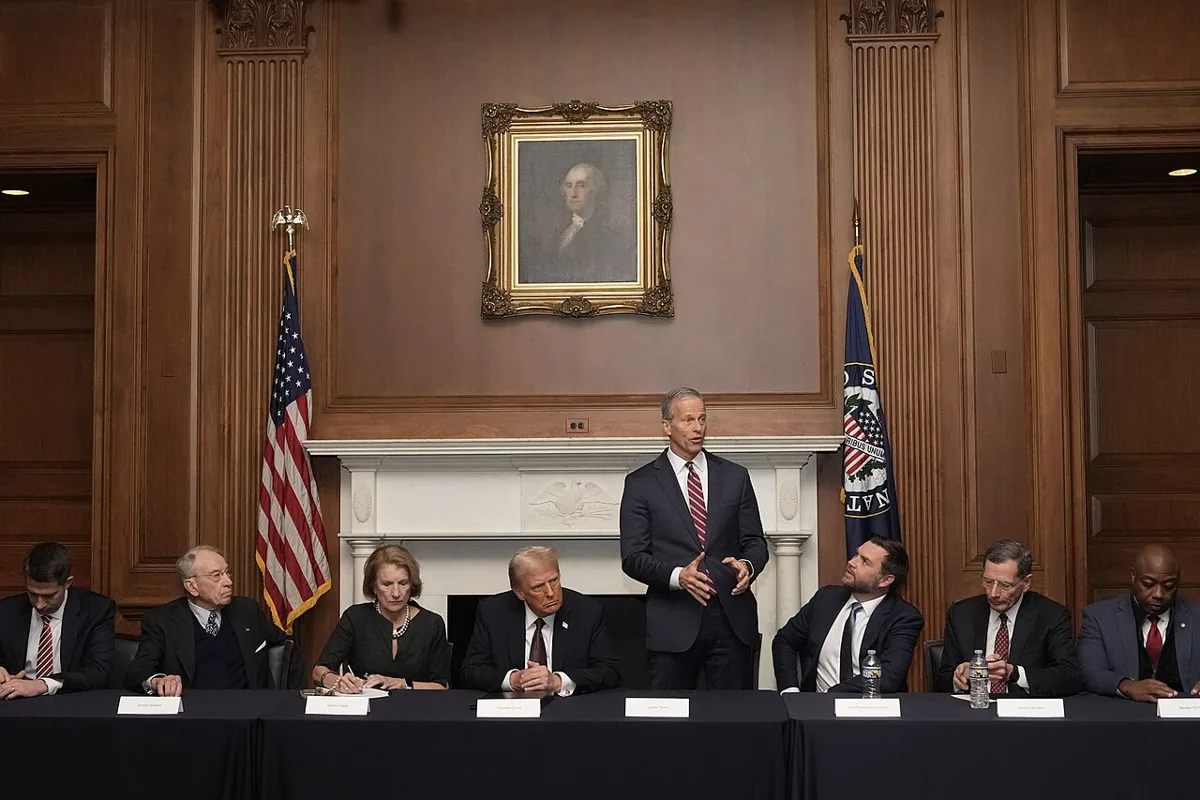
Donald Trump signed a memorandum of understanding with Iran to end a war, set a ceremonial signing date in Geneva for Friday, and apparently forgot to tell Congress what was in it. The Senate Majority Leader, a Republican, says he hasn't been personally briefed. The deal is, by JD Vance's own description, about a page and a half long.
A Page and a Half to End a War
Here's the thing about negotiating a nuclear deal with one of America's longest-standing adversaries: you might want to write more than a page and a half. That is, apparently, the full length of the memorandum of understanding the Trump administration announced Sunday to end the war in Iran, reopen the Strait of Hormuz, lift a US naval blockade, and address one of the most dangerous nuclear situations on the planet.
JD Vance went on CNN Monday and called it "a very general document." Then he went on NBC News and clarified it was "about a page and a half," which is slightly more reassuring than "about a page" but still roughly the length of a solid cover letter. The specific details, Vance explained, will be worked out during "the technical negotiation phase." Which is a diplomatic way of saying: we'll figure it out later.
Both Trump and Vance have already digitally signed the document. Iran's parliamentary speaker Mohammad-Bagher Ghalibaf signed on Tehran's behalf, according to a senior US official cited by The Guardian. The ceremonial signing is set for Friday in Geneva. The Senate has not seen it.
The Senate Majority Leader Finds Out From CNN, Apparently
John Thune is the Senate Majority Leader. He is, nominally, one of the most powerful Republicans in the country and a key figure in any treaty or agreement requiring congressional review. On Monday, Thune told reporters at the Capitol, "I just don't know enough about it. Even the people who follow this stuff closely up here don't know that much about it."
Thune said he had not been personally briefed on the deal. Not before the announcement. Not after. The Guardian reports he's specifically concerned about compliance and enforcement mechanisms, which would be a lot easier to evaluate if anyone had shown him the document. "I think the issues are going to be compliance, and how are you going to enforce that," he said, which is a genuinely important question about an agreement with a country that has spent decades developing centrifuges in secret underground facilities.
Senator Thom Tillis of North Carolina put it more directly: "If it's a secret deal then how can I take it seriously?" That's a Republican senator, talking about a Republican president's signature foreign policy achievement. When your own majority leader is getting his briefings from press conferences, something has gone sideways.
What We Know, What We Don't, and What's in the Deal
The MOU is centered on reopening the Strait of Hormuz, lifting the US naval blockade, and providing financial incentives for Iran if it meets certain benchmarks. According to US officials who spoke to reporters, those incentives include the possibility of releasing Iran's frozen funds, sanctions relief, and a $300 billion fund to help rebuild Iran if Tehran follows through.
Vance confirmed that IAEA nuclear inspectors would be allowed back into Iran under the terms of the deal, and that the agreement includes helping Iran destroy its highly enriched uranium stockpile. "One of the core parts of the agreement is that the IAEA and the United States are going to help Iran destroy the highly enriched stockpile, and that's something that's spelled out very clearly," he told NBC News. That's notable, given that the enriched uranium is believed to be buried under nuclear sites that were badly damaged by US strikes last summer.
What remains unanswered, and what Trump has not yet explained publicly, is who will verify Iranian compliance, how the destruction of enriched uranium actually gets carried out at damaged sites, and what happens if Iran doesn't meet its benchmarks. Vance says all of that gets resolved during a 60-day technical negotiation phase. So: trust us, essentially.
Hawks Circling, Pompeo Muzzled
The skepticism on Capitol Hill didn't appear Monday morning from nowhere. When details of the framework first leaked in late May, The Guardian reports that senior Republicans launched a rare public rebuke of Trump. Senator Roger Wicker of Mississippi, who chairs the Armed Services Committee, wrote a letter declaring that Trump was "being ill-advised to pursue a deal that would not be worth the paper it is written on," and argued the US military should finish destroying Iran's conventional military capabilities instead.
Mike Pompeo, Trump's own former Secretary of State, went further and called the emerging framework "not remotely America First," arguing it amounted to paying the Revolutionary Guard to build weapons and terrorize the world. The White House's response, per The Guardian, was to have communications director Steven Cheung tell Pompeo to "shut his stupid mouth." Which is one way to handle foreign policy criticism from your own former cabinet.
Lindsey Graham, a close Trump ally and longtime Iran hawk, is publicly demanding Congress get to review and vote on the deal. "The way Iran describes it, it's awful. The way we describe it, it makes sense to me," Graham said. "Let's look at it and see what it actually is." That's the Senate's most reliable Trump defender essentially saying he doesn't know what his president just agreed to.
The Obama Ghost at the Table
There's a particular irony threading through all of this. Trump spent most of his first term treating the 2015 Iran nuclear deal as the single greatest act of American diplomatic stupidity in history. He pulled out of it. He called it catastrophic. He mocked the Obama administration for releasing frozen Iranian assets, reducing it in every speech to "pallets of cash" being handed over to terrorists.
Now Trump has signed a one-and-a-half page document that, by Vance's own description, includes the possibility of releasing Iran's frozen funds, sanctions relief, and a $300 billion reconstruction fund, in exchange for nuclear concessions and IAEA access. The 2015 deal ran to 159 pages and took two years to negotiate. This one fits on a page and a half and the Senate majority leader found out about it Monday morning.
Chuck Schumer, for the Democrats, is demanding Trump "release the details publicly, brief Congress immediately, and end this war for good." Which is a reasonable ask. The document exists. It has been signed. There's no obvious reason it can't be shown to the people's elected representatives before the Friday ceremony in Geneva.
The Dingo Take
Let's be honest about what's actually happening here. Trump signed an agreement, with a country the United States has been in open conflict with, that his own vice president describes as "very general" and just over a page long, and the Senate Majority Leader says he hasn't seen it. This is not normal governance. This is a man who likes announcing things, and has decided that the details are someone else's problem for the next 60 days.
The deal might be good. It might be a genuine achievement. Reopening the Strait of Hormuz and bringing IAEA inspectors back into Iran would both be legitimate wins, and if Iran actually destroys its highly enriched uranium stockpile under international supervision, that matters. But "might be" is doing an enormous amount of work in that sentence, because no one outside a very small circle has read the document. The 2015 Obama deal, which Trump torched, was 159 pages long and still didn't prevent a decade of cheating accusations. This one is a page and a half, with the hard parts deferred to a "technical negotiation phase" that hasn't started yet.
The $300 billion reconstruction fund is going to land like a grenade in the Republican caucus the moment it gets real attention. Trump spent his entire first term calling Obama's far smaller sanctions relief "pallets of cash to Iran." Now his administration is dangling three hundred billion dollars. Watch how that plays on Capitol Hill when Thune finally gets his briefing.



Comments