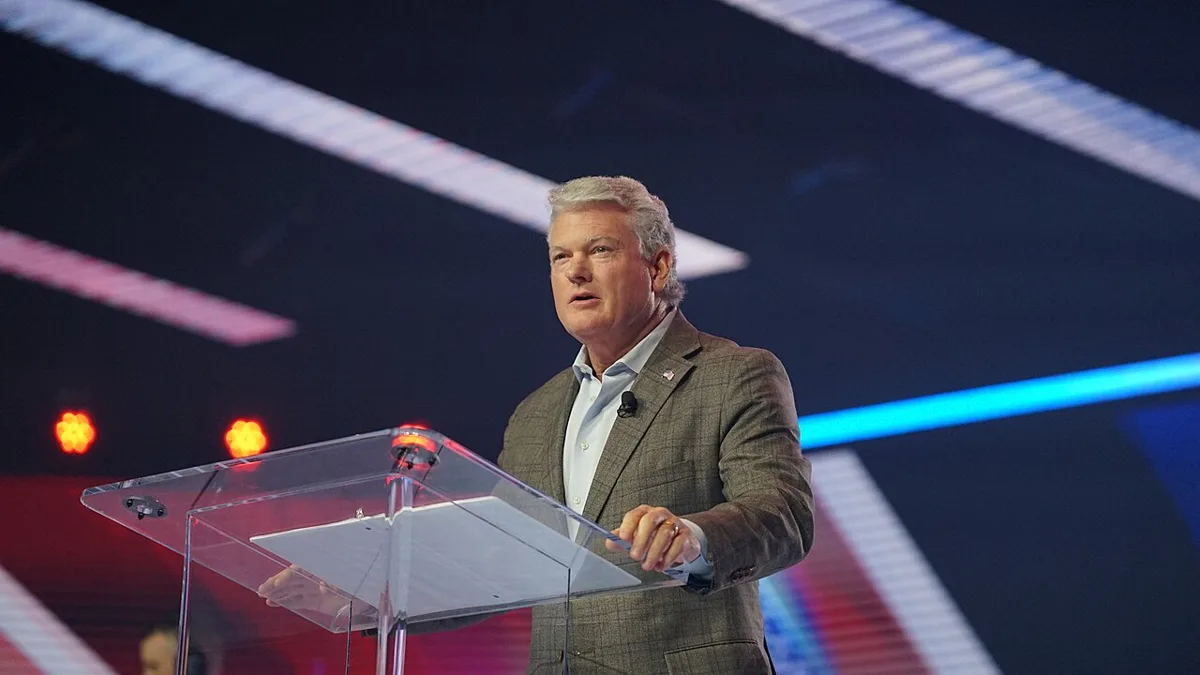
Donald Trump waited until the last possible weekend before Georgia's Senate runoff to endorse Rep. Mike Collins over Derek Dooley, a move so late in the game it raises the obvious question: was this a bold show of force, or did he just barely make up his mind? Either way, his grip on the Republican Party is about to get graded, live, in public, with real consequences for which party controls the Senate.
The Endorsement Nobody Saw Coming Until Sunday
According to Fox News, Trump dropped his endorsement of Rep. Mike Collins in Georgia's Senate runoff this past weekend, days before Tuesday's vote. Collins is a MAGA loyalist who represents a district between Atlanta and Augusta, a trucking company co-owner, and the son of the late Rep. Mac Collins. He is, in every conventional MAGA sense, the obvious pick. Which makes it weirder that Trump waited this long.
His opponent, Derek Dooley, is not some establishment RINO ghost. He's a former University of Tennessee football coach, son of Georgia legend Vince Dooley, and he has the full-throated backing of Georgia Gov. Brian Kemp, one of the most popular Republican governors in the country. Kemp's own top political advisor is a senior consultant on Dooley's campaign. When Fox News asked Dooley how he felt about Trump endorsing his rival, he gave the only answer available to a man in his position: "The most important endorsement I'm fighting for is the people of Georgia."
That's a very dignified way of saying he got passed over.
Collins Is Calling It a Master Stroke. Sure.
Collins, freshly armed with his presidential blessing, told Fox News Digital on Sunday that Trump "has this impeccable ability of putting his thumb right on the scale at the right time." He said it with the enthusiasm of a man who just got picked for dodgeball and is very loudly pretending he was never worried.
Maybe he's right. Trump's endorsement record in Republican primaries is genuinely impressive, and there's an argument that a late endorsement in a runoff creates a surge right when it's needed most. Turnout in runoffs is lower, the base is more activated, and a presidential tele-rally the week before counts for something in Georgia's Republican electorate. The mechanics are real.
But Collins and Dooley were the top two finishers in a crowded May primary that also included Rep. Buddy Carter, and nobody cracked 50%. That means this race was genuinely competitive before Trump weighed in. It was not a blowout waiting to be formalized.
Meanwhile, $100 Million Doesn't Buy What It Used To
The Senate race is only half the story Tuesday. Georgia's gubernatorial runoff is its own test of what actually moves Republican primary voters in 2026. Trump endorsed Lt. Gov. Burt Jones for governor last year, well ahead of the primary, giving him every structural advantage. Jones made the runoff. So did billionaire Rick Jackson, who has spent over $100 million of his own money on the race, per Fox News.
One hundred million dollars. Self-funded. And he's in a runoff against the Trump-backed incumbent lieutenant governor of a state where Trump remains enormously popular. That either says something about the limits of personal wealth in politics or something alarming about how much it costs these days just to stay competitive against a presidential endorsement.
Kemp made a last-minute endorsement of Jones on Sunday as well, calling him the candidate best suited to win in November against former Atlanta Mayor Keisha Lance Bottoms. So both major runoff races now have Trump and Kemp pointing in the same direction, which is either a unified front or two powerful people who waited until the last minute to coordinate.
What's Actually at Stake Beyond Georgia
The Senate race matters nationally in a specific and urgent way. The winner of the GOP nomination faces Democratic Sen. Jon Ossoff in the fall, and Fox News reports Republicans view Ossoff as the most vulnerable Senate Democrat running for re-election. Georgia is a genuine battleground. Republicans are spending accordingly.
But here's the catch Ossoff has had months of runway while Republicans were busy fighting each other. He's built what Fox News describes as a powerful war chest that gives him a major fundraising advantage as the general election begins. Whoever wins Tuesday starts the general election behind on money and ahead on attention, which is not the most comfortable place to be in a competitive state.
There's also a California special election happening the same day, narrowing the field for Eric Swalwell's old seat after he resigned amid scandal, plus primaries in Oklahoma and D.C. But nobody outside those districts is pretending those are the main event.
The Kemp Factor Nobody Is Talking About Enough
Brian Kemp is term-limited, departing the governor's mansion, and deeply invested in who replaces him and who wins Georgia's Senate seat. He has spent the final stretch of this campaign visibly, aggressively, and personally backing Dooley in the Senate race and Jones for governor. His wife has appeared at Dooley campaign events. His top political advisor is on Dooley's payroll.
If Collins wins the Senate runoff, it will be read as a repudiation of Kemp's influence in his own state. If Dooley wins, it will be read as a check on Trump's late-game dominance. Either outcome rewrites something about the Georgia Republican power structure heading into the fall. Kemp endorsed Jones for governor and Dooley for Senate, meaning he's playing both ends of Tuesday's ballot. If he goes two for two, he leaves office with his coalition intact and his successor positioned. If Trump sweeps him, he exits with his influence diminished.
For a politician with obvious future ambitions, those are very high personal stakes dressed up as civic concern.
The Dingo Take
Here's what's actually happening in Georgia on Tuesday: two powerful Republicans are testing which of them controls the state's future, and they're using regular voters as the instrument. Trump's late endorsement of Collins is either a savvy show of force or an admission that he wasn't sure who he wanted to back until the last possible moment. Both are plausible. The fact that his supporters immediately reframed it as strategic genius rather than cutting it close tells you everything about how presidential endorsements work as political theater.
The broader midterm stakes are real though, and worth not losing in the noise. Republicans need to hold Georgia in November. Ossoff is sitting on a pile of money and watching the GOP spend the spring beating each other up. Whoever emerges Tuesday is going to be bruised, broke relative to their opponent, and heading into a general election in a state Democrats have proven they can win. The internal squabbling is fun for political junkies and genuinely bad for Republican Senate majority math.
And if both Trump-backed candidates win and Kemp's guy goes down in the Senate race, expect every Republican with White House ambitions to spend the next year pretending Kemp was never that influential anyway. That's how this works. The scoreboard gets rewritten the morning after every election, and everyone acts like they saw it coming.


Comments