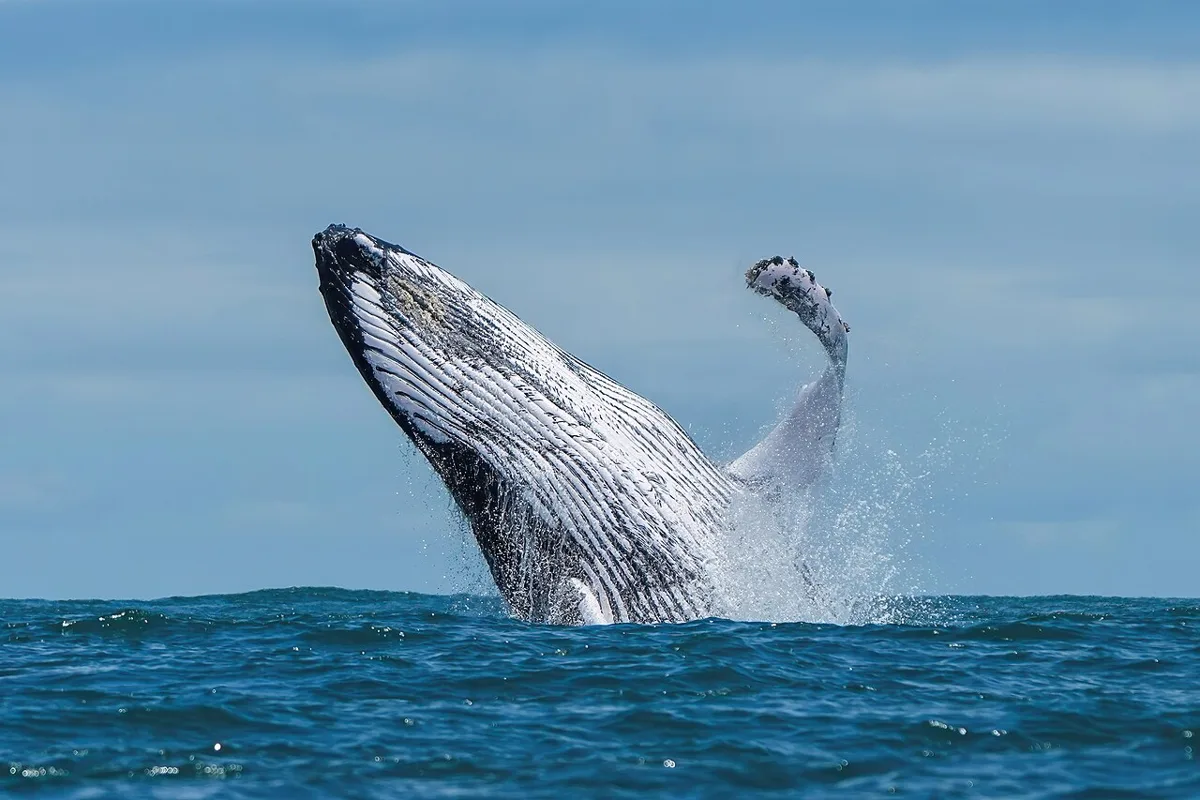
Scientists have found a 750-mile-long graveyard of whales at the bottom of the Indian Ocean, and it has been quietly accumulating bones for over five million years. The site holds hundreds of fossils, at least five recently dead whale carcasses crawling with newly discovered species, and enough unanswered questions to keep marine paleontologists busy until the sun burns out. When the researcher leading the study says the density of remains 'defies belief,' that is a scientist trying very hard not to lose his mind on the record.
A Strip Mall of Death, 750 Miles Long
The Diamantina Zone necropolis, as researchers have named it, sits in the southeastern Indian Ocean in an area of underwater ridges and fractures. According to the study published June 10 in the journal Nature, a team led by Xiaotong Peng of the Chinese Academy of Sciences used a submersible called the Fendouzhe to survey the seafloor at depths between 13,800 and 23,000 feet. They found 476 whale fossils and five active whale carcasses across a survey area of roughly a quarter of a square mile.
Extrapolate those numbers across the full zone and you get an estimated 750 fossils and seven to eight carcasses per square kilometer. The site stretches over 1,200 kilometers. The math alone is staggering. Stephen Godfrey, curator of paleontology at the Calvert Marine Museum in Maryland, told Live Science it is 'like each one of these whale falls is a new little restaurant that opens up in a 1,200-kilometer-long strip mall.' Which is, genuinely, the best scientific analogy anyone has used this decade.
Nick Pyenson, a curator of fossil marine mammals at the Smithsonian National Museum of Natural History who was not involved in the study, called the find 'really special' and said the scale of it 'defies belief.' These are scientists who look at dead things for a living. When they say something defies belief, pay attention.
Five Million Years of Whale Bones, and They're Still Adding Up
The team recovered 43 fossils and dated 33 of them using strontium isotope ratios. The oldest belonged to an extinct beaked whale from the Pterocetus genus, dating to approximately 5.3 million years ago, back in the Early Pliocene. One specimen was so distinct it represented an entirely new species, which the researchers named Pterocetus diamantina after the site itself.
Most of the fossils came from two species of beaked whale that still swim the Indian Ocean today: the Andrews' beaked whale and the strap-toothed whale. But the fossilized versions of these animals could be up to a million years old. As Pyenson put it to Live Science, 'you are getting extinct species overlapping the fossil remains of extant species,' which gives scientists a rare window into beaked whale ecology across geological time. That is the kind of continuity paleontologists dream about.
Godfrey compared the megasite to both the famous Lagerstatte fossil deposits, known for their exceptional preservation, and the Burgess Shale in Canada, known for sheer abundance. The key difference, he noted, is that this one is still being built. The dead whales are still arriving. The fossils are still forming. It is a live crime scene and a cold case file at the same time.
The Carcasses Are Basically Tiny Alien Ecosystems
The five more recently dead whales, called whale falls, are doing something remarkable. According to the Nature study, they are hosting dense communities of jellyfish, brittle stars, bone-eating Osedax worms, and bivalve mollusks, reaching densities of up to 2,840 individual animals per square meter. The whole community runs on bacteria that eat oil from the whale bones without any sunlight or oxygen, producing hydrogen sulfide as a byproduct. It is a completely self-contained economy of rot.
These are also the deepest whale-fall communities ever documented. The deepest sits at around 22,000 feet, which is roughly 8,200 feet deeper than any previously known whale-fall ecosystem. The researchers tried to identify the species living there using DNA samples and could match most to a genus or family level, but could only confirm a species match for one: a clam called Abyssogena southwardae. Everything else is almost certainly new to science.
'The density is crazy, as is the fact that they're probably all new to science,' Godfrey told Live Science. There are hundreds of animals per square meter that nobody has ever named, living in the dark at the bottom of the ocean, eating a dead whale. This is what the planet gets up to when we are not watching.
Why Do So Many Whales Die Here?
The honest answer is that scientists are not entirely sure, and they are upfront about it. Peng and his colleagues offered a few possibilities in their study. The Diamantina Zone appears to be rich feeding ground, with lots of squid and fish visible during the research dives. More whales hunting there means more whales dying there.
There is also a more grim possibility. Beaked whales are extreme divers, capable of descending to roughly 10,000 feet, but the prey in this area may tempt them to push past their limits. Going too deep risks lung collapse and decompression sickness. The V-shaped topography of the zone may also funnel sinking carcasses from the surface into the area, concentrating remains from a much wider region.
Beaked whales are also rarely observed alive. They spend most of their time in open water, diving for long periods, and scientists know relatively little about them. The Diamantina Zone might be offering the best sustained look at beaked whale behavior over geological time that researchers have ever had, and it took five million years of accumulated corpses to get there.
Why Beaked Whale Bones Last So Long
Most whale bones do not survive long on the seafloor. The bone-eating Osedax worms get to work quickly, and dissolution from seawater pressure does the rest. Beaked whales appear to be different. Godfrey explained to Live Science that beaked whale rostra, the bony upper jaw that makes up most of the recovered specimens, have among the highest bone density and mineral content of any living vertebrate.
That density buys them time. The bones persist long enough at depth that ferromanganese oxides begin to crust over them, sealing the specimen inside a natural mineral sarcophagus. 'This seals the specimen in, so it will last in perpetuity, or at least over 5 million years, and who knows how much longer,' Godfrey said. A jaw bone that outlasts civilizations, sealed in manganese at the bottom of the Indian Ocean. The ocean is doing a better job of archiving its history than we are.
The Dingo Take
Here is the thing about a discovery like this: it is enormous, genuinely mind-bending science, and it will get approximately one news cycle before being buried under whatever fresh catastrophe the political class has cooked up. A 750-mile graveyard of ancient whale bones, hosting ecosystems of unnamed species, accumulating for five million years at the bottom of the ocean, and we will have moved on to the next disaster by Thursday. The universe is doing extraordinary things and we are barely paying attention.
What strikes you when you sit with this story is how much of the planet we simply have not seen. The Diamantina Zone has been there for five million years. The whales have been dying there, the bones have been fossilizing, the clams and worms have been building their little hydrogen-sulfide economies, and nobody knew. We talk a lot about exploring other planets, which is fine, but there are ecosystems at 22,000 feet below the ocean surface that we cannot even name yet. We have better maps of Mars.
Spend some time thinking about Godfrey's restaurant strip mall analogy. Every whale that falls to the seafloor in the Diamantina Zone opens a new venue, feeds hundreds of species, and eventually fossilizes into the geological record. It has been doing this since before modern humans existed. The ocean does not need us to find it remarkable. It just keeps going. We show up with a submersible five million years late and call it a discovery. Which is accurate, technically, but you have to appreciate the audacity of the framing.



Comments