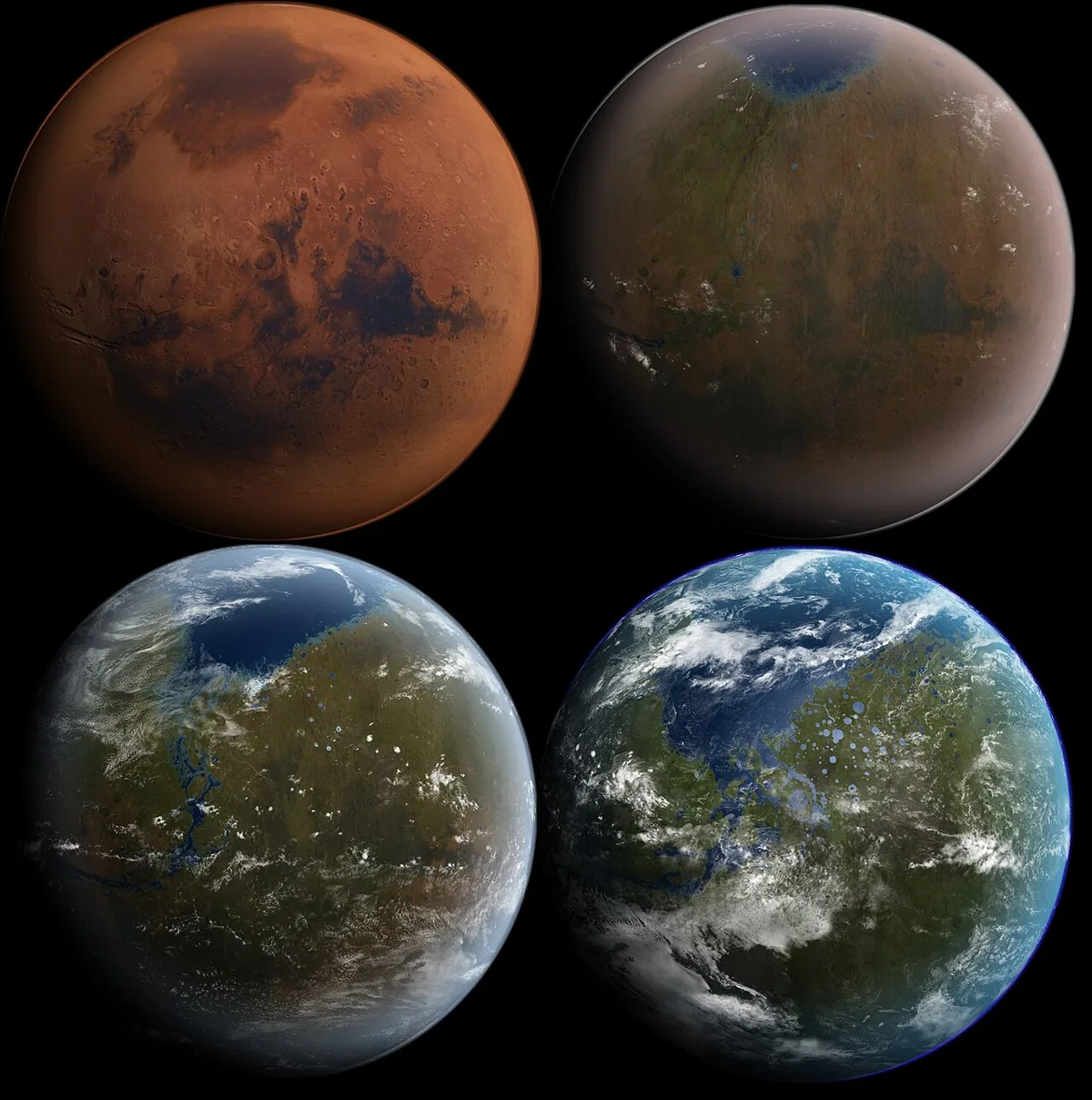
Mars has been sitting on a secret for three billion years. Two back-to-back studies have now revealed that the Red Planet didn't lose its water and atmosphere to space, as scientists long assumed. It buried them. Both of them. Underground.
The Planet We Thought We Knew
Here's the version of Mars everyone learns: cold, dead, rust-colored, thin atmosphere, no liquid water, end of story. NASA's Mariner 4 flew past in 1964 and basically killed every romantic notion of alien jungles and ancient civilizations in one batch of grainy photographs.
But the story was always more complicated than that. Over subsequent decades, orbiters and rovers sent back images of deep canyons, river deltas, and fan-shaped flood deposits that looked uncomfortably familiar to anyone who's seen a geology textbook. Then in the early 2000s, the Spirit and Opportunity rovers found sedimentary rocks and minerals that can only form in the presence of liquid water, according to BBC Sky at Night Magazine. That settled it: Mars once had water. A lot of it.
The question that's been gnawing at planetary scientists ever since is a simple one with a brutally complicated answer. Where did it go?
The Numbers Don't Lie, and They Are Alarming
When researchers started taking stock of Mars's atmosphere, they found something deeply weird. The planet has about a tenth the carbon of Earth or Venus, according to BBC Sky at Night Magazine. All three rocky planets presumably started with roughly the same primordial atmospheric soup. Which means Mars has shed at least 90 percent of its carbon somewhere along the way.
The obvious answer was space. Mars has no plate tectonics, essentially no magnetic field, and zero volcanic activity replenishing atmospheric gases. Without a magnetic field doing its job, the Sun's solar wind gets a free run at the atmosphere, stripping it away layer by layer. Less atmosphere means lower surface pressure. Lower pressure means water evaporates faster. More water vapor in the atmosphere means more water escaping to space. A death spiral, basically.
Except when scientists ran the climate simulations, atmospheric loss to space could only account for a fraction of the missing water and didn't come close to explaining the carbon deficit. Something else was going on. Something bigger.
InSight Heard Something Incredible
In August 2024, a team of geophysicists published findings that flipped the whole conversation on its head. They found Mars's missing water. Not traces of it. Not evidence that it once existed. The actual water, still there, still liquid, hiding between 11.5 and 20 kilometers underground, trapped in the cracks and pores of deep rock, according to BBC Sky at Night Magazine.
The tool that cracked this open was NASA's InSight lander, which spent four years from 2018 to 2022 listening to marsquakes. Seismic waves change subtly as they pass through different materials, and by analyzing those changes, the team was able to reconstruct a picture of what Mars looks like from the inside. What they found was enough water to cover the entire surface of Mars to a depth of one to two kilometers.
Michael Manga from the University of California, Berkeley, who was part of the study, told BBC Sky at Night Magazine that the underground reservoir is almost certainly habitable in principle. "Deep, deep mines host life, the bottom of the ocean hosts life," he said. "We haven't found any evidence for life on Mars, but at least we have identified a place that should, in principle, be able to sustain life." That is a sentence worth sitting with for a moment.
Then MIT Showed Up With the Atmosphere
One month later. One month. A separate team from MIT published findings suggesting they had tracked down Mars's missing atmosphere too, and that it was also underground, according to BBC Sky at Night Magazine. The researchers weren't even studying Mars initially. They were looking at a type of clay mineral called smectites found on Earth, and the trail led them straight to the Red Planet.
The implication of both studies landing within weeks of each other is staggering. Mars didn't lose its water and carbon to the void of space in some slow, tragic bleed-out over billions of years. It locked them away underground, possibly preserved, possibly still chemically active, sitting beneath a barren surface that has been sending scientists on a wild goose chase for decades.
This changes what a crewed Mars mission would actually be looking for. And it changes what finding it might mean.
What This Actually Means for the Future
The practical upshot here is enormous and a little dizzying. If Mars has liquid water sitting in vast underground reservoirs, that water is accessible in theory. A future surface mission with the right drilling equipment could reach it. That is not science fiction. That is an engineering problem, which is a very different category of obstacle.
For life, the implications are even harder to process calmly. Life on Earth shows up in places that would have seemed absurd to biologists a century ago: deep ocean hydrothermal vents, mine shafts miles underground, inside Antarctic rocks. If those environments host biology, the warm, pressurized, liquid-water environment deep beneath Mars is not obviously worse. We have not found life there. But we have now identified the kind of place where it could exist.
The more sobering point is that Mars lost its surface habitability around 3.6 billion years ago, according to BBC Sky at Night Magazine. If anything was alive up top, it had to either die or go very, very deep. Whatever is down there, if anything, has had three billion years to adapt or perish.
The Dingo Take
Let's be honest about what this moment actually is. For decades, the working assumption was that Mars was a cautionary tale: a planet that lost the cosmic lottery, got stripped of its water and air by an indifferent sun, and became a monument to planetary death. Turns out Mars was playing a longer game than anyone realized. It didn't lose those things. It hid them. That is either deeply reassuring or deeply unsettling depending on your relationship with existential questions about life in the universe.
The timing of these two studies, one on the water and one on the atmosphere, dropping within a single month of each other in 2024, is the kind of convergence that doesn't get enough attention in the broader news cycle because it doesn't fit into a tidy political narrative or generate enough outrage to trend. It should be the biggest science story of the decade. Two independent teams, working different problems, arriving at the same general answer at almost the same time. That's not coincidence. That's science working the way it's supposed to.
The next question is when we send something down there to look. Not a rover rolling around on the surface taking photographs of rocks. Something that drills. Something that goes deep. If there is liquid water sitting 12 kilometers below the Martian surface and we have the technology to go find out what's in it, the only real argument against doing so is cost. Given what's potentially at stake, that argument is going to sound pretty thin pretty fast.



Comments