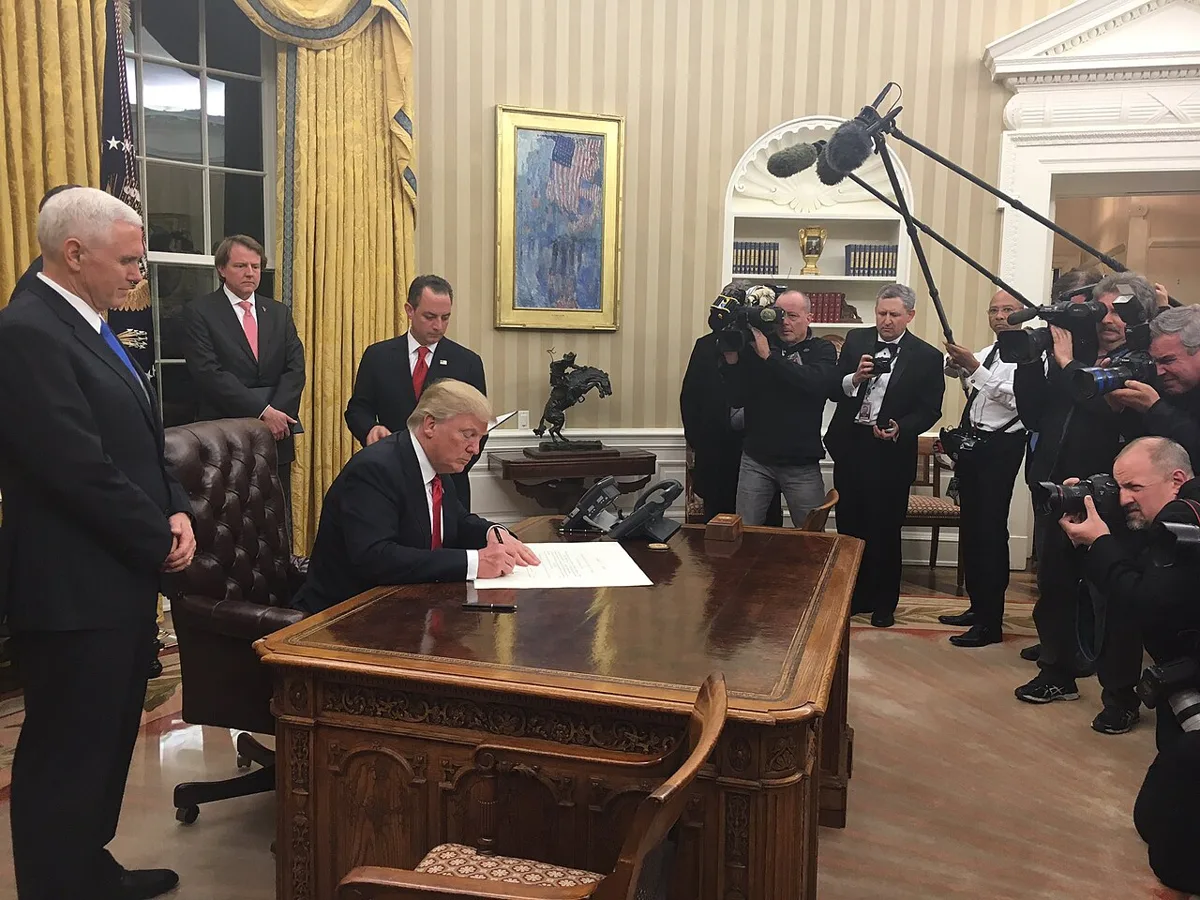
Donald Trump flew to a luxury resort town in France this week to tell European leaders about his big Iran win, remind everyone that Benjamin Netanyahu needs to cool it in Lebanon, and casually mention that he has personally settled eight wars. Eight! The man who spent four years of his first term lighting diplomatic fires across the planet would like some credit for the fire extinguisher.
The Deal That Nobody Can Read Yet
Here is the centerpiece of Trump's G7 performance: a tentative agreement with Iran that he says will reopen the Strait of Hormuz, the chokepoint through which roughly 20 percent of the world's oil flows. The agreement has been enough to dominate conversation at the summit in Evian-les-Bains, France. It has not, however, been enough to actually show anyone its terms.
When reporters asked Trump when the text of the agreement would be made public, he did not say "soon" or give a date. He said he thinks it's going to happen "fairly on time." That's not an answer. That's the diplomatic equivalent of "I'll get to it when I get to it." According to NPR, Trump added that Iran "wants to get back to business" and that their relationship is now "normalized," which is an interesting way to describe the aftermath of a U.S.-Israel-led military campaign that, per NPR, rocked the global economy and cratered Trump's approval ratings even among his own supporters.
The press conference Trump is scheduled to hold Wednesday morning will presumably include some pointed questions about what, exactly, he agreed to and with whom. We will be watching.
Bibi, Buddy, Dial It Back
One of the more remarkable moments to come out of the summit so far is Trump publicly telling Israeli Prime Minister Benjamin Netanyahu to be "more responsible with respect to Lebanon." Those are Trump's words, per NPR. The same Trump who spent his first term writing Netanyahu a series of essentially unconditional blank checks is now, in the middle of trying to lock down an Iran agreement, telling him to put the guns down for a second.
This matters because the tentative Iran deal is fragile in ways Trump has not fully explained. One of the questions hovering over the G7, as NPR reports, is how confident Trump actually is that Israel won't do something to blow the whole thing up. Netanyahu's military has been active in Lebanon. Trump needs the ceasefire architecture to hold. These two things are in tension, and "Bibi has to be more responsible" is doing a lot of heavy lifting as a diplomatic strategy.
The European leaders at the summit are apparently involved in discussions about helping with the demining of the Strait of Hormuz, which tells you something about the physical reality of what reopening that waterway actually requires. This isn't a press release. It's a minesweeping operation.
The War He Can't Win
While Trump has been busy taking victory laps on Iran, the other war on his diplomatic to-do list continues to not be settled. Russia and Ukraine are still at it. Trump met with Ukrainian President Volodymyr Zelenskyy at the Evian summit and said he plans to meet with him again. He also mentioned he spoke with Vladimir Putin on Sunday, NPR reports.
"Russia should make a deal. Russia has lost tremendous amounts of people, and so has Ukraine," Trump said. This is the kind of observation that sounds like insight until you realize it describes literally every war ever fought and contains zero actionable content. Russia has been losing tremendous amounts of people for years now. It has not resulted in a deal.
Then came the line that really lands. "I have settled 8 wars," Trump told reporters. "This was the one I thought would be the easiest to settle." He said that. Out loud. To humans. The Russia-Ukraine war, which has been grinding through cities and farmland and human lives for years, was supposed to be the easy one. The confidence is genuinely staggering.
What Comes Next
Trump is scheduled to leave France on Wednesday after his press conference. The Iran agreement text, whenever it materializes, will tell us whether this week's summit produced something real or whether the world just watched an expensive photo opportunity in the French Alps.
The questions that NPR flags are the right ones. What are the actual terms? What happens if Israel escalates? What does "normalized" mean in practice when it comes to U.S.-Iran relations? And will Trump offer any additional concrete help to Ukraine, or will Zelenskyy leave the summit with the same handshake and vague encouragement he's been collecting for months?
Those answers are supposed to come Wednesday. We'll see.
The Dingo Take
Let's give credit where it's very grudgingly due: if the Iran agreement holds and the Strait of Hormuz actually reopens, that's a meaningful outcome. Wars ending is good. Trade routes reopening is good. Nobody at this publication is rooting for diplomacy to fail just to score points. But "if it holds" is doing enormous work in that sentence, and the fact that nobody outside the negotiating room has seen the terms of this agreement is not a minor footnote. It's the whole story.
The eight wars claim is the tell. That number is doing exactly what Trump numbers always do: it sounds specific enough to be impressive while being impossible to verify without a lengthy argument about what qualifies as a war. It's a rhetorical magic trick, the kind of thing that gets tweeted as a fact by supporters and forensically dismantled by analysts while the news cycle moves on. Meanwhile, the one war Trump thought would be "the easiest" has outlasted his confidence in it by roughly two years.
Netanyahu is being scolded. Putin is being called upon to be reasonable. Zelenskyy is being met with again. The Strait of Hormuz needs to be demined by Europeans. This is the state of American foreign policy in June 2026, managed through a series of bilateral phone calls and summit photo ops by a president who measures success in wars-settled the way a golfer counts birdies. Whether the scorecard is accurate is, as always, left as an exercise for the reader.




Comments