The UN Secretary-General visited Haiti on Tuesday and got a tour of what a country looks like when gangs have eaten 70% of its capital city. António Guterres walked past bullet-pocked buildings, families living under canvas scraps, and a bus with a windshield that had been shot to pieces, all while new UN statistics confirmed 2,300 people have been killed in Haiti so far this year. A cabinet official was kidnapped just last week.
The Numbers Are Staggering and Getting Worse
Let's just sit with the scale of this for a second. According to new statistics released during Guterres's visit, 2,300 people have been killed in Haiti in 2026 so far. Another 100 have been kidnapped. And 1.5 million people have been displaced from their homes, which works out to more than one in ten Haitians who no longer have a place to live. This is not a crisis that is brewing. It has been brewing for years. It is now fully boiling over.
In Port-au-Prince alone, more than 300,000 people have been displaced by gang violence, a record according to NPR. More than 18,000 of those fled the Cité Soleil slum alone in May. The UN's migration agency chief in Haiti, Gregoire Goodstein, said Haiti's displacement crisis is entering an "even more alarming phase." That's bureaucratic language for: we did not think it could get this bad, and it got this bad.
The gang federation responsible for most of this is called Viv Ansanm. The US government designated it a foreign terrorist organization. It controls, by current estimates, 70% of Port-au-Prince. Think about that. The capital city of a country of nearly 12 million people is 70% controlled by a terrorist organization. That is not a government struggling with crime. That is a government that has largely lost the city.
A Convoy Through a War Zone
Guterres's convoy, per the Associated Press, sped through a neighborhood that gangs had previously occupied and left in ruins. Decimated car dealerships. Abandoned homes. Concrete buildings riddled with bullet holes. A tap-tap, the colorful shared buses that are a staple of Haitian street life, rolled past with its windshield shot through.
On a crumbling wall, someone had spray-painted: "Down with Viv Ansanm, long live the police." That graffiti might be the most defiant and heartbreaking sentence written anywhere in the Western Hemisphere right now. The people of Port-au-Prince are rooting for their own police force like it's an underdog sports team, because the alternative is unthinkable.
Last weekend, more than 30 people were killed, injured, or went missing in Cité Soleil, according to the Cooperative for Peace and Development, a local human rights group. Guterres arrived the day after Human Rights Watch published an open letter urging him to protect the population and address the root causes of the violence. His response after visiting a makeshift shelter crammed with displaced families: "What I saw will not leave me."
The New Force That Might Actually Do Something
Guterres's first official stop was the headquarters of a new gang-suppression force that the UN Security Council approved back in September. This replaces the previous Kenya-led mission, which the Associated Press describes as having remained underfunded and understaffed throughout its existence. That is a polite way of saying: it did not work.
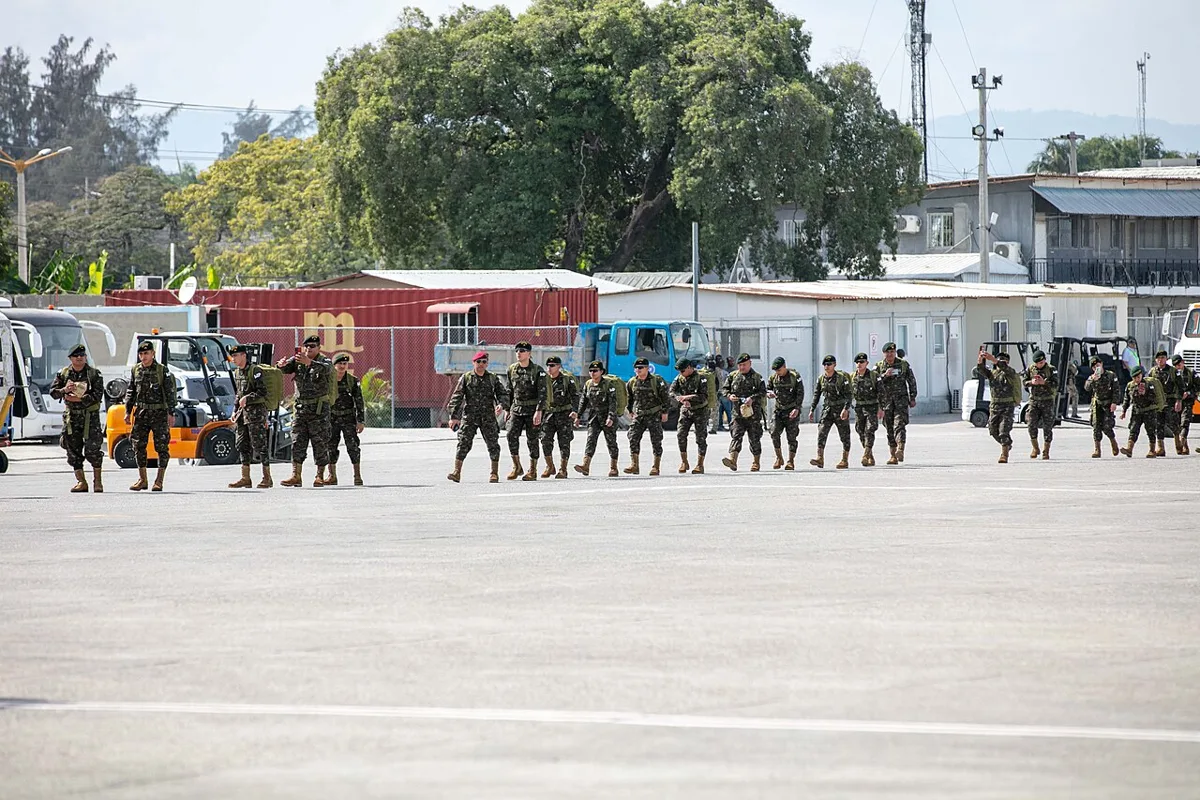
So far, Jamaica, Chad, El Salvador, and Guatemala have deployed troops to form the new force. Total number on the ground right now: fewer than 1,000. The plan is for them to operate alongside Haiti's National Police and its growing Armed Forces, with hundreds of Haitians lining up on a dusty road just hoping to interview for a spot. The force is due to start operations in the coming weeks.
Prime Minister Alix Didier-Fils-Aimé, who met with Guterres behind closed doors, told the Associated Press that security has to come first so the transitional government can hold elections and, as he put it, "get back to republican rule." Haiti has not had a president since Jovenel Moïse was assassinated at his private residence in July 2021. That is five years without a president, while gangs filled the power vacuum with extraordinary efficiency.
1,200 People in One School, One Meal a Day
Guterres also visited a makeshift shelter set up in a former school. More than 1,200 people live there, sleeping side by side. One meal a day is guaranteed. Some of these people have been there for four years.
He met privately with six women who described conditions that made the term "displaced" feel almost comically inadequate. No privacy to shower. No privacy to use the bathroom. Children everywhere with nowhere safe to go. "It's skin-to-skin and mouth-to-mouth," one woman told him, according to the Associated Press.
Outside the meeting, a man began hitting the building's metal siding and shouting that he wanted to go home. His voice got louder. Security moved Guterres out. A 26-year-old named Wendy Cejour, who has been living in the school with his family for a year and a half, told the AP: "As long as we're alive we have hope, but things are difficult." That sentence is doing a lot of heavy lifting.
The Dingo Take
Here's the thing about Haiti that the international community has never fully reckoned with: this is not a natural disaster. There is no earthquake to point to this time, no hurricane, no act of God to absorb the blame. This is a political and security catastrophe that has been unfolding in slow motion for years, accelerated by the 2021 assassination of a sitting president, and met at every turn with international responses that were too small, too slow, and too underfunded to matter. The new gang-suppression force has fewer than 1,000 troops deployed right now. Viv Ansanm controls 70% of a capital city. Someone do that math.
Guterres saying "what I saw will not leave me" is the kind of thing that sounds meaningful and changes nothing on its own. The UN has been watching Haiti deteriorate for years. Human Rights Watch wrote him a letter the day before his visit urging action on root causes. The root causes are not mysterious. They are poverty, political collapse, international neglect, and an arms supply chain that someone, somewhere, keeps feeding. A cabinet director from the Defense Ministry was kidnapped last week in one of the few areas of Port-au-Prince still considered relatively safe. Let that sink in. The Defense Ministry.
The people living in that school, one meal a day, four years running, are not waiting for a UN press release. The man slapping the metal siding and yelling that he wants to go home is the entire story. Fewer than 1,000 international troops and some carefully worded statements from the Secretary-General is not going to give him his neighborhood back. The world has been willing to watch Haiti suffer for a long time. The only real question is how much worse it gets before that changes.




Comments