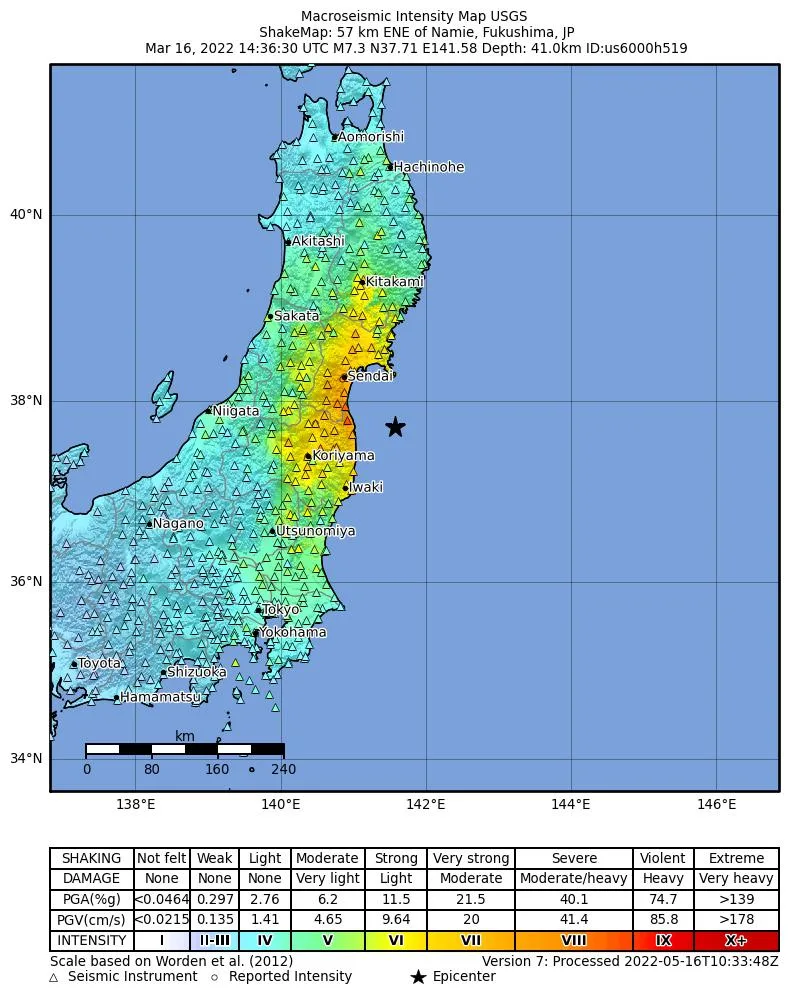
Japan got hit with a 7.1-magnitude earthquake Tuesday afternoon that registered at the absolute maximum level on the country's own seismic intensity scale. Tsunami warnings went out almost immediately. This is not a drill, and it is not a small thing.
What Just Happened in Kumamoto
The earthquake struck Japan's southern Kumamoto Prefecture at approximately 4:27 p.m. local time Tuesday, according to Japan's Cabinet Office Disaster Management Division. That's 3:27 a.m. Eastern Time for anyone waking up to this news in the United States.
The Japan Meteorological Agency put the preliminary magnitude at 7.1 and the depth at 10 kilometers, which is just over 6 miles underground. Shallow quakes like this one tend to cause more surface damage than deeper ones, because the energy has less distance to travel before it starts shaking buildings and people. That detail matters.
On Japan's Shindo intensity scale, which measures ground shaking rather than raw energy release, this quake registered at seven. As NBC News reports, that is the highest level the scale goes. There is no eight. You have hit the wall.
The Tsunami Warnings and Who Needs to Worry
Minutes after the quake struck, a tsunami advisory went out for the Ariake and Yatsushiro Seas, according to NBC News. Residents in coastal areas got a direct message: leave now and do not come back until officials say it is safe. That is not precautionary boilerplate. That is the system working exactly as intended.
Reuters, as cited by CBS News, reported the tsunami alert was for waves up to one meter high, which is roughly one yard. One meter does not sound catastrophic until you remember that water moving at that scale and speed can knock a person off their feet and drag them into debris. The 2011 Tohoku disaster recalibrated Japan's entire relationship with tsunami warnings. Nobody dismisses a one-meter advisory there anymore.
For anyone outside the region checking in anxiously: the Pacific Tsunami Warning Center in Honolulu confirmed there is no tsunami threat to Hawaii or American Samoa. The danger is localized to the coastal areas of southern Japan named in the advisory.
What We Know, and What We Don't Yet
Here's the honest answer as of this writing: the full picture on the ground is not yet clear. NBC News noted in its report that the immediate impact on people and infrastructure had not been confirmed. This is a breaking situation and assessments take time, especially when the infrastructure needed to make those assessments may itself have just been shaken at maximum intensity.
Kumamoto Prefecture has been here before. In April 2016, the region was struck by a 6.2-magnitude foreshock followed by a 7.0-magnitude mainshock that killed 50 people and damaged or destroyed tens of thousands of structures. The area rebuilt. It reinforced. But a 7.1 hitting at the same maximum intensity rating is not a trivial test of that reconstruction work.
Emergency response teams were mobilizing, and updates were expected as daylight reporting from the region came in. Watch this space, because the next few hours are going to tell a much more complete story.
Japan's Warning System Did Its Job
One thing worth saying plainly: the speed of the response here is not an accident. Japan runs the most sophisticated earthquake and tsunami early warning infrastructure on the planet. The advisory for the Ariake and Yatsushiro Seas went out within minutes of the strike. That gap between shaking and warning is measured in seconds and minutes, not hours.
The country built that system with its own blood. The 1995 Kobe earthquake. The 2011 Tohoku earthquake and tsunami that killed nearly 20,000 people and triggered the Fukushima nuclear disaster. Every catastrophe fed back into the system, made it faster, made it louder, made it harder to ignore. Tuesday's response, whatever the damage turns out to be, represents that institutional memory at work.
The Dingo Take
There is a grim kind of competence on display whenever Japan activates its disaster response machinery, and it is worth pausing to acknowledge that even in the middle of a breaking emergency. The warning went out in minutes. Residents were told exactly what to do and where not to be. The international warning centers confirmed the scope of the threat clearly and quickly. This is what a government that takes its responsibilities seriously looks like in practice.
The damage assessment is still coming in, and it may be bad. Kumamoto at maximum Shindo intensity with tsunami advisories on two coastal seas is not a situation that tends to end cleanly. The 2016 quakes in the same prefecture left deep scars. Whatever the rebuilding accomplished since then is about to get stress-tested in the most literal possible sense.
What we can say right now is that the people in those coastal areas got a warning and they got it fast. In a world where we regularly watch governments fumble basic disaster preparation, Japan's system is a reminder that this stuff is not magic. It is investment, planning, and institutional commitment built over decades of painful lessons. The rest of the world has those lessons available too. Most just choose not to do the homework.



Comments