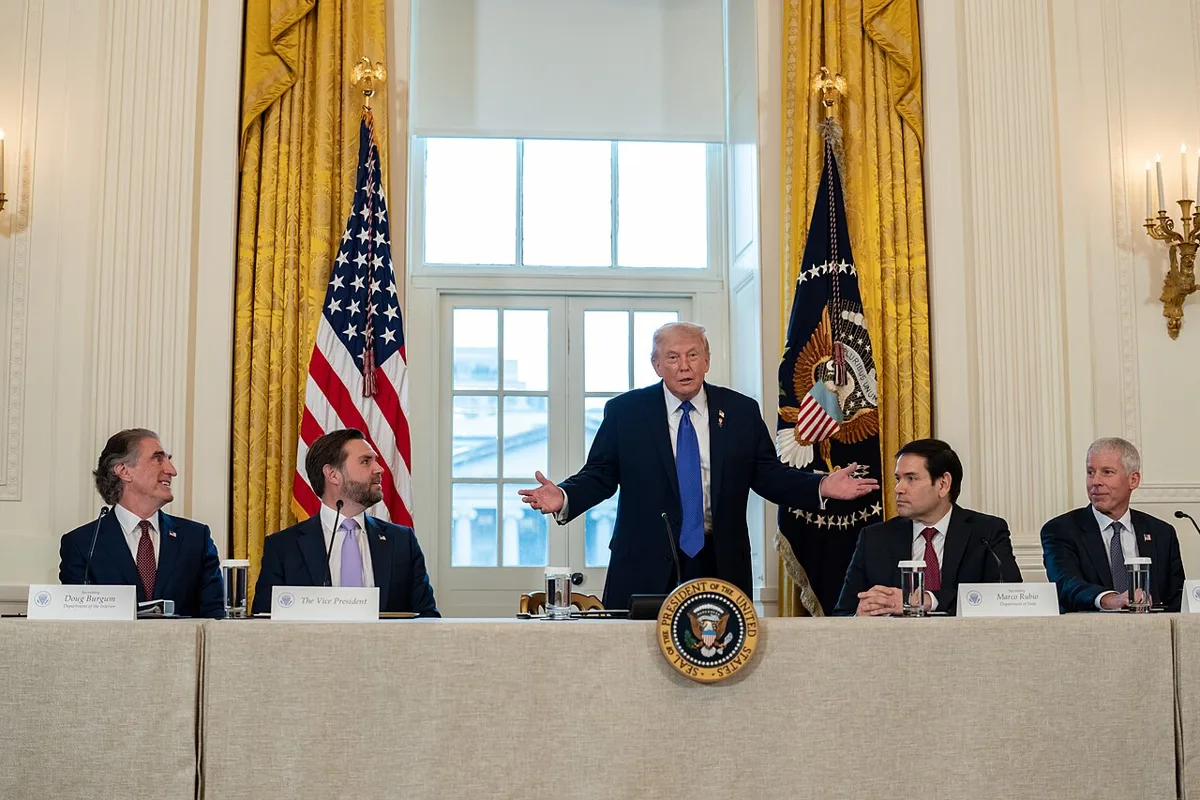
The United States has signed a memorandum of understanding with Iran that lifts sanctions, unfreezes billions in Iranian assets, and reopens the Strait of Hormuz. The Strait of Hormuz, which was open before the war started. The war that the United States started in February.
What the MOU Actually Says
According to BBC News international editor Jeremy Bowen, the memorandum of understanding signed by President Trump and Iranian President Masoud Pezeshkian lays out the political, military, and economic fallout from what Bowen flatly calls "the ill-judged decision to attack Iran on 28 February." The document commits the US to lifting its counter-blockade of Iranian ports, waiving sanctions so Iran can earn billions from oil exports, and beginning the process of returning frozen Iranian assets held abroad.
In exchange, Iran will reopen the Strait of Hormuz, through which one fifth of the world's oil and gas supply flows. That's it. That is the full transaction. America pays Iran billions of dollars to stop doing the thing Iran started doing after America attacked it.
As former Secretary of State Antony Blinken put it on X, with the kind of precision that only comes from watching something go catastrophically wrong in slow motion: "the only 'achievement' of the ceasefire is the likely reopening of the Strait of Hormuz, which was open before the war started. And we will apparently pay Iran to do so."
Thousands Dead, Regime Still Standing
The BBC reports that thousands have been killed since the war began, many of them civilians in Iran and Lebanon. The US and Israel launched joint operations, per BBC reporting, with the explicit goal of regime change. Trump told the Iranian people this was their "once-in-a-generation chance" to take back their country. He called for unconditional surrender.
The regime did not surrender. It did not collapse. According to the BBC, the Islamic Republic's institutions were engineered over nearly five decades specifically to resist attempts at destruction. It is not, Bowen notes, Venezuela. The ideology goes deep. The memory of the 1980s war with Saddam Hussein's Iraq, with its culture of martyrdom and national survival, is baked into the regime's DNA.
What actually happened is that after Israel killed Supreme Leader Ali Khamenei and his closest advisers in the opening bombing sorties, his successors concluded, correctly, that they were in an existential fight and had nothing left to lose. So they closed the Strait. And the whole global economy started screaming within weeks.
The Weapon Nobody Thought They'd Use
Here's the darkly brilliant part. Iran spent decades and billions of dollars building its so-called axis of resistance, a network of proxies and allies across the Middle East. Israel spent years systematically dismantling it. That whole strategic investment is now, per BBC reporting, so badly damaged that whether it can actually "resist" anything is an open question.
But the Strait of Hormuz? The BBC reports that Tehran always knew it had this card. The previous Supreme Leader Khamenei, described by Bowen as cautious and elderly, chose not to play it. His successors, staring down American and Israeli bombers, played it immediately. And it worked faster and more decisively than any proxy war ever did. Cheap. Simple. Devastating. They hit a chokehold on the global economy and squeezed.
The US and Israeli air forces, for their part, scored what the BBC describes as "a series of tactical victories." They just didn't add up to anything. Winning every battle while losing the war is a very specific kind of humiliation.
Netanyahu's Biblical Blunder
Benjamin Netanyahu reportedly used scripture to frame what he thought was about to happen. The BBC quotes him saying this coalition "allows us to do what I have yearned to do for 40 years: smite the terror regime hip and thigh." He yearned for this for 40 years. He finally got Trump to pull the trigger. And the result is an MOU that hands Iran sanctions relief and billions in unfrozen assets.
According to the BBC, Netanyahu now faces Israeli elections in October and a reckoning from voters over his role in the worst security failures in Israel's history, starting with the October 7th Hamas attack in 2023 that his military and intelligence services completely failed to anticipate. His hawkish strategy, Bowen reports, was designed at least partly to restore his reputation as "Mr Security." The ledger on that particular project is not looking good.
The MOU also calls for an end to the war in Lebanon, which Israel has flatly rejected. The BBC reports Israel wants a free hand in Lebanon, and that specific disagreement has the capacity to drive a serious wedge between Jerusalem and Washington, while simultaneously handing ammunition to Iranian hardliners who opposed any deal in the first place. So there are still several ways this gets worse.
Where Things Stand Right Now
The MOU is not a final deal. The BBC is clear about that. It is an agreement to start talking about the biggest unresolved issue, Iran's nuclear programme, with the US-Iran sanctions relief and asset unfreeze front-loaded as inducements to get to the table. Negotiators will go back to work. Ships will move through the Strait again.
We are, in other words, roughly back to February 27th. The day before the war. Except with thousands of people dead, the global economy badly rattled, Iran's hand considerably strengthened, American credibility in the region shredded, and a US president who promised regime change now cutting a deal with the regime. The BBC's Bowen calls it, without apparent hesitation, Trump's "worst foreign policy blunder so far." The "so far" is doing real work in that sentence.
The Dingo Take
Let's just sit with the core geometry of this for a second. The United States attacked Iran. Iran closed the Strait of Hormuz. The world economy convulsed. The US signed a document agreeing to give Iran billions of dollars and sanctions relief. The Strait reopened. That's the whole story. That is the complete arc of a war that has killed thousands of people.
The hawks who pushed for this, the people who spent years insisting that the Iranian regime was a hollow shell that would crumble the moment America applied real force, were simply wrong. Not nuanced, not partially right, not victims of bad intelligence. Wrong in the way that people are wrong when they let ideology eat the parts of their brain that process evidence. The Islamic Republic survived because it was built to survive, because its population had been through worse, and because closing a shipping lane is a more effective weapon than anyone in Washington or Jerusalem apparently took seriously enough.
Trump promised a once-in-a-generation transformation of the Middle East. He delivered a billion-dollar payment to the regime he promised to destroy, a ceasefire document, and a return to the nuclear talks that were already underway when he blew everything up in February. The people who said this would happen before the first bomb dropped were called naive. They should send Blinken a fruit basket.




Comments