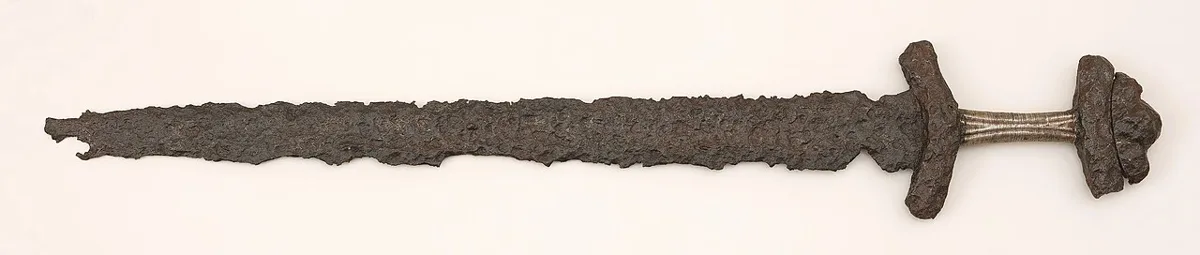
A six-year-old Norwegian boy named Henrik went on a school field trip and came home having personally expanded the archaeological record of early medieval Scandinavia. The weapon he yanked out of the dirt is roughly 1,300 years old. You, presumably, went on school field trips and came home with a worksheet.
What Henrik Actually Found
According to Only Good News Daily, Henrik and his class were visiting Hadeland, a region whose name literally translates to "warrior land" and which has a long history of producing significant archaeological finds. Henrik was doing what six-year-olds do, which is wander around looking at things on the ground, when he noticed a rusty piece of metal sticking out of the soil and picked it up.
He brought it to his teachers. His teachers, to their enormous credit, did not throw it away or tell him to put it down because it was dirty. They looked at it carefully and thought, actually, this might be something. They contacted local archaeologists. The archaeologists confirmed that yes, this child had just found a genuine early medieval weapon with his bare hands during a school excursion.
The sword is a single-sided iron blade known as a scramseax, designed to be sharp on only one edge to maximize the force and weight behind each swing. Archaeologists from the Cultural Heritage Authority in Innlandet have dated it to the late Merovingian Period or early Viking Age, somewhere between AD 550 and 800. It has since been transferred to the Museum of Cultural History in Oslo, where it will be cleaned, preserved, and studied.
The Location Was Practically Asking for This
Hadeland, or "warrior land," is in the Innlandet region of Norway, and it is not new to delivering historical goods. Archaeologists have been pulling significant finds out of this area for years, and the region sits in a part of Norway that was clearly a hub of activity during the period when Scandinavian warriors were absolutely terrorizing the coastlines of Europe.
The fact that a 1,300-year-old sword was just sitting there, partially exposed, waiting for a first-grader to pick it up, says something interesting about how much is still out there. Ground conditions in Scandinavia can preserve iron objects for extraordinary lengths of time, and there is no particular reason to think Henrik's sword is the last one Hadeland has to offer. There are probably more. There are almost certainly more.
Henrik just happened to be the one looking down at the right moment.
A Brief and Useful History Lesson
Here is something worth knowing, and Only Good News Daily actually mentions it in their coverage. In medieval Scandinavia, "Viking" was not really a noun describing a type of person. It was closer to a verb, or a profession, describing the act of sailing out to raid and trade. The Icelandic family sagas describe characters as "going Viking," the same way you might say someone is "going fishing."
A warrior who stayed home was not a Viking. A farmer who jumped on a longship and went raiding for the summer and then came back and farmed again was Viking, temporarily. It is a more complicated and frankly more interesting picture than the horned-helmet mythology we have ended up with, and it is the kind of detail that makes you realize how much of what we think we know about history was simplified to the point of distortion somewhere along the way.
The scramseax that Henrik found would have been a working weapon during a period when that distinction mattered to the people carrying it.
Where Henrik Stands in the Annals of Accidental Discovery
Accidental archaeological finds are more common than you might think. The Dead Sea Scrolls were found by a Bedouin shepherd who threw a rock into a cave and heard pottery break. Lascaux cave paintings were discovered in 1940 by a group of teenagers who fell into a hole. The Rosetta Stone was turned up by French soldiers digging a fort foundation in Egypt.
Henrik fits into a long and distinguished tradition of regular people stumbling onto things that professionals had not. The difference is that he is six, and the thing he found is a sword, and he was on a class trip specifically to the region of Norway that translates to "warrior land," which honestly sounds like a school trip designed by someone who wanted exactly this to happen.
He will have a better story for the rest of his life than most adults will ever get to tell.
The Dingo Take
Look, there is very little to editorialize about here. A child found a Viking sword. The archaeologists confirmed it is real. It is going to a museum. Everyone involved behaved reasonably and well. This is what a functioning society looks like when something unexpectedly good happens.
But let's sit with the specific absurdity of it for a moment. There are professional archaeologists, funded by governments and universities, with ground-penetrating radar and decades of training, whose entire careers are dedicated to finding exactly this kind of object. Henrik is six years old. He beat them by tripping over it. The scramseax spent somewhere between 1,200 and 1,450 years underground and then surfaced just enough for a first-grader on a school trip to notice a rusty bit of metal and think, I should show someone that.
Sometimes history just wants to be found. Sometimes it sends a six-year-old to do the job.




Comments