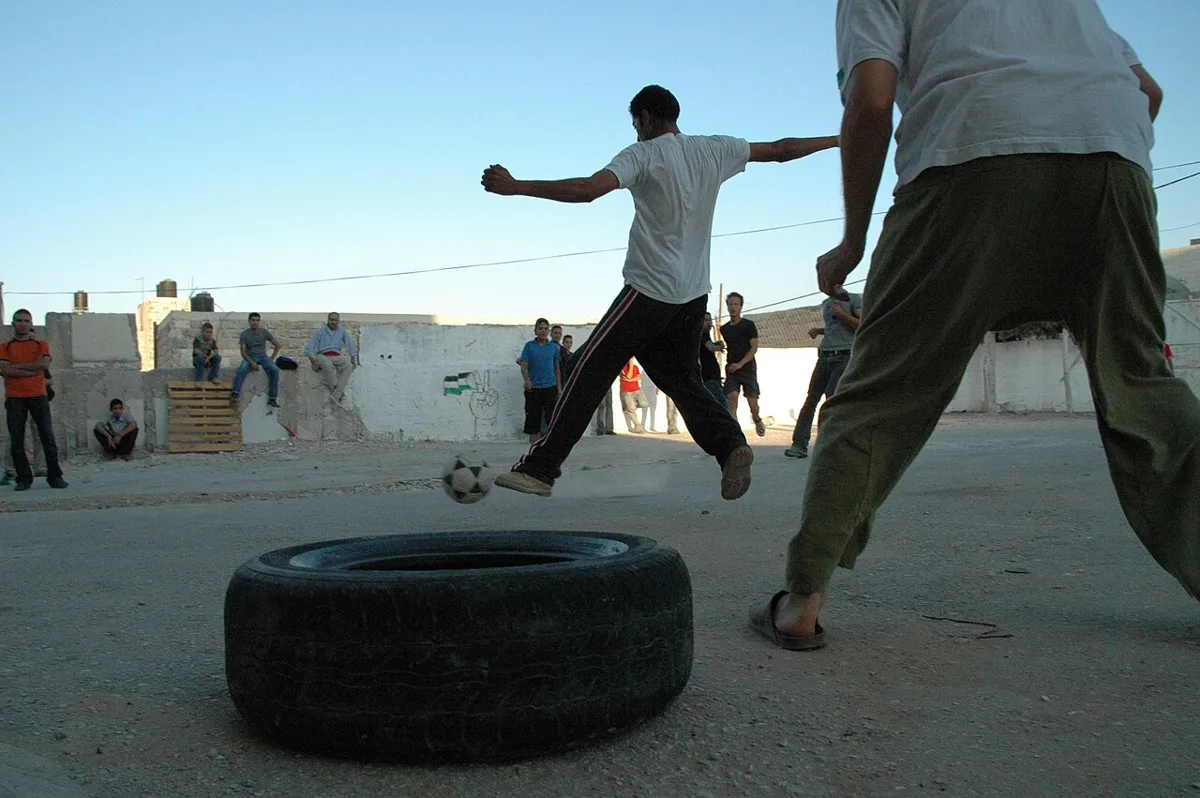
Palestinian officials told NPR that 90% of Gaza's sports infrastructure has been destroyed and 450 people connected to soccer, players, coaches, referees, and officials, have been killed in Israeli attacks. Meanwhile, in a park in New Jersey, about 60 kids are sweating through evening practice, trying to remember what it feels like to just play. This is not a sports story. It is, but it isn't.
A team built from grief
The Palestino Soccer Academy runs out of Frank D. Zaccaria Memorial Park in Woodland Park, New Jersey, a short commute from the FIFA NY/NJ Stadium, where the 2026 World Cup is playing out in real time. The timing is not lost on anyone.
Coach Omar Abdulaziz started the club three years ago, according to NPR, specifically to address what he was watching happen to the kids around him as the war in Gaza intensified. 'We could hear their frustrations, they were emotionally unwell,' he told NPR, speaking in Spanish. Abdulaziz knows displacement personally. He moved from the West Bank to Puerto Rico as a teenager in the 1980s.
The club now serves children of all backgrounds, but it is anchored in Northern New Jersey's Palestinian-American community, and everyone there knows exactly what is happening on the other side of the world. You do not get to forget. But for a few hours on a sweltering Saturday evening, you get to run.
What it means to ball out when you're bawling inside
Fourteen-year-old Obaida Al Amleh was born in the West Bank and spent part of his childhood there. Five of his close family friends were killed in an Israeli airstrike. When he got the news, there was no practice scheduled. He called up teammates anyway.
'You can ball in the pitch, or you can bawl at home, I guess,' he told NPR. So they came, and played for hours straight. That is not a coping mechanism a therapist assigns you. That is a kid inventing survival tools in real time.
It is always on his mind, he said. Soccer does not make it go away. It just gives it somewhere to go.
The World Cup they aren't in
The Palestinian national soccer team did not qualify for the 2026 World Cup. That sentence would sting in any year. In this one, it lands like a gut punch.
NPR reports that the destruction in Gaza has made training and playing effectively impossible. The 450 people connected to the sport who have been killed are not abstractions. They are coaches who ran drills and referees who blew whistles and players who had their whole lives in front of them. The Palestinian national team could not even get to the starting line because the country where many of its players would have come from is being systematically destroyed.
The kids in New Jersey know this. They root for other teams now. They find proxies. They look for people on the world stage who see them.
Lamine Yamal and what a flag means
The player these kids have latched onto hardest is Lamine Yamal, the 18-year-old Spanish striker who, according to NPR, waved a Palestinian flag during FC Barcelona's La Liga championship parade last month. The video went viral. The photo lives as wallpaper on multiple kids' phones at this club in New Jersey.
Yamal, himself the child of immigrants, also recently took a public stance against anti-Muslim chants at Spanish soccer games. That combination, the flag, the voice, the background, reads as something close to representation for kids who have watched the 2026 World Cup unfold without a team to carry their name.
'I thought it was very special for the people who are going through the worst right now,' Obaida told NPR. He is 14 years old. He has buried five family friends. And he is finding something to hold onto in a teenager from Barcelona who waved a flag at a parade.
Thirteen years old and all he has is God and soccer
Taim Nadin is 13, originally from Qatar, and he told NPR with the absolute conviction of someone who has clearly thought about this: 'Without soccer in life there's nothing. If I didn't play soccer, I'd be nothing, right?' He also said, 'All I care about is God and soccer.'
That is not a 13-year-old being dramatic. That is a 13-year-old telling you exactly where his weight is distributed right now. Soccer is not a hobby for these kids. It is structure. It is the one place where the rules are clear and the outcome is something you can actually affect with your own two feet.
Coach Abdulaziz put it plainly to NPR: 'Soccer, to us, is a moment to disconnect, a moment of tranquility, a moment to detach from the suffering of reality.' That is a sentence that should not need to exist about children's sports. And yet here we are.
The Dingo Take
Here is the thing about this story. It is a beautiful piece of reporting by NPR's Jasmine Garsd and Liz Baker, and it covers something genuinely moving. But it exists inside a context that we should not allow the warmth of the human detail to fully obscure. Palestinian officials are telling reporters that 450 people connected to soccer have been killed in Israeli attacks. Not in combat. Connected to soccer. Coaches, referees, athletes. Ninety percent of Gaza's sports infrastructure, gone. We are talking about the wholesale destruction of the infrastructure of childhood joy.
These kids in New Jersey are doing something remarkable by building something here, but let's be very clear about what they are building it in response to. They are processing a live war. They are watching their culture get bombed into rubble in real time while the 2026 World Cup plays out in their backyard, without a Palestinian team, because the place those players might have come from is being turned into ruins. The warmth of the story is real. The reason it exists is a catastrophe.
Obaida Al Amleh is 14 and he already knows, with the weary wisdom of someone who should not have to know it yet, that the pitch is where you go when home is too full of grief to hold you. 'You can ball in the pitch, or you can bawl at home.' That line is going to stick with anyone who reads it. It should. Write it down. Do not move on too fast.


Comments