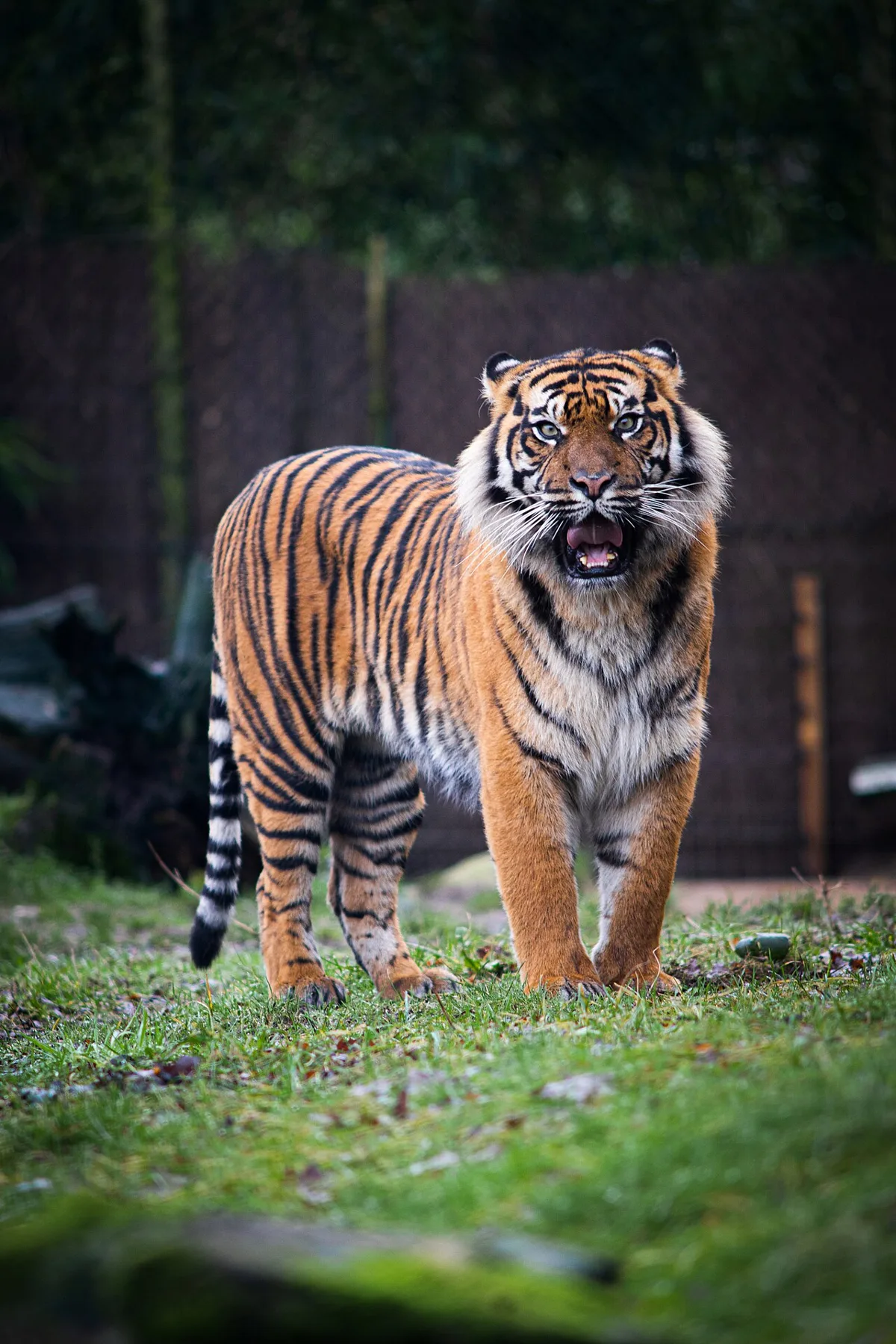
There are fewer than 400 Sumatran tigers left alive on this planet, which means three cubs born at a Canterbury zoo in April and just now waddling out of their den for the first time represent something like two percent of the entire future of the species. No pressure, kids. Their mom Tipah is handling it better than most of us would.
Meet the Three Cats That Kind of Matter More Than You
Howletts Wild Animal Park in Canterbury, Kent announced this week that three Sumatran tiger cubs, born April 9th to first-time mother Tipah and father Nakal, have grown confident enough to leave the maternity den and start exploring their enclosure. Two girls and one boy. Eight weeks old. Already developing distinct personalities, according to Good News Network, which covered the story.
The International Union for Conservation of Nature lists the Sumatran tiger as Critically Endangered. The wild population sits somewhere below 400 individuals, all confined to the Indonesian island of Sumatra, where habitat destruction and poaching have been grinding their numbers down for decades. That number is not a typo. There are more people employed at a mid-sized American car dealership than there are Sumatran tigers left on Earth.
These three cubs, however improbably, are now part of the conservation math. Howletts says their births represent an important step forward for the subspecies' survival beyond its natural range. That is the kind of sentence that sounds like zoo PR boilerplate until you sit with the actual numbers for a moment.
Tipah Is Out Here Mothering Like a Professional
Richard Langston, Head of Carnivores at Howletts, had nothing but praise for first-time mom Tipah, telling Good News Network that she has handled every stage of this process with what he called "calmness, patience and a natural ability to be a fantastic mom." He added that she spends most of her time up on a platform keeping watch over the cubs while grabbing a little peace from the constant jumping, biting, and general chaos that comes with raising tiger cubs.
Which, honestly, sounds like parenting universally.
The cubs spent their first weeks entirely in the den with Tipah before recently beginning to venture outside. A photographer was on hand to capture what Howletts described as the cubs' sensory overload moment, which is a phrase that should be on a motivational poster somewhere.
One of Them Is Already the Weird Independent One
The park reports that the three cubs are becoming increasingly bold and exploratory, starting to show off their individual personalities as they test out more of their enclosure. One cub in particular has already developed what Howletts calls an independent streak, often choosing to wander away from its siblings rather than stick with the group.
In humans, this is the kid who ends up either very successful or on a podcast. In tigers, it probably just means this one is going to be trouble for keepers.
Howletts is part of a broader international captive breeding network for the Sumatran tiger. Good News Network has previously covered similar births at Wroclaw Zoo in Poland and San Diego Zoo in California. Captive breeding programs like these have pulled multiple species back from the edge before, though they work best when paired with actual habitat protection in the wild, which is where the story gets considerably less cheerful.
Why Captive Breeding Is Both Genuinely Heroic and a Little Depressing
Let's be clear about what captive breeding programs are and what they are not. They are remarkable, painstaking, expensive scientific work carried out by people who genuinely give a damn about species survival. They have helped bring animals including the California condor, the black-footed ferret, and the Arabian oryx back from near-certain extinction. They matter enormously.
They are also, at some level, a monument to how badly we have already failed. When the survival of an entire subspecies depends partly on a handful of zoos coordinating international breeding programs because the wild habitat has been so thoroughly compromised, that is not a conservation success story. That is a conservation emergency with some good news in it.
Sumatra has lost over half its forest cover in recent decades, according to widely reported figures from environmental monitoring organizations. The tigers that remain in the wild are fragmented into isolated populations, many of which are too small to be genetically viable long-term on their own. The cubs at Howletts are wonderful. The situation that made their existence so consequential is not.
The Dingo Take
Three tiger cubs stumbling out of a den into British sunlight for the first time is, objectively, one of the better things that happened this week. It is hard not to feel something watching a critically endangered animal take its first exploratory steps toward a world that has not exactly been generous to its species. Tipah raised three cubs in captivity for the first time without a manual, and by all accounts nailed it. That is not nothing.
But the fact that we are genuinely excited about three tiger cubs because there are fewer than 400 of their kind left alive is the kind of math that should make people uncomfortable at a policy level, not just misty-eyed at a zoo-visit level. The deforestation driving the Sumatran tiger toward extinction is not a mystery or an accident. It is the result of specific economic pressures, specific corporate supply chains, specific government decisions in Indonesia and in the countries that buy what Indonesian land gets cleared to produce. The cubs are wonderful. The system that made them so precious is a slow-motion catastrophe.
So yes, go look at the photos. Feel good about Howletts and Tipah and the little independent one already doing its own thing. Then maybe think about what you buy, what you demand from companies, and what you vote for. Three cubs is a win. Four hundred tigers is a crisis. Both things are true at the same time.




Comments