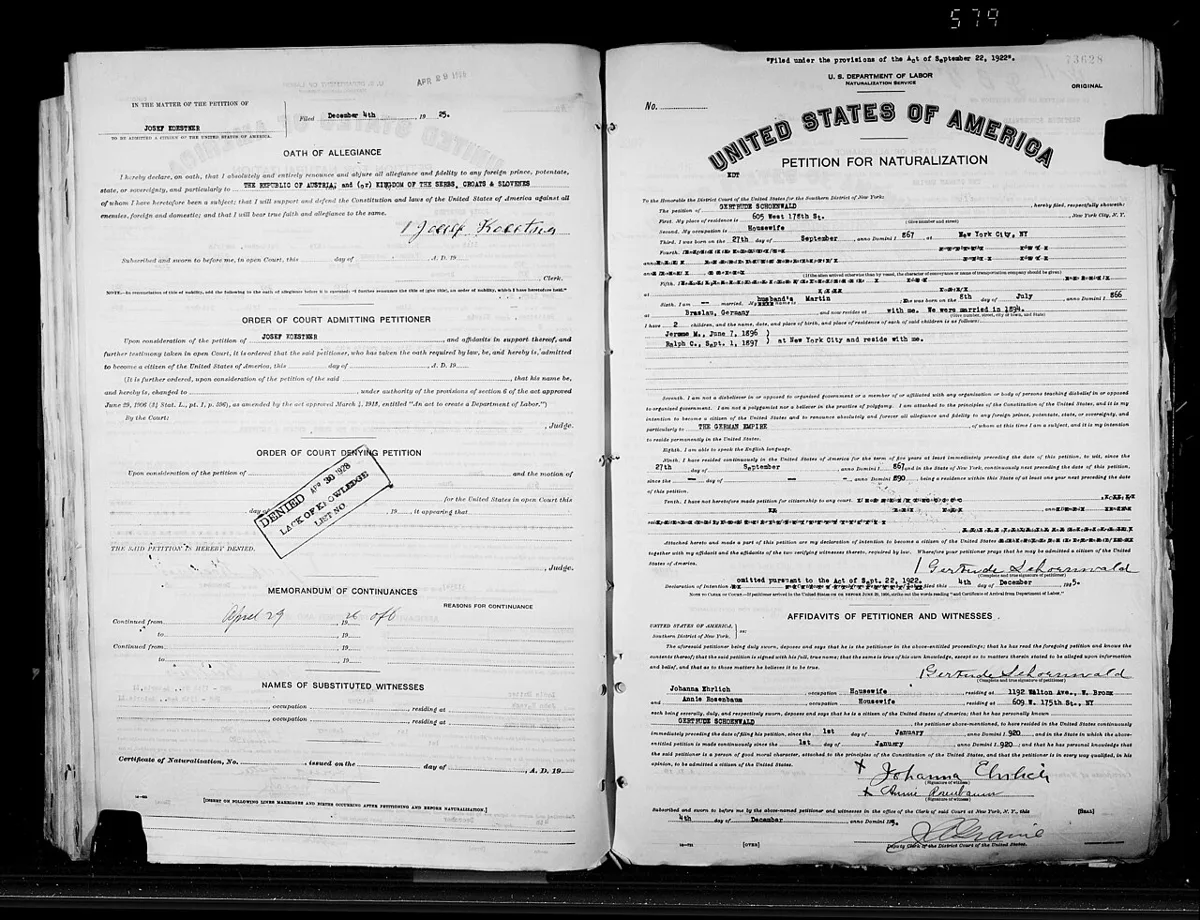
Donald Trump signed an executive order in January 2025 trying to rewrite one of the foundational promises of American democracy, and now the Supreme Court gets to decide if he can actually do that. The order targets birthright citizenship for children born in the United States to parents who are in the country illegally or on temporary visas, a move that could strip citizenship from roughly a quarter of a million children every single year. The 14th Amendment has been sitting in the Constitution since 1868. It says what it says. But here we are.
What the 14th Amendment Actually Says
Let's start with the text, because the text matters. The 14th Amendment grants citizenship to "all persons born or naturalized in the United States." All persons. Not "all persons whose parents have the right paperwork." Not "all persons whose parents arrived through channels the current administration finds acceptable." All persons.
This was not an accident. Congress wrote it that way on purpose, in the wreckage of the Civil War, specifically to demolish the logic of Dred Scott, the 1857 Supreme Court decision that had declared Black Americans could never be citizens. The whole point was to draw a bright, permanent, inarguable line. You are born here, you are American. Full stop.
That context is not ancient history. It is the entire legal architecture the Trump executive order is now asking the Supreme Court to tear down.
A Quarter Million Kids a Year
According to Pew Research Center, as CBS News reports, the executive order would potentially affect approximately 250,000 children born in the United States every year. These are not hypothetical people. These are kids born in American hospitals, who drew their first breath on American soil, and who, under 157 years of settled constitutional law, are American citizens.
The order targets two categories of parents: those who are in the country without authorization, and those who are here on temporary visas, which covers an enormous range of people including students, guest workers, and tourists. If the Supreme Court lets this stand, a child born to a tourist mom who went into labor early would not be an American citizen. A child born to a grad student here on an F-1 visa would not be an American citizen. The scope of this is not small.
Amanda Frost, a professor at the University of Virginia School of Law and the author of "You Are Not American: Citizenship Stripping from Dred Scott to the Dreamers," has been one of the sharpest voices explaining what is actually at stake here. The title of her book alone should tell you this story has ugly historical company.
How We Got Here
Trump signed the order on his first day back in office, January 20, 2025, which should tell you how high a priority this was. It was not a late-term afterthought. It was the opening move. Federal courts immediately blocked it, with multiple judges pointing out the obvious fact that the executive branch does not get to unilaterally reinterpret a constitutional amendment.
But the administration kept pushing, and now the case has reached the Supreme Court. The question before the court is not merely whether this particular order is legal. It is whether the president has the authority to decide, on his own, what the 14th Amendment means. That is a significantly bigger question than it might look like on a Sunday morning.
Rogers Smith, an emeritus professor of Political Science at the University of Pennsylvania, is among the constitutional scholars CBS News consulted for their coverage. These are not activists. These are people who have spent careers reading the history of American citizenship law, and they are worried.
The Longer Game Being Played
Here is what makes this particular fight different from a standard immigration enforcement argument. The Trump administration is not just trying to deport people. It is trying to change who counts as a person entitled to rights in the first place. That is a different category of action entirely.
Citizenship stripping, as Professor Frost's research documents, has a history in this country that the architects of the 14th Amendment were explicitly trying to close off. The amendment was designed to be self-executing, meaning it does not require additional legislation or executive action to apply. It applies. Because it is in the Constitution. That is how constitutions work.
If the Supreme Court's current majority decides that a president can reinterpret the amendment's plain text through executive order, the implications stretch well beyond immigration. It would establish that constitutional guarantees are negotiable depending on who is in the White House. That precedent would not stay in this lane.
The Dingo Take
Let's be honest about what this is. This is not a good-faith legal dispute about ambiguous constitutional language. The language is not ambiguous. "All persons born" means all persons born. The administration is betting that a Supreme Court shaped by Trump's own appointments will find a creative way to make "all" mean "some," and it is not an unreasonable bet given recent history.
The cruelty is also the point, and it is worth saying that plainly. A child has no control over where they are born or what documents their parents carry. Targeting that child's citizenship is not a policy designed to fix anything. There is no security problem it solves. There is no economic argument that survives scrutiny. What it does is create a permanent underclass of people born on American soil who are legally stateless, or at least legally in limbo, which is exactly what the 14th Amendment was written to prevent.
The Supreme Court will rule when it rules. But whatever they decide, the rest of us should be clear-eyed about what was attempted here: a sitting president tried to rewrite a post-Civil War constitutional amendment with a single executive order on his first day in office. That happened. It is happening. Pay attention.




Comments