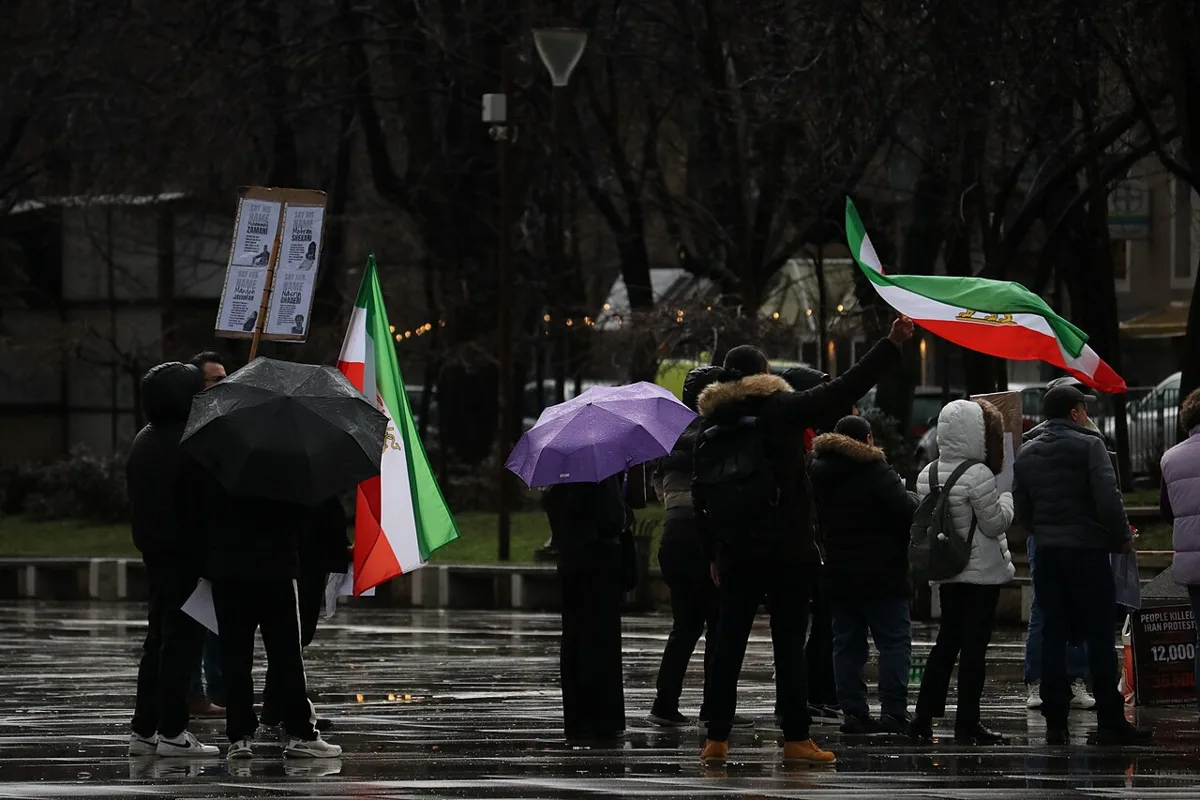
Benjamin Netanyahu walked into the Oval Office and told Donald Trump that one more push would collapse the Iranian regime like a house of cards. Four months later, the United States signed a memorandum of understanding with that same Iranian regime, effectively acknowledging its control over the Strait of Hormuz and agreeing to temporarily lift oil sanctions while nuclear talks resume. So. How did that go.
The War That Was Supposed to End Everything
Let's be precise about what happened here, because the details are damning. According to The Guardian, the US and Israel attacked Iran in what amounted to a blatant violation of international law. The stated premise, pushed hard by Netanyahu, was that the Islamic Republic was on its last legs. Weakened by internal protest. Crushed by an unprecedented wave of repression. One good shove and the whole thing would fall over.
It did not fall over. The regime that emerged from the attacks is, per The Guardian's reporting, younger, more militaristic, and more hardline than the one that went in. This is not a small thing to get wrong. This is the entire premise of the operation, inverted.
What 'Winning' Looks Like Now
The memorandum of understanding the US eventually agreed to is being sold, in certain circles, as a Trump win. It is not a Trump win. As The Guardian reports, Iranian frozen assets are expected to start flowing again, oil sanctions will be temporarily waived, and Iranian control over the Strait of Hormuz is de facto recognized. Criticism of the deal is mounting in both the US and Israel.
To be clear about the trajectory here: the United States, the world's dominant military superpower, struck a country the White House described as nearly broken. Then it signed a deal that treats that country as a sovereign entity with legitimate maritime interests. The strongest did not prevail. That's not editorializing. That is what the MoU says, implicitly, by existing.
And yet the deal is still being described in some corners as better than nothing. Sure. It is better than nothing. So is a participation ribbon.
Ukraine Is Still Standing, Which Was Also Not the Plan
Meanwhile, over in Europe, a similar story is playing out on a different timeline. Russia invaded Ukraine expecting a quick collapse. The west was divided, hesitant, slow. The assumption, shared by a depressing number of analysts through 2023 and 2024, was that Ukraine was simply going to lose. The Guardian reports that the narrative has now shifted.
Russia remains the stronger party militarily and demographically. Trump's America has largely abandoned Kyiv. European support has been real but, as The Guardian puts it, insufficient. And yet Ukraine stands. This is not nothing. This is, in fact, the thing that the architects of the invasion specifically tried to prevent, and failed to prevent.
Two wars, two superpowers, two outcomes that were not supposed to happen. International law is battered. Multilateral institutions are hollowed out. But the strong did not simply do whatever they wanted and walk away clean. That matters.
Europe Is Doing Some Things Right, Some Things Very Wrong
The Guardian flags two European initiatives worth watching, with wildly different prospects. A coalition of roughly 40 countries, led by France and the UK, has assembled a taskforce to clear mines from the Strait of Hormuz and secure shipping lanes. It sounds useful. It will probably not happen. Iran has rejected the idea of European warships in the strait, and without Tehran's consent, the Europeans themselves admit, there will be no operation. Trump, for his part, told everyone at the G7 in Evian that he has no interest in European contributions. So that's where that stands.
The second initiative is quieter and, frankly, more interesting. Norway has been providing legal counsel to Iran, Oman, Pakistan, and Qatar to ensure that any post-crisis arrangements in the strait comply with the UN Convention on the Law of the Sea. Unglamorous. Unannounced. Actually useful. As The Guardian notes, neither the US nor Iran is formally a party to the convention, but both have indicated interest in respecting its core principle: freedom of navigation. That's the kind of soft, demand-driven diplomacy that actually moves things.
Where Europe has absolutely no credibility right now is Gaza. European governments have, as The Guardian bluntly puts it, played no small part in shielding Israel from its international legal obligations. Strongly worded concern has not translated into meaningful policy. Not once.
Gaza and the Accountability Vacuum Nobody Wants to Fill
This is the part of the story that doesn't get a tidy resolution. Israel's conduct in Gaza, per The Guardian's framing, represents the most acute trampling of international law in this entire period, and it remains almost entirely unaccountable. War crimes. Crimes against humanity. Possibly genocide. European governments have expressed concern. They have not done much else.
The EU's legal service has reportedly clarified that banning imports from illegal Israeli settlements would require only a qualified majority vote, not unanimity. That's a lower bar than sanctions against individual ministers like Ben-Gvir and Smotrich, which would need every member state on board and won't happen. Whether Europe actually clears even that lower bar remains to be seen. The history of this conflict suggests: don't hold your breath.
The Dingo Take
Here is the thing nobody wants to say out loud in polite foreign policy circles: the United States and Israel spent enormous political and military capital to bomb a country into a deal that legitimizes that country's strategic position. That's the ledger. You can dress it up in whatever language you want about de-escalation and diplomatic progress, but the MoU exists because the alternative was worse, and the alternative was worse because the regime did not collapse on schedule. Netanyahu's house-of-cards theory got tested against reality and lost.
None of this means international law is fine. It is not fine. Russia is still in Ukraine. Gaza is still being destroyed. The institutions built after World War II to prevent exactly this kind of behavior are running on fumes and goodwill and the occasional Norwegian lawyer. But the argument that power alone determines outcomes, that the strong simply win because they are strong, has taken some real hits lately. That's worth holding onto, even if it doesn't feel like nearly enough.
What it should not be is an excuse for Europe, or anyone else, to declare victory and go home. Ukraine is still standing partly because people kept showing up. The legal architecture around the Strait of Hormuz is getting quietly reinforced because somebody decided to do the boring work. Gaza is still burning because nobody with the power to stop it has chosen to use that power. The lesson here is not that everything works out. It's that sometimes the thing you were told was inevitable turns out not to be, and whether that matters depends entirely on what you do next.




Comments